The profile: charge, time, rate of rise, development time ratio, drop
What does the roaster set, and what do they read?
Start the scene or choose a stage. The animation simplifies the mechanism; what follows gives the details and the available references.
A profile begins with the charge: the mass of green, never more than 90% of nominal capacity, and the temperature at charging, which decides the vigor of drying. Too small a charge heats too fast. Morten Münchow takes as reference the air of the empty machine, ideally rising: charging on a falling temperature is charging into a machine that is already giving its energy back.
Read the stages without animation
- ChargingA profile begins with the charge: the mass of green, never more than 90% of nominal capacity, and the temperature at charging, which decides the vigor of drying. Too small a charge heats too fast. Morten Münchow takes as reference the air of the empty machine, ideally rising: charging on a falling temperature is charging into a machine that is already giving its energy back.
- Pushing earlyMünchow's plan comes down to a few thresholds: flame at maximum at 140 °C, still at maximum at 160 °C. The rate of rise, or RoR, is the derivative of the probe curve, in degrees per minute: Scott Rao holds that it must decrease continuously.
- Reducing before the crackThe plan reduces the flame by one notch at 180 °C, because first crack is approaching, at 190 °C on Münchow's probe and around 200 °C on most machines, then again at 195 °C, during the crack. Rao denounces the “crash and flick”: the RoR plunges as the crack approaches, when the gas is cut too hard, then rebounds at the end of the crack; he associates it with flat coffees. The decision window is thirty to sixty seconds, at best.
- Developing, then droppingThe development time ratio relates the time between the start of first crack and the drop to the total time. Rao recommends 20 to 25%, as an indicator and not a guarantee; Münchow goes down to 3.5% for an extremely light roast. The drop temperature roughly predicts the degree. A specialty coffee roasts in 10 to 14 minutes, rarely more than 20.
- Reading the traceFor Münchow, the roasting plan is the cause and the profile the effect: the curve is looked at to verify, not to decide. To compare two machines without a colorimeter, he aims for the midpoint, the mean of the temperatures of the two cracks: 190 and 210 °C give 200 °C, readings of his probe that another machine shifts all together. And one tastes after at least 8 hours of rest.
To remember: Only three levers, heat, air and drum speed; the curve records their effect, it does not say whether the coffee is good.
In history: The world roasting championship, created in 2013, scores exactly this kind of control: announced profile, adherence to the profile, cup.
Read the full article and its sources ↓| Profile parameter | Cited marker |
|---|---|
| Load | ≤ 90% of capacity (Ukers 1922); 100 g, 150-200 °C for a sample |
| Total time | 8-12 min sample; 10-14 min specialty; under 20 min |
| First crack | around 200 °C on the probe (175 to 207 depending on the probe and the machine); up to 2 min |
| Rate of rise (RoR) | decreasing with no crash or flick (Rao) |
| Development time ratio (DTR) | 20-25% (Rao 2016, an indicator, not a guarantee) |
| Second crack | around 225 °C on the probe (200 to 232 depending on the machine) |
| Resting before cupping | ≥ 8 h; color measured between 30 min and 4 h |
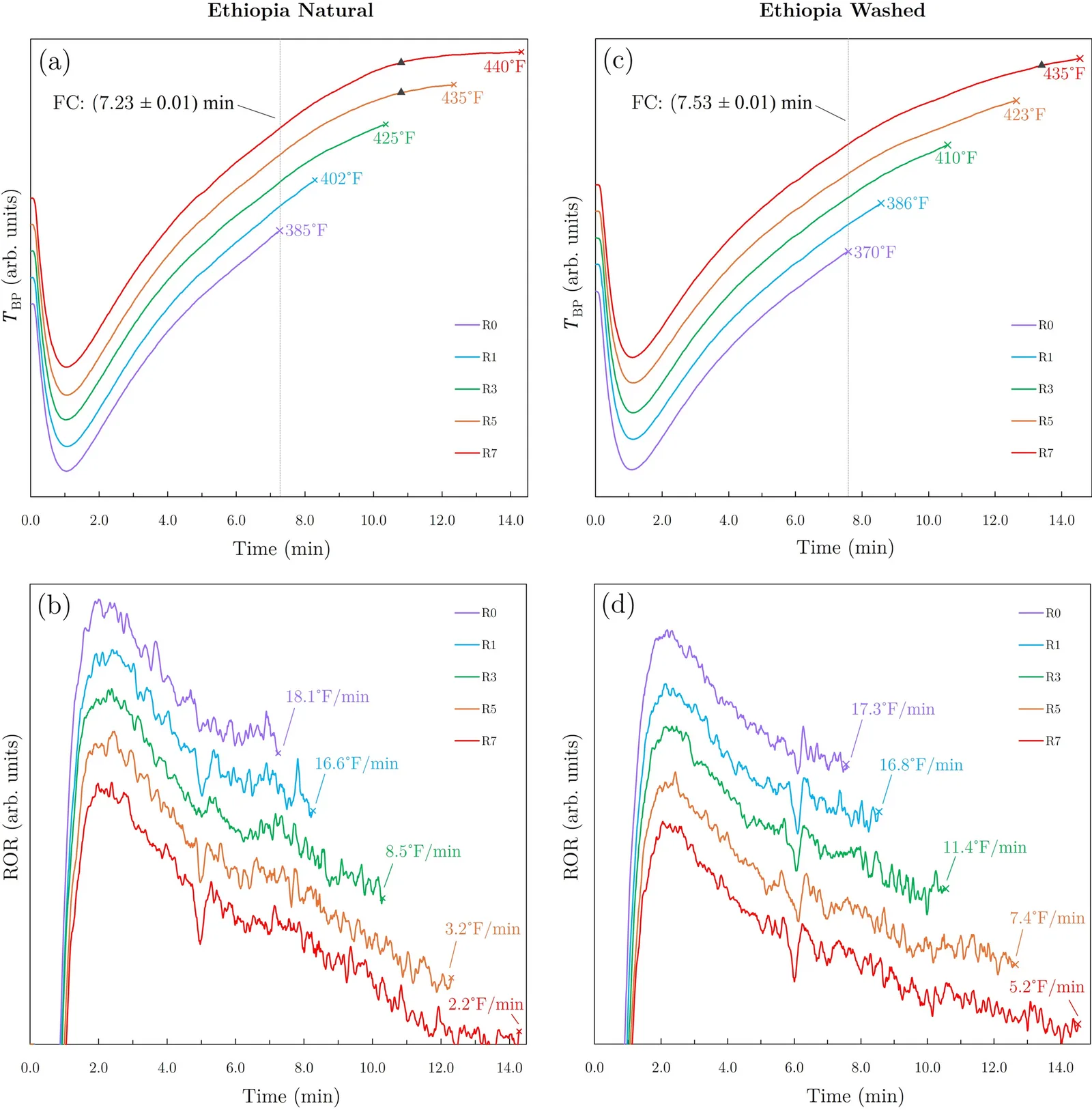
A profile is described by a few numbers.The chargemass of green coffee and drum temperature at charging, which decide the vigor of drying; Ukers already noted that one does not exceed 90% of nominal capacity and that too small a charge heats too fast.The total time8 to 12 minutes for a sample, 10 to 14 minutes for a specialty coffee according to the author of the book, rarely more than 20; 25 to 45 minutes in the coal-fired cylinders of the 19th century. The rate of rise (RoR): the derivative of the probe curve, in degrees per minute; Scott Rao holds that the RoR must decrease continuously and denounces the “crash and flick,” a sharp drop as first crack approaches (gas cut too hard, endothermic reactions of the bursting) followed by a rebound at the end of the crack, which he associates with flat coffees.The development time ratio (DTR): time between the start of first crack and the drop, relative to the total time; Rao recommends 20 to 25% for most degrees between first and second crack, specifying that these are “round numbers” drawn from the observation that 18 of the 20 best batches among more than 20,000 examined fell within that range, and that the DTR is one indicator among others, not a guarantee.The dropexit probe temperature, which, according to Vosloo, roughly predicts the degree since the cracks occur at constant temperatures on a given machine.
Rao, Development time ratio, scottrao.com, 08/25/2016; Mill47 and Green Coffee Collective on the crash and flick (accessed 09/07/2026); Vosloo 2017, § 2.2.4, p. 22-23; § 6.1, p. 133; Ukers 1922, ch. XXV, p. 386; professional training document, cupping guide, p. 3; LC ch. 11Only three levers: heat (flame or element), airflow, which carries the heat, removes steam, chaff and smoke and cools the bed when it is increased, and drum speed, which sets the contact with the wall. No fixed rule gives a given degree; adjustments must be almost instantaneous, and “it takes years” to read color, sound and smell at the same time as the curve.
The author's book adds two positions: the probe and the software do not roast, they turn a judgment into a trace, and the trace can be compared, passed on and reproduced, which makes a profession of a craft; but the decision window has narrowed since Thurber, not widened, because machines are more responsive, coffees more revealing and expectations more precise, so that “thirty to sixty seconds” is today a generous estimate. The World Roasting Championship, created in 2013, scores precisely this handling: announced profile, adherence to the profile, cup.
Vosloo 2017, § 2.2.4, p. 22; LC ch. 11; interview digest, Q17-Q18Twenty-five percent, or three and a half: the sharpest disagreement in the file
The plate gives Rao's development time ratio, 20 to 25 percent of the total time between the start of first crack and the drop, specifying that it is an indicator and not a guarantee. The specification is right, and it must be added that it is Rao's own. Still, confronted with the manual that underpins SCA certification, this number does not survive as a rule.
The two versions
Rao sets the range and names the two symmetrical failures: below 75 percent of the total time before the crack, the coffee will probably be flat; beyond 80, the development will probably be insufficient. It is a narrow window, and it is presented as such.
Münchow gives benchmarks that do not fit. His central case, nine minutes to first pop and three minutes after, falls exactly on 25 percent: up to there the two men agree. But his ranges go from five to thirteen minutes before the pop and from one to four minutes after, and he adds that development can drop to one minute for a light coffee, even to half a minute for an extremely light roast, and rise to four or five minutes for a dark one, over rise times of five to fourteen minutes.
Half a minute after fourteen minutes of rise makes a ratio of three and a half percent. Rao would call that a flat coffee. Münchow calls it an extremely light roast, and teaches that it is the main difficulty of the light style.
A factor of six between the two lower bounds. This is not a nuance of adjustment, it is a disagreement over what developing means.
What the two numbers are worth
We must know how each was obtained, because it is the only thing that really distinguishes the two positions.
Rao explains his method, and it is to his credit. He examined the data of more than twenty thousand batches tasted over nineteen years of trade and consulting, then looked for what the best ones had in common, not the very good ones, but those exceptional enough that he could taste them from memory years later. It is serious work and it is not an experiment: the sample is self-selected, since these are the batches he liked; the tasting was not blind; the judge and the theorist are the same person; and he indicates in a note that the analysis was done with pencil, calculator and spreadsheet.
He goes further, and it is the most useful admission in the corpus: he is convinced that the optimal range is much narrower than 20 to 25 percent and that it should vary with the target degree, but he writes that he does not yet have enough data to support these convictions. A belief declared as such by its author is not a rule, and the plate would do well to cite it with that quality.
Münchow, for his part, explicitly frames his benchmarks as rules of thumb and compares them to the twenty-five-second rule in espresso: useful for a first trial on an unknown machine, worthless in competition. He therefore does not claim to describe an optimum, he describes the range within which coffees actually sold are found.
What would settle it
A comparative trial, and none exists. It would take one coffee, one machine, one final color reached with development time ratios staggered from five to thirty percent, and a blind tasting with enough judges for the result to emerge from the noise. Neither author has done it, neither cites anyone who has. The plate would do well to give Münchow's range next to Rao's ratio, not to decide between them but because their coexistence is the more instructive fact of the two: on the most cited number in roast control, professional consensus does not exist.
Scott Rao, The Coffee Roaster's Companion, 2014, p. 42 and 43 for the method of establishing the commandments and for the pencil analysis, p. 48 for the ratio of 20 to 25 percent, the two symmetrical failures and the admission about the optimal range; Morten Münchow, Roasting Foundation, CoffeeMind, p. 35 for the ranges and the comparison with the twenty-five-second rule, p. 36 for development dropping to half a minute.The roast plan, the midpoint, and the batch that is sacrificed
Three contributions of Münchow's are missing from this section and they hold together, because all three answer the same question: how to work on a machine you know nothing about.
The plan is the cause, the profile is the effect
The distinction appears nowhere in this plate and it changes the way of working. The profile, that is, the record of temperature over time, is an effect. The sequence of flame and air settings is the cause. What is commonly called a profile is therefore the trace of something that has not been named, and that something, Münchow calls the roast plan: a strategy written before the batch, not an improvisation during it.
His example fits on one line: preheat to 220 °C, charge at 140 with the flame at maximum, maximum again at 160, reduced one notch at 180, reduced again at 195, drop. Nothing but thresholds and gestures. A roaster who works this way no longer watches the curve to decide, he watches it to verify, which is a completely different posture: it removes the lag between what one reads and what one acts on, since the decision was made before the reading existed.
He adds a benchmark that is missing from this section: the reference temperature at charging is that of the air in the empty machine, ideally rising, and not that of the bean. To charge on a falling temperature is to charge into a machine that is already giving back the energy it had stored.
The midpoint, an answer to the problem of probes
Münchow describes a simple device for obtaining comparable degrees on different machines and without a colorimeter, which is exactly the problem that the section on colors declares insoluble. The bean temperature is noted at the start of first crack and at the start of second, then the average of the two is targeted. In his example, first crack at 190 °C, second at 210, midpoint at 200. These are the readings of his probe: another machine shifts them all together, from 175 to 207 °C for first crack depending on the sources, and the midpoint remains an average between two readings of the same instrument, not a figure to copy.
The trick gets around the problem of non-comparable probes, and one must see why. The two cracks are physical events of the bean and not instrument readings: they happen when they happen, whatever probe is installed. The probe now serves only to measure an interval between two landmarks that it did not define, and the midpoint is recalculated on each machine, giving a similar degree everywhere. It is the only solution in the corpus to the problem of comparability between workshops, and it costs nothing.
Münchow himself gives its limit, which is rare: this degree is chosen for teaching, because it falls in the middle and can be targeted anywhere, not because it would be good in itself. It serves to compare, not to do well.
The batch that is sacrificed
What remains is the calibration method, and it is brutal. On an unknown machine, roast a first batch at full load and full flame until second crack. It is the worst possible profile and the batch is lost. But it gives at once two things that no catalog supplies: the real energy potential of the machine, that is, what it can deliver when asked for everything, and the bean temperatures at which the two cracks occur on that probe. These are the landmarks of all the following profiles.
Münchow judges the sacrificed coffee less costly than groping about, and he attaches to the advice a safety warning that must be repeated with him: carried through to the end, the coffee can catch fire.
Finally he compares his set of starting benchmarks, air temperature at the inlet 200 °C with a range of 170 to 230, nine minutes to first pop with a range of five to thirteen, three minutes after with a range of one to four, exit at 200 °C with a range of 185 to 225, to the twenty-five-second rule in espresso: useful for a first trial, worthless in competition. Few manual authors frame their own numbers this way, and the plate would do well to take up this framing along with the figures.
Morten Münchow, Roasting Foundation, CoffeeMind, p. 16 and 17 for the midpoint, p. 21 for the effect of the probe, p. 35 for the rules of thumb, the calibration batch and the comparison with the twenty-five-second rule, p. 36 for the ranges of time and exit temperature, p. 39 for the distinction between roast plan and profile, p. 40 for the example of a roast plan.In this plateThe 19 sections
- 01What roasting does, and what it does not do
- 02From the brazier to the cylinder, 1200-1800
- 03Industrialization, 1824-1864
- 04Gas, the sphere and “fast roasting,” 1868-1922
- 05The physics: how heat enters the bean
- 06Five stages, two cracks
- 07The chemistry, stage by stage
- 08The technologies, one by one
- 09The manufacturers, one by one
- 10The tools
- 11The profile: charge, time, rate of rise, development time ratio, drop
- 12Colors and scales
- 13Roast defects
- 14Degassing, resting, freshness
- 15Espresso, filter, decaf
- 16Industrial versus artisanal: time, energy, emissions
- 17Roasting at origin
- 18Today
- 19Archive plates
The table of contents, with the first sentence of each section