Industrialization, 1824-1864
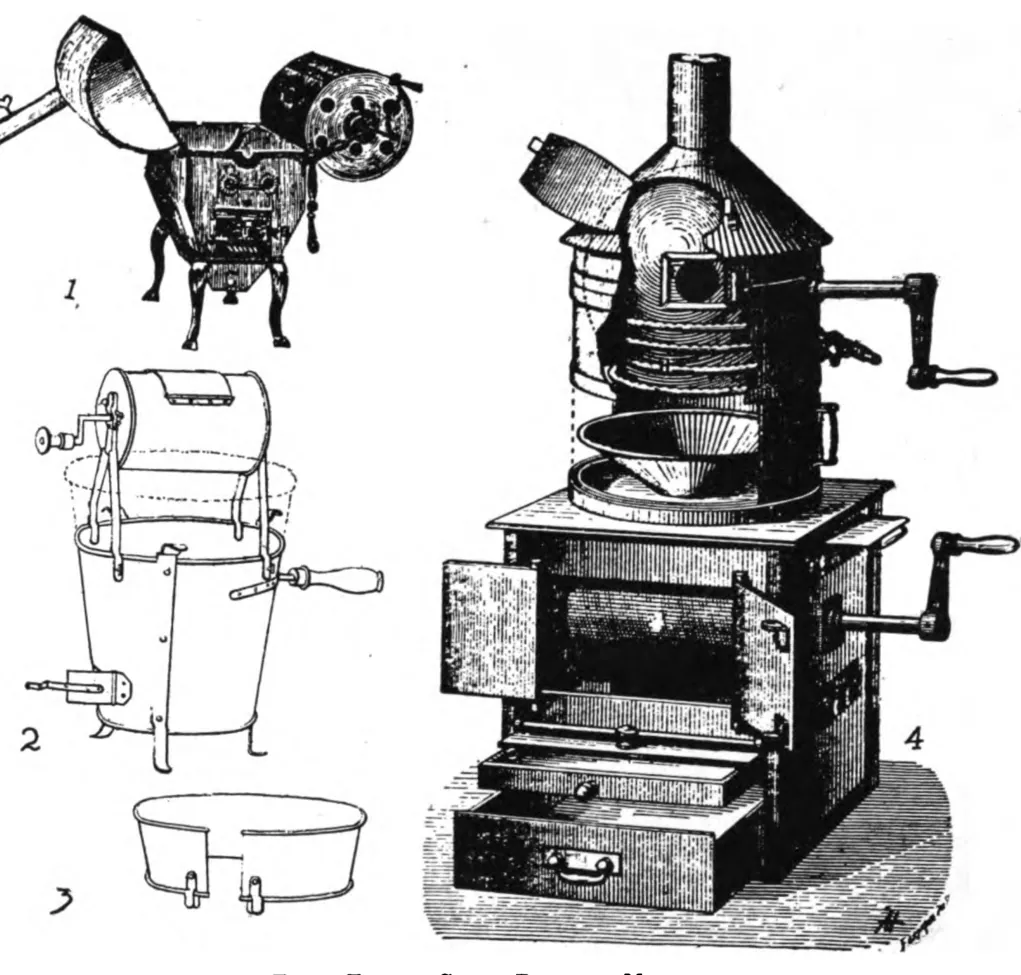
Richard Evans obtains in 1824 the first English patent for a commercial roaster, and his machine already contains three ideas that will not change.
A sheet-iron cylinder with improved vanes for stirring the coffee. A hollow tube with a probe, the trier, which makes it possible to draw a few beans during the roast to look at them. And a complete tilt to empty it.
This probe is the most important of the three: it is the first instrument that lets one know where one stands without stopping the machine.
What follows is a race between Europe and America. The dates answer one another from one continent to the other, and each builds its own version of the cylinder.
Lauzaune makes crank-operated iron cylinders in Paris from 1829. In 1833-34, James Wilde sets up in New York, on Wooster Street, a complete English roasting and grinding plant. It is the first one Thurber has kept a record of, and it comes from England: America buys the machine before making it.
The Hope Mills follow in 1835 with four cylinders. They burn down in 1845, ten years later, without the source saying why.
The first French patent, issued to Lacoux in 1836, is a porcelain roaster-grinder. Why porcelain? Because the inventor believed that metal gave a bad taste. He was wrong, but the error is reasoned.
The Dakins, in England in 1847-48, push the same worry to the extreme. Since metal is suspected of giving a taste, they line the cylinder with gold, silver or platinum, and enclose it in an oven.
Above all they add a taster, the first sampler allowing the beans to be examined without stopping the machine. It is Evans's trier pushed a notch further, and it answers the same problem as ever: a roast that cannot be seen can only be judged by drawing samples.
And in 1849, in Le Havre, Preterre makes the decisive move: he mounts the roaster on a scale. The device indicates the weight loss and stops the roast by itself when it is reached. It is the first attempt to run a roast by measurement and not by eye, and it is exactly what today's machines do.
Ukers 1922, ch. XXXIV, p. 625-632; Thurber 1881, p. 23; chronology p. 728-729James W. Carter, in Boston, patents in 1846 the “pull-out”: an unperforated sheet-iron cylinder pulled out of the furnace on its shaft to be emptied or reloaded through a sliding door, heated with bituminous coal 40 to 45 cm below; the machine dominates the American trade for twenty years. The recollections of A.E. Forbes (St. Louis, 1853) describe the trade: the end is judged by the color of the smoke escaping through the slit, the cylinder is drawn and opened several times to look, the batch is poured into a wooden bin and stirred until cool, a bucket of water is thrown on; the roaster has to lift sacks of Rio weighing 70 to 80 kg. At Dwinell-Wright in Boston, the coffee is spread on the floor to a depth of 8 to 10 cm and sprinkled with a watering can, the room disappearing in steam with each batch. In 1846, according to Ukers, around New York one could already roast as much coffee as Great Britain consumed, at half a cent a pound.
Ukers 1922, ch. XXXIV, p. 632-635We must stop at Jabez Burns, because he settled in one stroke the problem that kept roasting from becoming an industry.
Born in London in 1826, arrived in New York in 1844, he is first a bookkeeper at the Globe Mills and invents an adding machine in 1858. An accountant, then, not a roaster.
The problem of the time is this: to empty a roaster, it has to be taken off the fire. Which means stopping, cooling, starting again. Impossible to work continuously.
In 1864, Burns patents the first roaster that is no longer taken off the fire. It is a closed iron cylinder, set in brickwork, fitted inside with a double screw, “a double auger, right-handed and left-handed, one inside the other,” which pushes the coffee from one end to the other during the roast and makes it come out at the front when decided.
In 1867 he adds a cooler that draws air through a wire-cloth bottom, instead of blowing it from underneath. It is more even, and it also carries off the smoke and dust.
In 1874, he predicts the end of home roasting. He was right, a century ahead of time.
In 1879, he lays down two control rules that still hold: the aroma must be “sharp and keen” to the nose, and the broken bean “crisp and uniform in color inside as well as out.” He draws from it an unappealable conclusion: a man with no sense of smell and color-blind has no business in the trade.
- The sequel is that of all good patents. The 1864 one expires
- 1881and Abele copies it in 1882 under the name Knickerbocker. Burns retaliates by patenting an improved roaster
- 1878then the first sample roaster in 1883. He publishes the Spice Mill
- 1888and dies
Thurber describes in 1881 the New York roasting room. The perforated iron cylinders there are built for 300 pounds and loaded with 200. It takes forty-five minutes of fire, an hour counting loading and cooling.
Judgment is made by the smell carried off in the smoke, and the margin is thin: “thirty to sixty seconds more than is necessary sometimes ruin the batch.” The weight loss is 16% on average, 14.5 to 22% at the extremes.
Walsh describes the same machine in 1894: perforated steel cylinder on a hollow shaft, four internal ribs, sampling probe, water quench at the end of the cycle, cooler with a screen bottom and forced air. He counts 30 to 40 minutes and 14% loss.
The change of scale, for its part, is brutal. Thurber counts more than a thousand roasting machines in the United States, 1,200,000 pounds a day. And he notes that twenty years earlier not a pound of roasted coffee was sold in the country. In one generation, the gesture leaves the kitchen and becomes a trade.
The author's book notes that this description is, give or take a few words, that of today's artisanal machine. Paddles, probe, quench (reserved for large volumes) and suction-air cooler have not changed. Only the time has dropped, from 45 to 10-14 minutes, because heat now enters mostly by convection and no longer through the wall.
Thurber 1881, p. 22-26, 165; Walsh 1894, p. 187-191 (Thurber-Walsh digest); LC ch. 11In this plateThe 19 sections
- 01What roasting does, and what it does not do
- 02From the brazier to the cylinder, 1200-1800
- 03Industrialization, 1824-1864
- 04Gas, the sphere and “fast roasting,” 1868-1922
- 05The physics: how heat enters the bean
- 06Five stages, two cracks
- 07The chemistry, stage by stage
- 08The technologies, one by one
- 09The manufacturers, one by one
- 10The tools
- 11The profile: charge, time, rate of rise, development time ratio, drop
- 12Colors and scales
- 13Roast defects
- 14Degassing, resting, freshness
- 15Espresso, filter, decaf
- 16Industrial versus artisanal: time, energy, emissions
- 17Roasting at origin
- 18Today
- 19Archive plates
The table of contents, with the first sentence of each section