Tools
What happens around the drum?
Start the scene or choose a stage. The animation simplifies the mechanism; what follows gives the details and the available references.
Before charging, the green is measured: its moisture, 10 to 12%, and its density, which sets the charge temperature. During the roast, a thermocouple planted in the bed of beans plots the profile, a second probe reads the incoming air. But the bean probe reads a mix of beans and air, never the core of the bean.
Read the stages without animation
- Charging, probingBefore charging, the green is measured: its moisture, 10 to 12%, and its density, which sets the charge temperature. During the roast, a thermocouple planted in the bed of beans plots the profile, a second probe reads the incoming air. But the bean probe reads a mix of beans and air, never the core of the bean.
- Pulling the trierThe trier is a hollow rod pulled out to drop a few beans into the hand, without stopping the machine. The author of the book uses it five or six times per batch: the curve records a temperature, it says neither the color, nor the smell, nor the sound.
- The cyclone holds the silverskinThe air leaving the drum carries off the silverskin, and the cyclone collects it. It is extremely flammable: “a roaster who does not clean his cyclone will eventually have a fire.”
- Burning the smokeAt the end of the roast, the coffee emits volatile organic compounds and carbon monoxide: the air must be treated before the stack. The thermal afterburner burns the smoke at 760 °C at least for 0.4 second; the catalytic one works from 400 °C, faster and with less gas. The electrostatic precipitator burns nothing: it collects the particles on plates.
- Emptying, cooling, destoningThe coffee falls into a circular tray with a perforated bottom; a fan draws air through the layer while an arm stirs it, Burns's principle in 1867. A coffee cooled late or badly loses its uniformity, and a hot mass piled up can catch fire. Downstream, the destoner separates stones by density, in an ascending air current.
To remember: The drum is only one station: the cyclone, the afterburner and the cooler decide as much as it does about the safety of the workshop and the consistency of the coffee.
In history: In 1860, an ordinary bag of Jamaica contained 3 to 5 pounds of stones and twigs, sorted by hand after roasting.
Read the full article and its sources ↓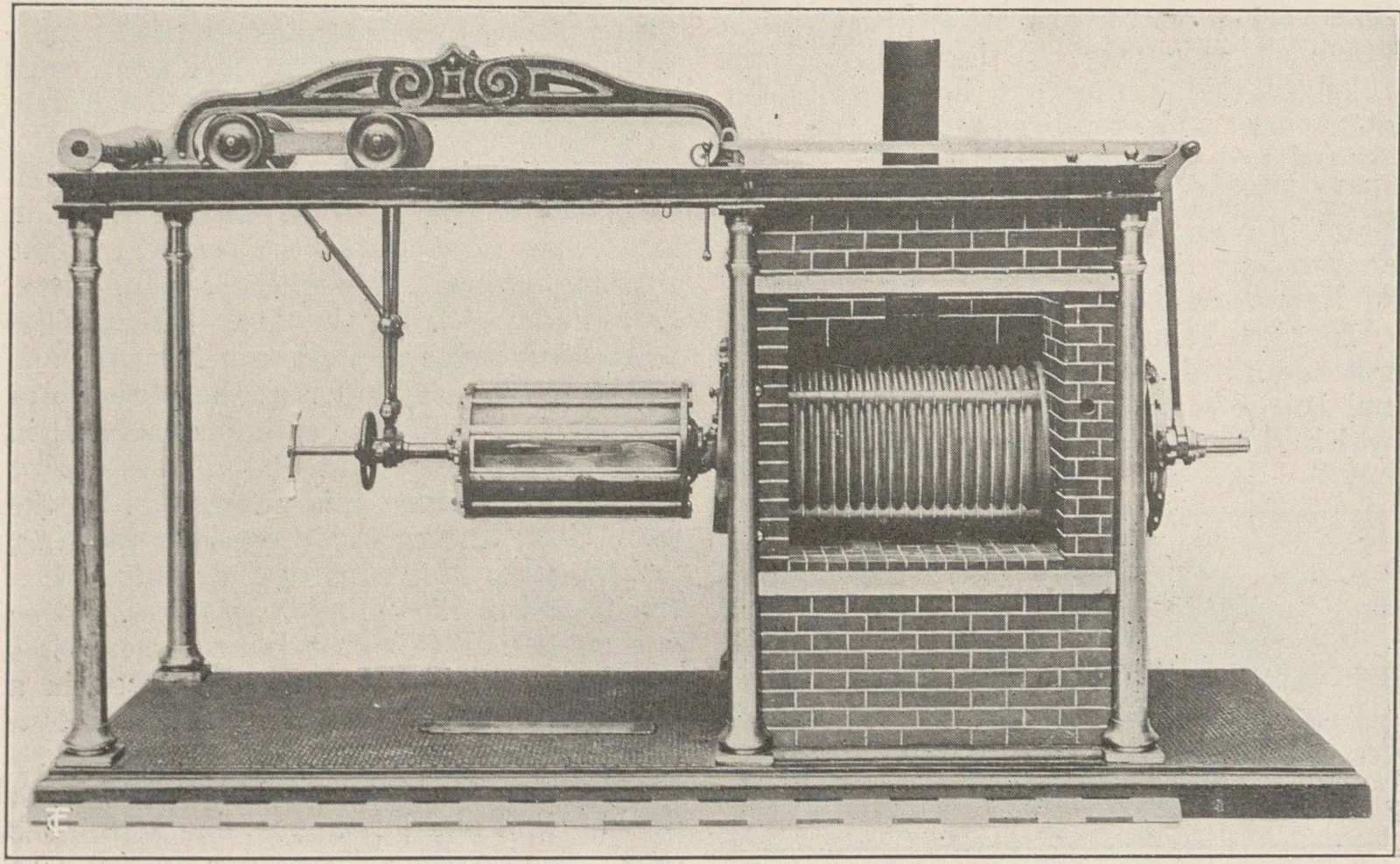
| Scale (ground coffee, cupping) | Value | Tolerance |
|---|---|---|
| Agtron Gourmet | 63,0 | ± 1 |
| Agtron Commercial | 48,0 | ± 1 |
| Colortrack | 62,0 | ± 1 |
| Probat Colorette 3b | 96,0 | ± 1 |
| Lighttells, Javalytics, RoastRite | = Agtron Gourmet | ± 1 |
- Probes and thermocouples
- The profile is the curve of a thermocouple planted in the bed of beans; a second probe reads the incoming air, others the air leaving the drum and farther along in the duct, connected to a recorder at one-second intervals. The bean probe reads a mixture of beans and air, never the core of the bean; its diameter and position change the displayed value and the figures can be compared only on the same machine (“Our world through a keyhole,” Roast Magazine). Vosloo had to add two gas probes for research, which the artisan roaster does not have.
- Profile software
- Cropster (Innsbruck2007, born originally from working with producers, today profile, stocks, quality control and green coffee marketplace)
- Artisan (2009free software under AGPL v3 by the programmers Rafael and Marko, more than 80 machine brands and 50 devices, artisan.plus platform, user base presented as ten times larger than any other)
- RoastLog (profilesstocks, samples, more than 1.5 million batches recorded)
- RoasTimespecific to Aillio
- Profiler 2.0 at Giesen, Roast Architect at Loring. All calculate the rate of rise (RoR) and the development time ratio.
- Colorimeters
Agtron (near-infrared reflectance, Gourmet and Commercial scales, the lower the number the darker the coffee); Probat Colorette (Colortest and Colorette 3b yesterday, Colorette 4 with a 64-channel photodetector today); Tonino (small wireless device from the Artisan team, “at the price of two bags of green”); RoastRite RA-720BF (15 g of grind, range 15-150 on the Agtron Gourmet scale, certified for competitions); Lighttells CM-100 and CM-200, the latter the official device of the World Coffee Events championships. The SCAA standard of 2015 for cupping requires 63.0 Agtron Gourmet (48.0 Commercial, 62.0 Colortrack, 96.0 Colorette 3b) on ground coffee, to ± 1, measured between 30 minutes and 4 hours after roasting; a professional training document gives 85-95 on whole bean and 100-120 on ground on Neuhaus Colortest II.
- Moisture meters and water activity
The moisture of green coffee, 10 to 12%, is measured by capacitance or by oven. It says how much water the bean contains, not what that water can do.
That is the role of water activity, aw, a vapor pressure ratio: it measures the share of water actually available, the water that molds can use. The Sustainable Harvest study (2021) recommends a window of 0.45 to 0.55, that is 10.5-11.5% moisture. Above it, mold and degradation accelerate. Below it, the seed dies, and the coffee becomes flat.
Yang's review retains higher ceilings, a moisture of 12.5% or less and an aw of 0.7 or less, to contain ochratoxin A.
These measurements protect, they promise nothing. To date, aw is not a predictor of the cup score: it says whether the coffee will spoil, not whether it is good.
The density meter, Sinar brand in the protocol cited above, sets the charge temperature. The first decision of a roast is therefore made on a green coffee instrument, before the machine heats up.
- Cooler
- Circular tray with a perforated bottom, fan drawing through the layer, stirring arm: Burns's principle (1867) has not changed. A.L. Burns recalled that a coffee “magnificently uniform” on exit loses all uniformity if it cools late or badly, and that a piled-up mass can catch fire. The big factories of 1922 used tilting carts and flexible arms; the water quench (3 to 4 liters for 60 kg in the “wet” method of 1922) is reserved for large volumes and frowned upon in specialty coffee.
- Destoner
- An ordinary bag of Jamaica contained in 1860 3 to 5 pounds of stones and twigs sorted by hand after roasting; the pneumatic destoner, downstream of the cooler, separates by density in an ascending air current; Loring sells a D35 with its machines. The cyclone, for its part, collects the silverskin, extremely flammable: “a roaster who does not clean his cyclone will eventually have a fire” (LC ch. 11), 170 years after the Hope Mills fire.
- Sampler (trier) and sample roaster
Evans's tubular probe (1824) and Dakin's “taster” (1848) became the trier. It is a hollow rod that is pulled out to drop a few beans into the hand. The tool has not changed function in two centuries, because the need has not changed. One must know where the batch stands without stopping the machine.
The author of the book uses it five or six times per batch. He holds that a roaster who claims to no longer use it “lies, or is roasting something he does not care about.” The probe curve records a temperature; it tells neither the color, nor the smell, nor the sound.
The sample roaster, for its part, follows a numerical protocol: Burns patents one in 1883, Probat makes it electric today, Ikawa air-driven. The numbers are fixed because a sample is useless if it is not comparable to another.
- 100 gthe mass of the test batch.
- 150 to 200 °C at the startdepending on the measured density of the green bean.
- 8 to 12 minutesthe total duration, shorter than that of a sales batch.
- Drop before second crackbeyond it, the roast taste covers the origin, and it is the origin one is trying to judge.
- At least 8 hours of restin a permeable container, away from light: the gas must be able to get out, the light must stay out.
- Spectrometers and analysis
- Agtron colorimetry is already a near-infrared measurement; full NIR spectroscopy (“Spectroscopy illuminated,” Roast Magazine) is used in the laboratory to estimate moisture, degree and composition without reagents, and CIE L*a*b* remains the scientific reference (L* of 28-30 in light to 18 in very dark). Vosloo recommends as a research priority an in-line measurement of the degree, all current methods judging after the fact.
- Smoke sensors and afterburners
At the end of the roast, the coffee emits volatile organic compounds and carbon monoxide. The air that leaves must therefore be treated before the stack. The trade has three afterburners and a filter.
- Thermalit burns the fumes at 760 °C at least, with 0.4 s of residence. It is the most energy-hungry, since that temperature has to be produced.
- Catalytica catalyst lowers the work to 400 °C at least, for 0.05 to 0.1 s of residence. Cooler and shorter, so less gas: it is the most common.
- Regenerative (RTO)alternating fires and a heat recovery, which takes back from the fumes a share of what has just been given to them.
- Electrostatic precipitator (ESP)it burns nothing. It ionizes the particles and collects them on plates: up to 95% fewer particles, 20 to 50% fewer VOCs. It also saves 30 to 50% of gas when it replaces an afterburner, which consumes about 4 m3 of gas per hour. Count 5,000 to 50,000 dollars and a payback in two to five years.
Two items remain. Low-NOx burners cut nitrogen oxides by about half. And the CO and opacity sensors in the stack are not used to run the roast. They serve regulatory checks; Roast magazine devotes a chapter to the rules on air quality.
In this plateThe 19 sections
- 01What roasting does, and what it does not do
- 02From the brazier to the cylinder, 1200-1800
- 03Industrialization, 1824-1864
- 04Gas, the sphere and “fast roasting,” 1868-1922
- 05The physics: how heat enters the bean
- 06Five stages, two cracks
- 07The chemistry, stage by stage
- 08The technologies, one by one
- 09The manufacturers, one by one
- 10The tools
- 11The profile: charge, time, rate of rise, development time ratio, drop
- 12Colors and scales
- 13Roast defects
- 14Degassing, resting, freshness
- 15Espresso, filter, decaf
- 16Industrial versus artisanal: time, energy, emissions
- 17Roasting at origin
- 18Today
- 19Archive plates
The table of contents, with the first sentence of each section