Gas, the sphere and “fast roasting,” 1868-1922
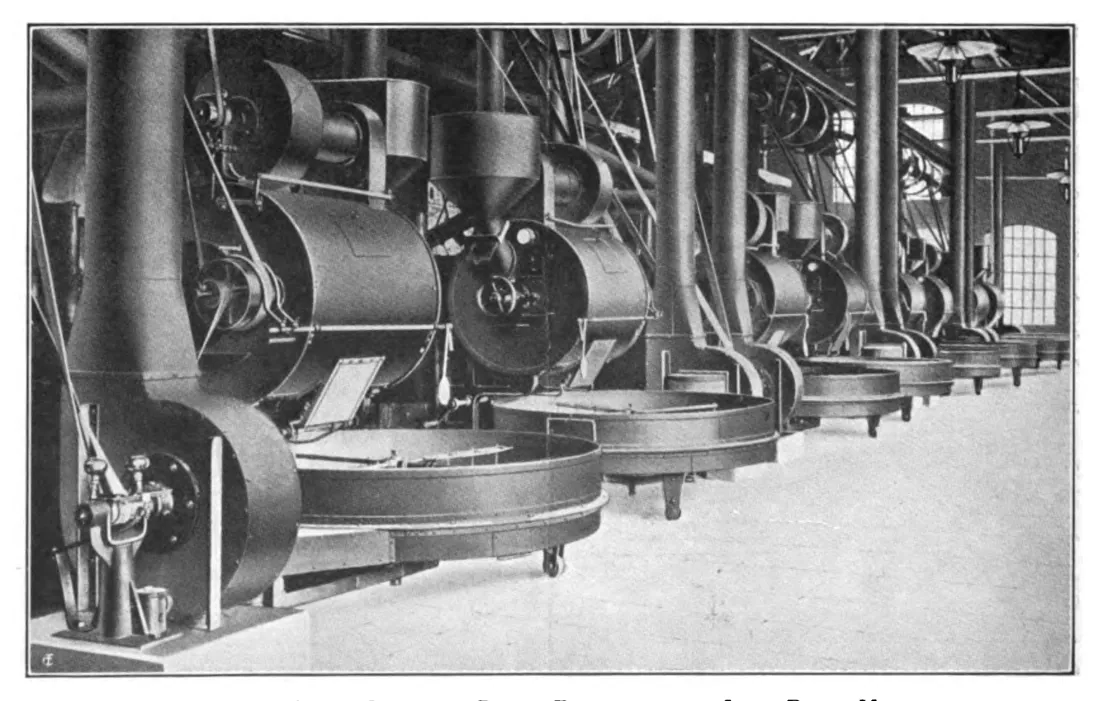
In Emmerich, on the Rhine, Alexius van Gülpen produces in 1860 a green coffee grader, then founds in 1868 with J.H. Lensing and Theodor von Gimborn the Emmericher Maschinenfabrik und Eisengiesserei; in 1870 the firm launches a spherical wood- and coke-fired roaster, perforated and fitted with an exhauster, the first commercial success of the future Probat (671 units produced in 1880 according to the registers). The first German roaster patent goes to G. Tubermann's Sohn in 1877; von Gimborn obtains in 1892 French and English patents for an open flame in a rotating cylinder; the firm acquires in 1889 the German rights to the Henneman patent and patents in 1897 a motorized tilting circular cooler. In 1922, it presents the Probat (coal) and Perfekt (gas) models, Gothot, in Mülheim an der Ruhr, sells its “Ideal-Rapid” fired by coke or gas, and G.W. Barth builds in Ludwigsburg.
Ukers 1922, ch. XXXIV, p. 641-643; chronology p. 730-733; Daily Coffee News, 08/10/2015 (history of Probat); Probat, history page (accessed 09/07/2026)Gas changes the trade, and for a reason that must be kept in mind: with coal, you adjust the heat by waiting; with gas, you adjust it by turning a tap. The roaster becomes controllable.
Roure, in Marseille, produces the first gas roaster in 1877. A decade follows in which everyone looks for where to let the flame in.
- Faulder, in Stockport in 1879, applies an external forced-air burner;
- Fleury and Barker, in London in 1880, gas jets above the cylinder;
- Pearson, in Manchester in 1881, a wire-cloth cylinder under a heated plate;
- Tupholme in London in 1887 and Henneman in The Hague in 1888 patent the direct flame in the cylinder, the one that will win out.
The first direct-flame machine in America, a Tupholme, is installed in 1893 at Potter-Parlin in New York, which rents it by the day all over the country. It is a way of teaching the process to a whole profession without its having to invest.
The rest follows quickly. Natural gas goes under the coal-fired cylinders of Pennsylvania and Indiana in 1896. Lambert sells in 1897 the first “self-contained” roaster, without brick masonry, hence movable. Burns adds a gas burner to his machine the same year, and brings out in 1900 his direct flame with a swivel door. Potter, in 1899, spreads the flame over a large surface to avoid scorching the beans.
In Germany, Otto, in Dresden, starts from a commonsense observation: a fifty-gram sample roasted in the small roaster gives more aroma than a large batch. Why? Because it roasts faster and more evenly. So in 1889 he patents a tubular spiral that roasts in three and a half minutes, and builds in 1893 the first continuous industrial machine, exhibited in Dresden in 1894. Thurmer will sell it from 1914, with a five-meter spiral and 200 kg an hour.
A quarrel follows that stirs the German and French trade, that of “fast roasting.” Thurmer advocates slow cooling after a fast roast; Mottant, in Paris, with his “Magic” machines, rapid cooling. The big German factories then roast in ten to seventeen minutes.
Ukers 1922, ch. XXXIV, p. 643-646; chronology p. 731-735Ukers's industrial chapter fixes the orders of magnitude of 1922: 25 to 30 minutes with coal or coke depending on the moisture of the beans, spongy or hard, and the degree wanted; 15 to 20 minutes with gas; 3.5 to 10 minutes claimed by the German manufacturers; and already the opinion of “many heads of the trade” that a short roast retains more aromas, that a slow roast “bakes” and makes the bean hard instead of brittle.
The consensus is a gentle fire at first, until some of the moisture is driven off, then stronger heat for development; intense heat at the start causes “tipping,” the charred germ at the tip of the bean. Arbuckle's Jumbos in New York, cylinders 3.7 m in diameter fed hot air by blower from an anthracite furnace, roast 2,270 kg every half hour.
Electricity is demonstrated in Germany in 1906 (Moegling roaster, invented in 1900) and patented in the United States in 1911 (Talbutt), but Ukers still judges it prohibitive because a machine must evacuate smoke and chaff and the lost heat costs too much to replace with current. American roasters found their national association in 1911.
Ukers 1922, ch. XXV, p. 385-389; chronology p. 735-736In this plateThe 19 sections
- 01What roasting does, and what it does not do
- 02From the brazier to the cylinder, 1200-1800
- 03Industrialization, 1824-1864
- 04Gas, the sphere and “fast roasting,” 1868-1922
- 05The physics: how heat enters the bean
- 06Five stages, two cracks
- 07The chemistry, stage by stage
- 08The technologies, one by one
- 09The manufacturers, one by one
- 10The tools
- 11The profile: charge, time, rate of rise, development time ratio, drop
- 12Colors and scales
- 13Roast defects
- 14Degassing, resting, freshness
- 15Espresso, filter, decaf
- 16Industrial versus artisanal: time, energy, emissions
- 17Roasting at origin
- 18Today
- 19Archive plates
The table of contents, with the first sentence of each section