Industrial versus artisanal: time, energy, emissions
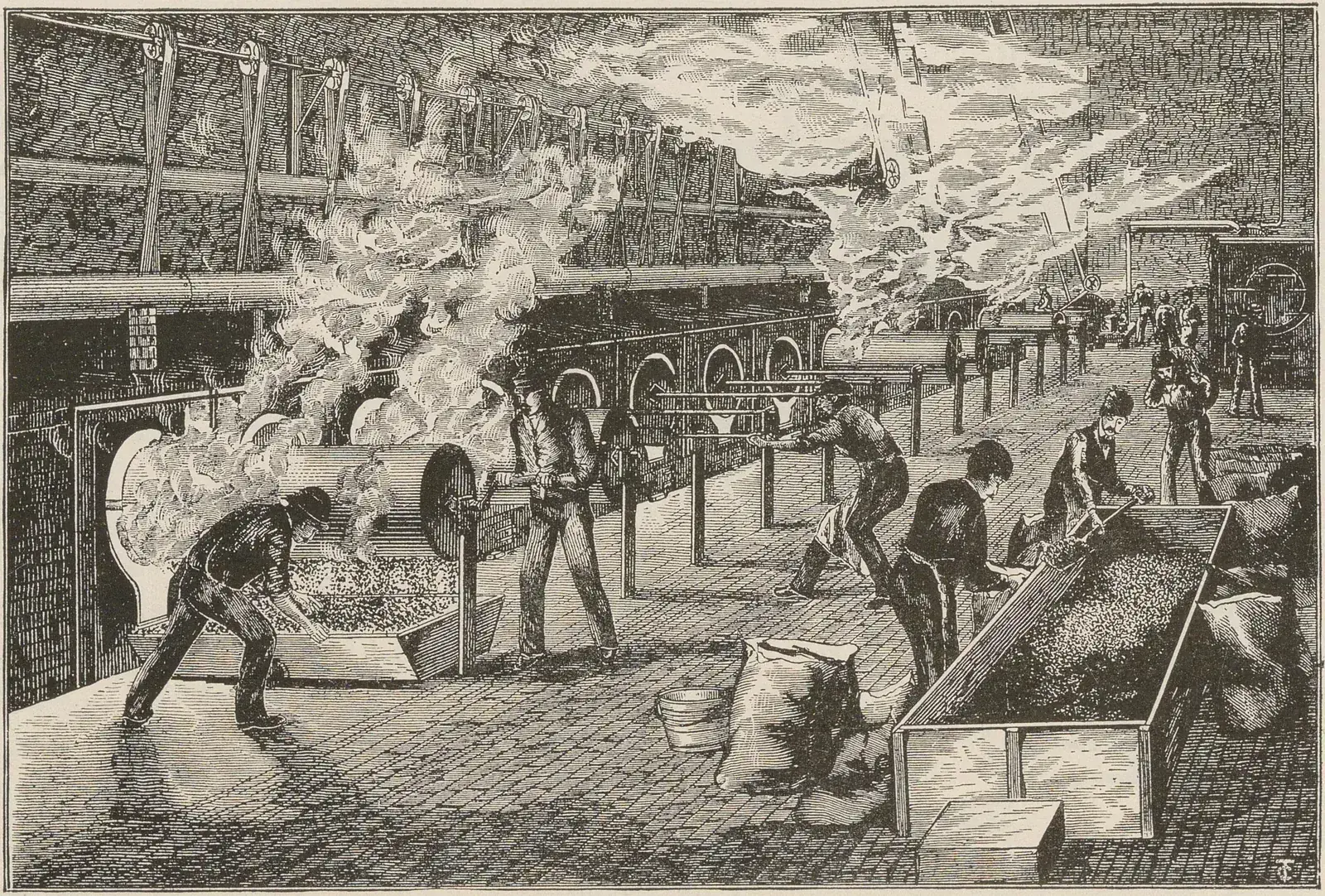
Schwartzberg first quantifies the sector: 6.7 billion kg of coffee roasted a year, mostly in batches. This takes about 11.2 × 10¹² kJ of fuel to roast and afterburn. The emission is 7.0 × 10⁸ kg of CO2 a year. The most striking thing is the loss. Nearly 75% of the heat supplied can leave through the stack.
His model concerns an average roast of 600 s, in a recirculating drum with a catalytic afterburner. It gives 1,621 kJ per kg of green all included, 1,491 in light and 1,729 in very dark.
| Configuration (medium roast, 600 s) | kJ per kg of green |
|---|---|
| Recirculating drum, catalytic afterburner | 1 621 |
| Same, very light / very dark | 1 491 / 1 729 |
| Same, thermal afterburner | 3 426 |
| Fast convection, air/bean 0.73, thermal | 3 266 |
| Measured: 250 kg drum, catalytic (Dorfner) | 1 245 |
| Measured: Probat type R, catalytic (Rothfus) | 1 675 |
| Measured: Probat SP, thermal (Rothfus) | 4 060 |
Smoke treatment therefore weighs more heavily than the roast degree. The same machine equipped with a thermal afterburner climbs to 3,426 kJ/kg. Fast-convection machines with a high air-to-bean ratio reach 3,266.
Recovering the heat of the smoke toward the afterburner, the roasting air and the oven allows up to 17% savings, 20% per kg of roasted coffee. One reservation, however: these are models calibrated on manufacturers' measurements, Rothfus and Dorfner, and not surveys of artisanal workshops.
Behind these numbers, two logics oppose each other, and they do not seek the same thing.
Industry roasts fast. Otto held 3.5 minutes in 1889, a rotating bowl does 2 minutes, an RFB about 5 minutes, the German factories of 1922 took 10 to 17. Speed pays twice. It gains weight, since a short roast loses less matter; and it makes the bean less dense, up to 34% in “high-yield,” therefore more soluble. The name says it: high yield, more cups per kilo of green bought.
The price to pay is a homogeneity and a taste judged inferior by Hoffmann and by specialty roasters. The artisan does the opposite. He roasts in 10 to 14 minutes in drums of 5 to 60 kg, and pays more gas per kilo. He treats his smoke according to local regulation, by afterburner, catalyst or electrostatic precipitator.
The gains announced by vendors are spectacular and unverifiable here. Loring claims 80% less gas through recirculation, Bellwether 87% less carbon through electricity. Electrostatic precipitators claim 30 to 50% less gas than an afterburner. These are manufacturers' figures.
A Thai study gives a measured order of magnitude. Roasting gas weighs 0.42 kg of CO2 per kg of green. Solar drops to 0.32 kg of CO2 equivalent per kg roasted, the local electric grid climbs to 0.74. Electricity is clean only if the grid is.
Schwartzberg, Batch coffee roasting, introduction, tables 1-2, § Energy saving methods and § High-speed roasting; Vosloo 2017, § 2.2.2, pp. 18-19; Ukers 1922, ch. XXXIV, pp. 645-646; Global Coffee Report, Neuhaus Neotec; Loring, Efficiency; Bellwether, Shop Roaster; STiR, 08/25/2025; Barista Hustle, Roasting, and European Journal of Sustainable Development, Carbon footprint of the coffee roasting process (accessed 09/07/2026); LC ch. 11In this plateThe 19 sections
- 01What roasting does, and what it does not do
- 02From the brazier to the cylinder, 1200-1800
- 03Industrialization, 1824-1864
- 04Gas, the sphere and “fast roasting,” 1868-1922
- 05The physics: how heat enters the bean
- 06Five stages, two cracks
- 07The chemistry, stage by stage
- 08The technologies, one by one
- 09The manufacturers, one by one
- 10The tools
- 11The profile: charge, time, rate of rise, development time ratio, drop
- 12Colors and scales
- 13Roast defects
- 14Degassing, resting, freshness
- 15Espresso, filter, decaf
- 16Industrial versus artisanal: time, energy, emissions
- 17Roasting at origin
- 18Today
- 19Archive plates
The table of contents, with the first sentence of each section