Roast defects
Where do roast defects come from?
Start the scene or choose a stage. The animation simplifies the mechanism; what follows gives the details and the available references.
The tips of the bean, and the germ lodged in them, are charred: the material is thinnest there, and heat passes through before the rest of the bean has been able to conduct it toward its core. A charge that is too hot at the start is enough. In the cup: smoke, burnt, ash.
Read the stages without animation
- Tipping: a burnt tipThe tips of the bean, and the germ lodged in them, are charred: the material is thinnest there, and heat passes through before the rest of the bean has been able to conduct it toward its core. A charge that is too hot at the start is enough. In the cup: smoke, burnt, ash.
- Scorching and facing: contactScorching is a sharp spot on a face left pressed against a wall that is too hot instead of rolling: a bent vane, a drum that is too slow, a charge that is too large are enough. Facing is the same accident, diffuse: the surface is darker than the core, which can only be seen by comparing the whole bean to its ground coffee. The remedy is the double drum, a solid cylinder placed around the perforated cylinder.
- Baked, or raw coreThese defects are tasted more than they are seen. Baked: the rate of rise collapses at first crack, then flattens or climbs again, and the cup smells of bread, of oat flakes, flat and dull. Underdeveloped: the surface is cooked, the core raw, the cup grassy, bitter and sour at once, and nothing rescues it. Over-roasted: ash and carbon, the origin has disappeared.
- The first batches of the morningA probe measures a temperature, not an energy. When a cold machine heats up, the air quickly reaches the stated temperature, but the mass of metal in the drum, which will give the heat back to the bean, is still far behind. The first batch comes out very underdeveloped, the second a little. Remedy: run the machine empty for longer than seems necessary, or sacrifice a batch.
- The quaker, a false defectThe quaker is an immature bean that stays pale after roasting, in the middle of an otherwise regular batch. It comes from cherries picked unripe or from a nutrient-deficient coffee tree: without the sugars that brown, no profile will make it brown. Correcting a sound profile because of it is degrading it; only sorting after roasting, manual or optical, answers.
To remember: Surface burns are a metal problem, roast defects a problem of how the roast is run; the quaker, for its part, comes from the field.
In history: In 1922, Ukers called scorching “kissing the cheeks”; the list of defects has not changed since.
Read the full article and its sources ↓One fact deserves to open this section, because it is more surprising than it looks: the defects Ukers described in 1922 are exactly those described today. In the meantime the machine has changed everything, coal became gas then electricity, the drum was doubled, probes appeared, the profile is plotted on a screen. And the list of failures has not changed by a line.
The reason is simple and it governs everything else. These defects are not machine defects, they are heat-transfer defects. Now heat enters a coffee bean in 1922 exactly as in 2026: through its surface, then toward its core, at a rate that depends on the temperature gap between the two. As long as seeds are roasted, there will be the same ways of ruining them.
They can therefore be sorted into two families, and this sorting is more useful than the alphabetical list read everywhere. On one side surface burns, where the bean touched something too hot. On the other roast defects, where heat entered the mass poorly. The first are a metal problem, the second a problem of how the roast is run.
Surface burns: metal that is too hot
Scott Rao groups under a single term three accidents that the trade treats separately. He calls them the surface burn of the bean, and grouping them is precisely what makes the advice usable, since all three have the same cause and the same remedy.
- TippingThe tips of the bean, and the germ lodged in them, are charred. That is where the material is thinnest: heat passes through there before the rest of the bean has been able to conduct it toward its core, where water evaporates and cools. A charge that is too hot at the start is enough to blacken them. In the cup, this gives smoke, burnt, ash.
- ScorchingA whole face of the bean carries a brown or black spot, because it stayed pressed against a wall that was too hot instead of rolling. A bent vane, a drum that turns too slowly, a charge that is too large are enough. Ukers called this “kissing the cheeks,” which says well what it is: a contact.
- FacingThe same accident, but diffuse: the entire surface of the lot takes on a darker shade than its core, without a sharp spot. The site ignored it, and yet it is the most frequent of the three on well-tuned machines, because it can only be seen by comparing the whole bean to its ground coffee.
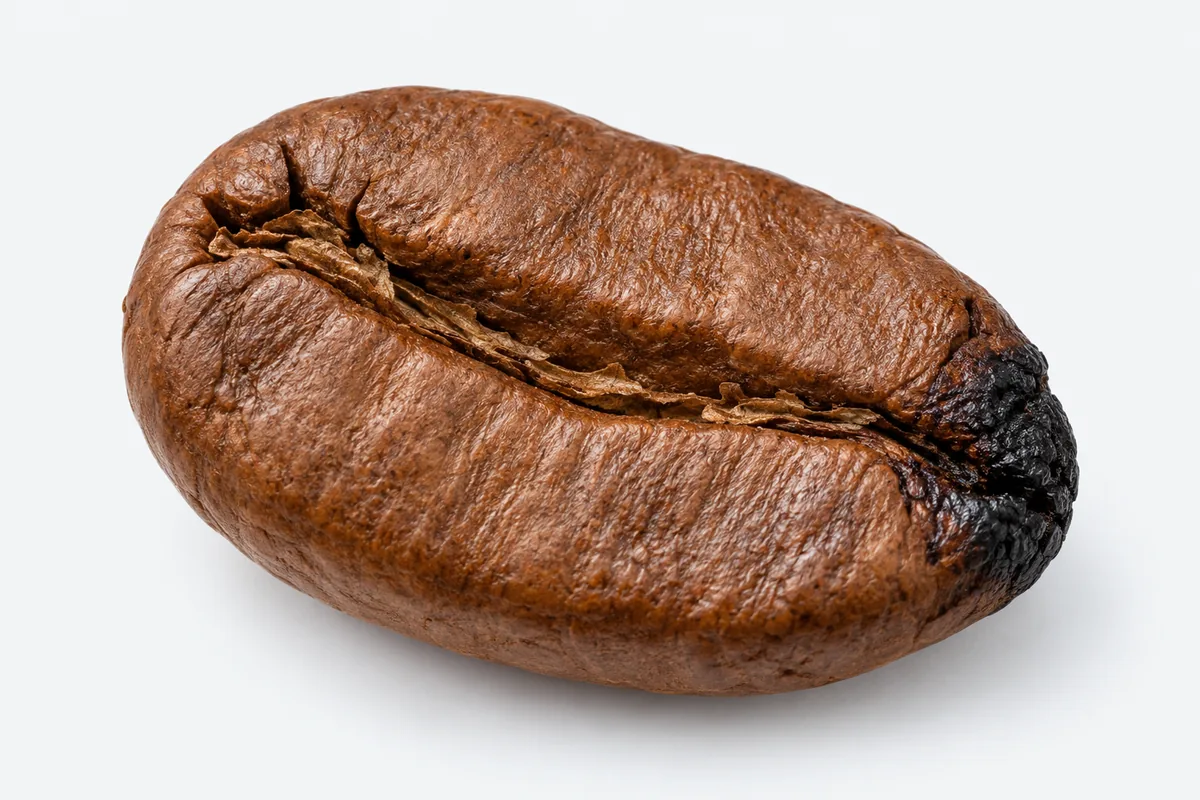 Tipping: a charred tipThe end of the bean, where the material is thinnest, has turned dark brown before the rest could conduct the heat toward its core. It is almost always only one of the two tips: the bean does not present its two ends to the metal in the same way.
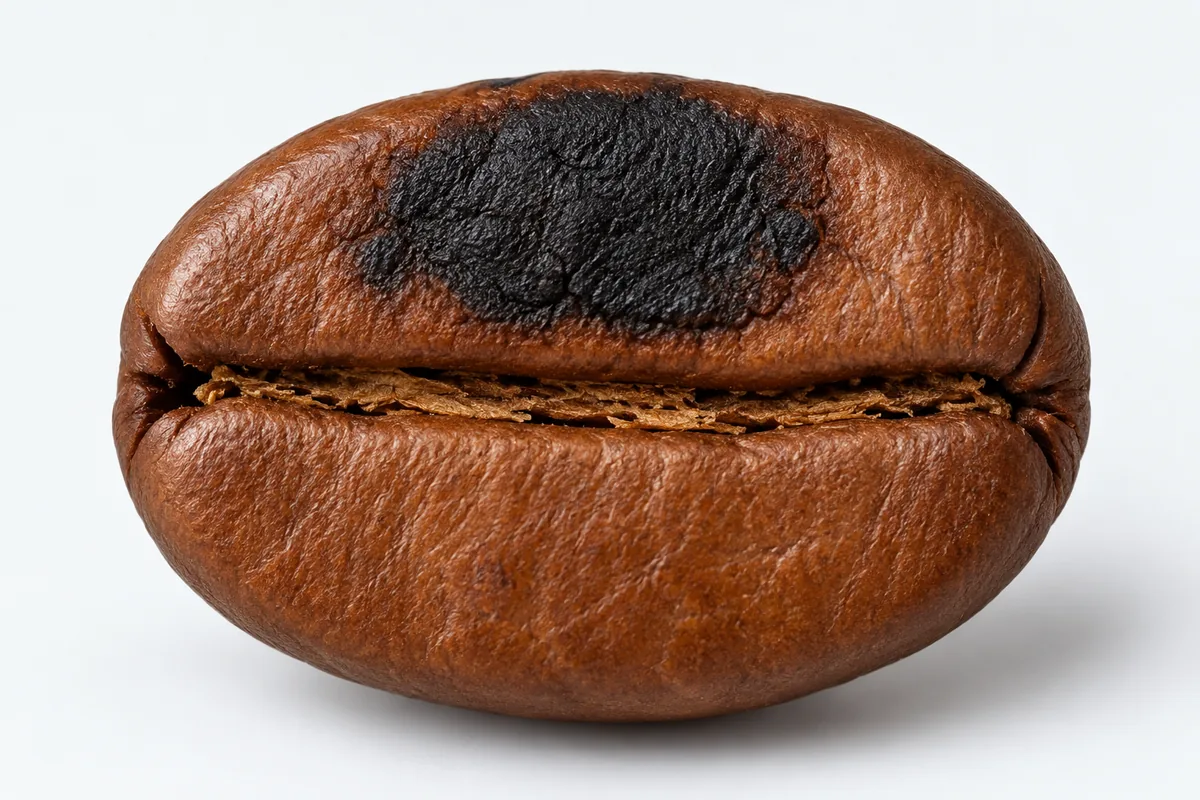 Scorching: a face pressed against the metalThe face carries a frankly black spot, with sharp edges, the mark of a bean that stuck to the wall instead of rolling. The outline is what distinguishes it from facing: here the boundary is visible, the heat entered through a point of contact.
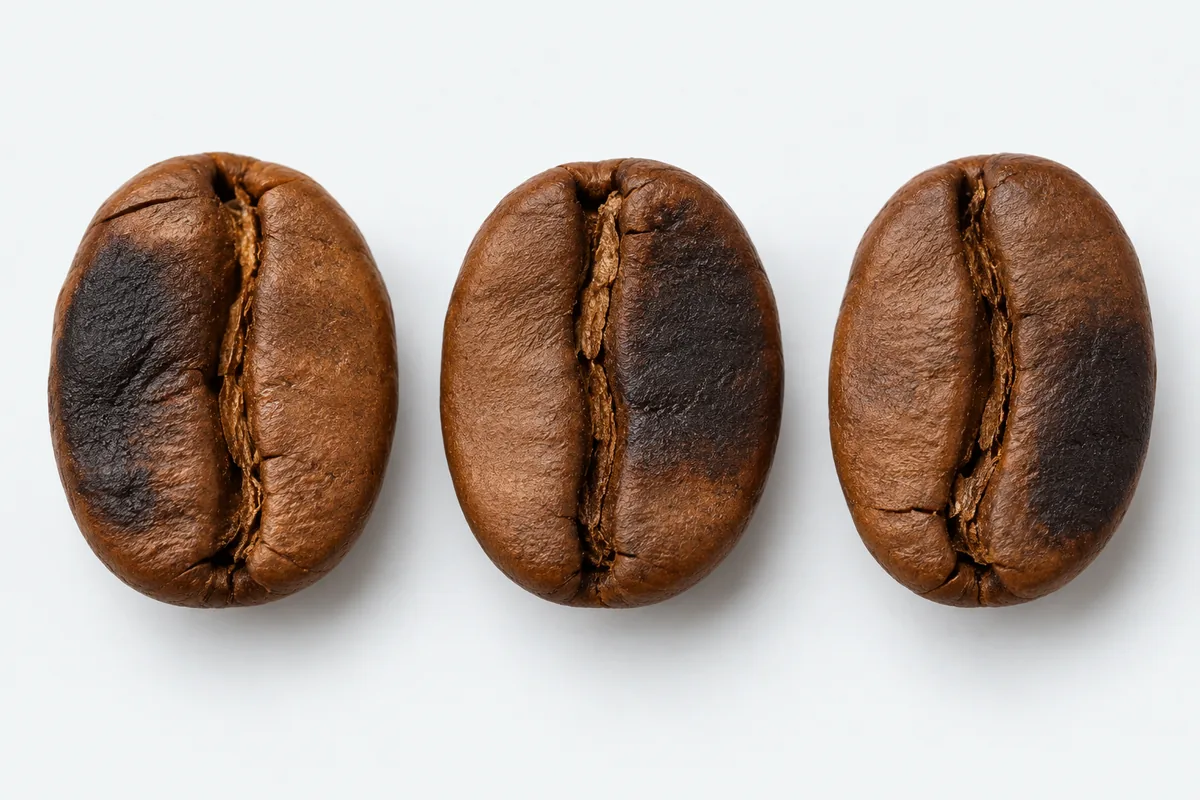 Facing: the surface darker than the coreThe same accident, but diffuse and with no sharp edge. It is the most frequent of the three on well-tuned machines, and the one that can only be seen by comparing the whole bean to its ground coffee.
The remedy is mechanical, and a century old. The double drum, that is, a second solid cylinder placed around the perforated cylinder, was introduced precisely for this: it keeps the flame from heating directly the metal the bean touches. It is therefore not a modern refinement, it is a response to a defect identified very early. And it explains why surface burns remain more frequent on small single-drum machines, where the bean rolls on a wall directly exposed to the burner.
Scott Rao, The Coffee Roaster's Companion, p. 22, for the grouping of the three defects; Book of Roast, p. 29, for the introduction of the double drum against tipping; Ukers, All About Coffee, 1922, ch. XXV, pp. 386 to 389, for “kissing the cheeks”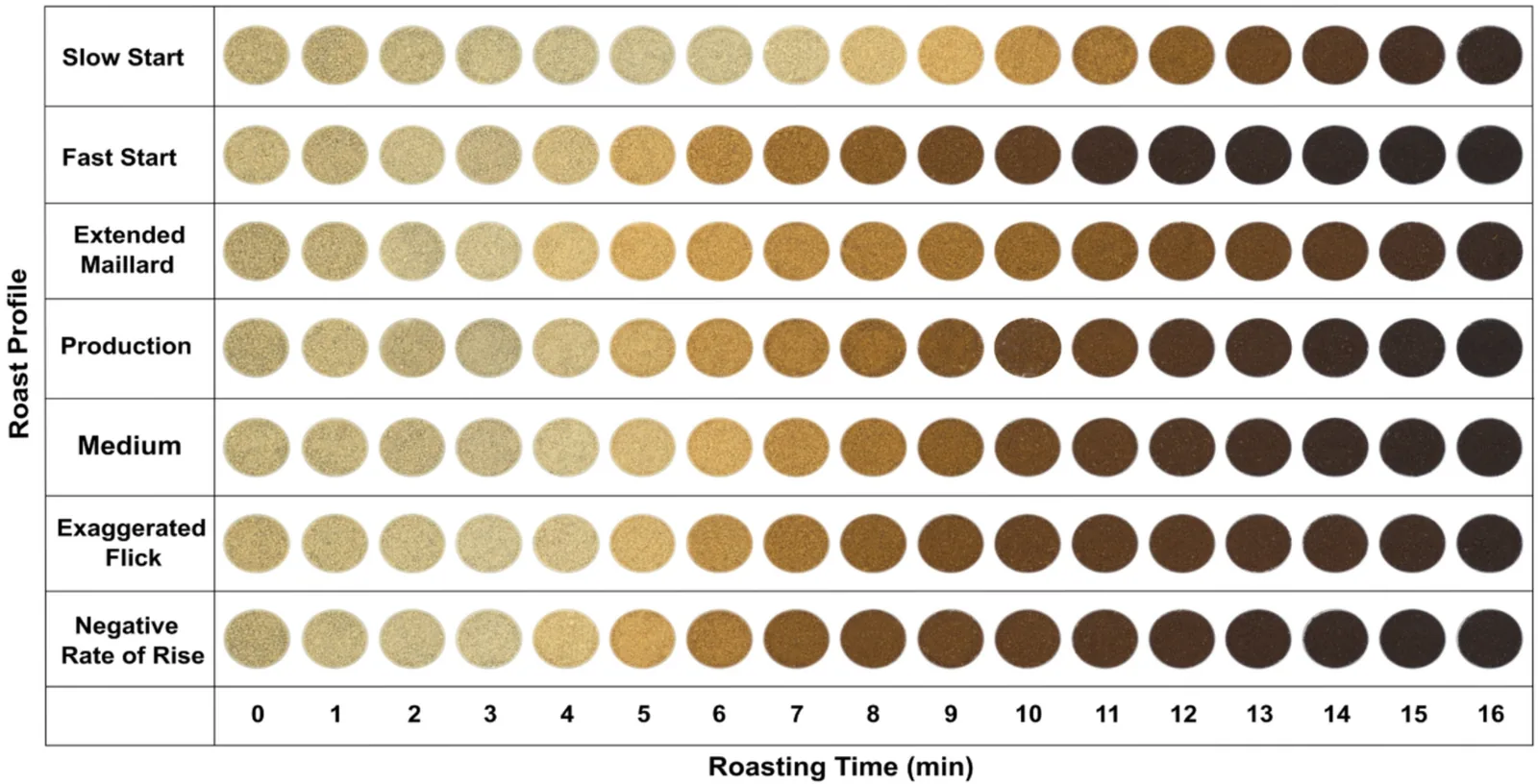
Roast defects: heat that entered poorly
These are not seen on the bean, or poorly. They are tasted. And to understand them a single idea is needed, the one this plate lacked.
Heat moves only by going down a temperature slope. Between the surface of a bean, which is hot, and its core, which is less so, there is therefore a gap, and this gap governs the rate at which heat enters. The larger it is, the faster the flow; when it vanishes, nothing enters anymore. Rao calls it DT, and all his approach fits in one sentence: establish a large gap early, then reduce it progressively until the end.
This idea finally gives its reason to the rule the trade recites without explaining it, that of the rate of rise in temperature that must decrease steadily. A rate that decreases is a gap that closes. A rate that collapses all at once is a gap that disappears before the core has finished roasting. A rate that climbs back is a gap reopened when the surface is already cooked.
- BakedThe rate of rise collapses at first crack, then flattens or climbs back, for lack of energy. The bean finishes its roast with no slope, so with nothing really entering. The cup tastes of bread, of oat flakes, and above all it is flat and dull: the sugars had time to degrade without the browning reaction, which requires speed, producing its molecules. Ukers already wrote it differently: a slow roast makes the bean hard instead of brittle.
- UnderdevelopedThe opposite: the surface is cooked and the core is raw. The cup is green, grassy, it recalls hay, peas or raw peanuts, and it is both bitter and sour, which is the signature of the defect. It is beyond rescue, for a structural reason: the parts of the bean evolved at different speeds, and no extraction setting rescues two coffees in the same bean.
- Over-roasted, or overdevelopedThe roast went too far. What remains is ash and carbon, and every singularity of the origin has vanished. It is the only defect the roaster chooses, at least in part, and the only one that long served commercially to mask a mediocre green.
Why the first batches of the morning are failures
Here is the case that makes everything else concrete, and any roaster can verify it on their own machine.
Rao tells of having spotted, on a table of award-winning coffees, one very underdeveloped sample and another that was slightly so, and of having guessed, correctly, that they were the first and second batch of the morning. The explanation lies in what a probe measures. A probe measures a temperature, not an energy. When a cold machine heats up, the air quickly reaches the stated temperature, and the probe says so; but the metal mass of the drum is still far behind, and it is what will give the heat back to the bean throughout the roast.
The first batch therefore roasts in a machine that displays the right temperature and does not contain the right energy. The second as well, less severely. It is a defect of operation that no curve shows, since the curve is precisely the instrument that lies. The remedy is known and costly: run the machine empty, for longer than seems necessary, or sacrifice a batch.
Scott Rao, The Coffee Roaster's Companion, pp. 19 and 20 for the temperature gap between surface and core, p. 49 for thermal mass and the first batches; Johandri Vosloo, engineering thesis, North-West University, 2017, § 2.2.3.2, pp. 20 to 21, for the bean cooked outside and raw insideTwo old remedies, and why they were abandoned
The trade has tried to make up for these defects, and two of these attempts are worth knowing because they come back regularly.
The double pass through the fire, called double roasting, consists in running an already roasted coffee through again. It brightens the color, which long sufficed to justify it commercially, and it harms the cup, for a reason that follows from everything above: the second pass finds a bean whose surface is already cooked and whose core can no longer receive a useful temperature gap.
Sprinkling at the end of the roast, for its part, did not aim at taste: it served to recover three to four percent of weight loss by putting water back into the bean. Ukers already noted in 1922 that the practice was “disapproved of by the best roasters,” which says enough about its being common among the others.
The numbers, and the two points where sources disagree
The temperature of first crack. This plate put forward 175 to 185 degrees, Vosloo's readings on his machine; it now holds at about 200 degrees on the probe, the median of nineteen published readings, which range from 175 to 207. Morten Münchow gives 190 degrees, and Kenneth Davids places the event under 205 degrees. The gap is too large to be a measurement imprecision, and it probably comes from what is measured: the air temperature, that of the probe planted in the mass, or that of the bean itself are not the same quantity, and none of the three sources says clearly which one it reports. A roaster who compares their figure with that of a book is therefore often comparing two instruments.
Development time. Rao gives 20 to 25 percent of the total roast time. Münchow gives a range that goes down to 3.5 percent. Here again the gap is not a quarrel over detail: it is a ratio of six. And a single study in the corpus has measured the sensory effect of these variables, that of Giacalone and Münchow in 2018, which attributes about 80 percent of the perceived variation to final color and 20 percent to time. If this result holds, a large part of the professional debate on profiles concerns the 20 percent.
The moment of the exothermic transition, that is, the instant when the bean begins to produce heat itself instead of receiving it, is placed by Rao at two thirds of the roast and by Münchow after first crack. This matters, because it is exactly the moment when the rate of rise becomes hard to hold.
The residual moisture of the roasted bean. This plate gives 2.8 percent, Münchow 1 to 1.5 percent. A factor of two on a quantity that governs the aging of coffee and the speed of its degassing.
None of the sources read provides a quantified curve of chlorogenic acid degradation during roasting, nor reflectance values that would tie a commercial color scale to a physical measurement. This is the most troublesome gap in the professional literature on roasting.
The quaker, a field defect that reads like a drum defect
This section lacks the defect that passes for one of them without being one, and that leads roasters every year to correct a profile that had nothing wrong with it.
The quaker is an immature bean. It reveals itself only after roasting, because it does not brown like the others: it stays pale, sometimes almost yellow, in the middle of an otherwise regular batch. That is why the term exists only in the tasting room. Before roasting, nothing distinguishes it to the naked eye, and this gap is what causes the whole misunderstanding: the defect appears at the moment of roasting, so it looks like a roasting defect.
It is not one. The main cause, on which all the sources agree, is the picking of unripe cherries, so a decision made at the farm several months earlier. Two other causes lead to it, soil deficiency and poor upkeep of the plot, by a mechanism worth understanding because it explains the look of the bean. A deficient coffee tree, that is, one deprived of a nutrient it needs, goes into survival mode and stops devoting its resources to its fruit.
The bean that results has a poorly defined cell structure and does not contain the sugars needed for flavor. Now these are precisely the sugars that brown: a bean that has none cannot brown, whatever heat it is given, and no profile manufactures the missing matter.
The practical consequence is clear. A roaster who sees pale beans in their batch and concludes insufficient mixing or too little heat will modify a correct profile, and will degrade it. Sorting, manual or optical, is the only answer, and it is done after roasting, since that is the only moment when the defect can be seen.
One last point deserves to be repeated as it stands, because the genre almost always neglects it. The prevalence of quakers, that is, their frequency in a lot, is higher where the dry process dominates. But the processing is not the cause. It is a correlation of sorting and not a mechanism: passage through water removes some of the immature cherries, which do not behave like ripe ones at the moment of sorting, whereas drying as cherry carries the whole lot along without distinction.
The dry process does not make quakers, it lets them through. Confusing the two would lead to blaming a processing method for a picking defect, which is one more error in a chain that already counts many.
Detecting Defects: Plants & Quakers, in The Book of Roast: The Craft of Coffee Roasting, Roast Magazine, JC Publishing, 2017, pp. 101 and 102 for the definition and causes, p. 102 for the mechanism of deficiency and for the distinction between prevalence tied to sorting and cause tied to processing.In this plateThe 19 sections
- 01What roasting does, and what it does not do
- 02From the brazier to the cylinder, 1200-1800
- 03Industrialization, 1824-1864
- 04Gas, the sphere and “fast roasting,” 1868-1922
- 05The physics: how heat enters the bean
- 06Five stages, two cracks
- 07The chemistry, stage by stage
- 08The technologies, one by one
- 09The manufacturers, one by one
- 10The tools
- 11The profile: charge, time, rate of rise, development time ratio, drop
- 12Colors and scales
- 13Roast defects
- 14Degassing, resting, freshness
- 15Espresso, filter, decaf
- 16Industrial versus artisanal: time, energy, emissions
- 17Roasting at origin
- 18Today
- 19Archive plates
The table of contents, with the first sentence of each section