Colors and scales
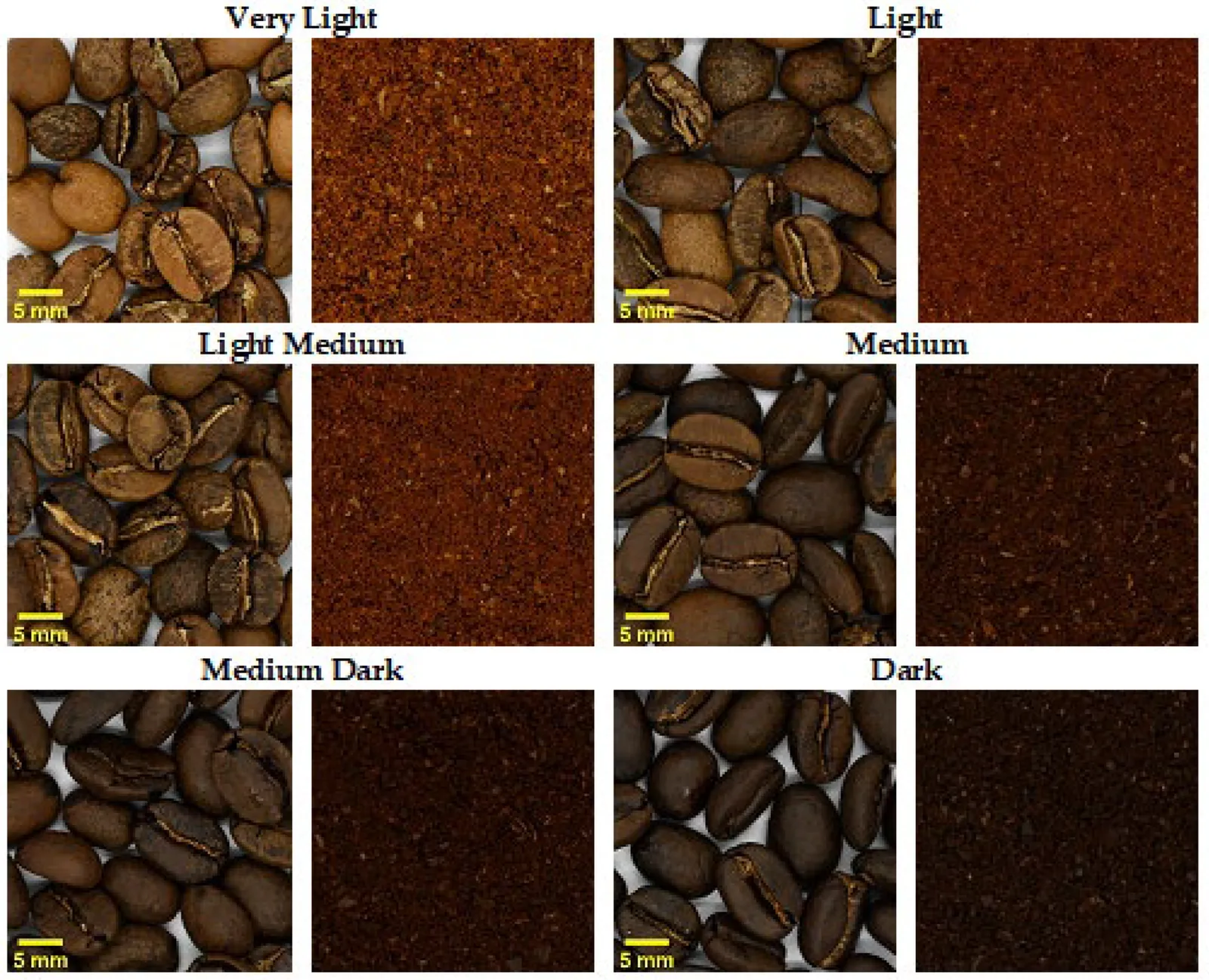
The degree is read by color, and there is no standard shared from one roaster to another. Each names what he sees.
The American names of 1922 are already numerous: light, cinnamon, medium, high, city, full city, French, Italian. Ukers superimposes a map of tastes on them. England likes it light. France, Italy, Brazil, Turkey and the producing countries, very dark. On American soil, the Pacific coast goes light, the South dark, Boston cinnamon. The source notes these preferences, it does not give the reason.
The table of Hoffmann and Rao, taken up by Vosloo, does it differently: it ties each name not to a shade of brown, but to an audible landmark, the crack.
- Cinnamondropped at the very start of first crack.
- Cityend of first crack.
- Full cityjust before the second, first oils on the surface.
- Viennesestart of second crack.
- Frenchduring second crack, dark brown and oily.
- Italianend of second crack, almost burnt.
What remain are the objective measurements: reflectance (Agtron, Colorette, L* of 28-30 to 18), final moisture (2.8 to 1.4%) and mass loss (10 to 22%). None makes a universal scale, and Vosloo says why: the composition of green coffee varies too much with climate, processing, species and origin. The same value therefore does not cover the same coffee.
Color has an even more troublesome limit. It does not tell the time spent reaching it, and the same shade can cover a fast roast and a slow one. This is the subject of an article in Roast magazine, “Flavor development: the relationship between time and color.”
Ukers 1922, ch. XXV, p. 387; Vosloo 2017, § 2.2.5, pp. 23-25, tables 2.2 to 2.5; Roast Magazine, The Book of Roast vol. 2, table of contentsDavids's table: ten degrees, four cross-referenced markers
The section has just said that there is no shared color scale. That is correct, and yet there is one item worth reproducing here, because it is the only place in the professional corpus where a commercial scale is tied to physical markers. Kenneth Davids published a table that crosses four systems at once: the named color, the state of the bean surface after resting, the exit temperature, and the Agtron Gourmet value with the corresponding SCAA disk. Ten degrees, with the common names alongside.
Two warnings before reading it, and they come from Davids himself. All the values and all the correspondences in it are approximate, because roasting remains difficult to quantify, owing to the chemical complexity of the bean and the variability of coffee. And the table is taken from his own 2003 book on home roasting: it therefore describes the state of the vocabulary around that date, not its current state.
The ten degrees
- Very light brown, dry surfaceAround 380 °F, or 195 °C. Agtron Gourmet 95 to 90, disk 95. Common names: light, cinnamon.
- Very light brown, dry surface, first crackUnder 400 °F, or 205 °C. Agtron Gourmet 90 to 80, disk 85. Light, cinnamon, New England.
- Light brown, dry surfaceAround 400 °F, or 205 °C. Agtron Gourmet 80 to 70, disk 75. Light, New England.
- Medium light brown, dry surfaceFrom 400 to 415 °F, or 205 to 215 °C. Agtron Gourmet 70 to 60, disk 65. Light, light-medium, American, regular.
- Medium brown, dry surfaceFrom 415 to 435 °F, or 215 to 225 °C. Agtron Gourmet 60 to 50, disk 55. Light, medium, mild, medium high, American, regular city.
- Medium dark brown, from dry to fine droplets or light spots of oilSecond crack, from 435 to 445 °F, or 225 to 230 °C. Agtron Gourmet 50 to 45, disk 45. Full city, mild, Viennese, northern Italian, espresso, continental, after-dinner.
- Moderately dark brown, light oily spots to fully shiny surfaceFrom 445 to 455 °F, or 230 to 235 °C. Agtron Gourmet 45 to 40. Espresso, bold, dark, french, european high, continental.
- Dark brown, shinyFrom 455 to 465 °F, or 235 to 240 °C. Agtron Gourmet 40 to 35, disk 35. French, espresso, Italian, dark, Turkish.
- Very dark brown, very shinyFrom 465 to 475 °F, or 240 to 245 °C. Agtron Gourmet 35 to 30. Italian, bold, Neapolitan, Spanish, heavy.
- Very dark brown, almost black, shinyFrom 475 to 480 °F, or 245 to 250 °C. Agtron Gourmet 30 to 25, disk 25. French and dark french, Neapolitan, Spanish.
What the surface column teaches
The least-watched column is the most useful to a roaster without instruments, because it gives a free marker. The bean stays dry until medium brown; the first droplets appear around second crack; full shine arrives about ten degrees Celsius later, and it never goes away. This oil is not added, it is expelled: the internal structure, weakened by the loss of water and by the pressure of the gases, stops retaining the lipids that the bean has carried since the field.
A shiny surface is therefore the admission of a cell wall that has given way, which incidentally accounts for a fact known to retailers, namely that very dark coffees go rancid faster: their fat is outside, in contact with the air.
The cross-reference the plate can make and Davids does not
The 2015 SCAA cupping standard requires 63.0 on Agtron Gourmet for samples presented on the table. Carried over to this table, that figure falls in the medium light brown band, between 205 and 215 °C exit, on Davids's probe scale; from one machine to another, these exit temperatures shift with the probe: on Gloess's Probatino, a medium coffee comes out between 186 and 196 °C. The reference degree of professional cupping is therefore lighter than what everyday vocabulary calls medium, and noticeably lighter than what a French drinker calls a normal coffee.
The degree at which a coffee's quality is judged is not the one at which it is sold, and this gap explains part of the misunderstandings between the cupping table and the counter.
Kenneth Davids, Roast Color Chart, in The Book of Roast: The Craft of Coffee Roasting, Roast Magazine, JC Publishing, 2017, pp. 38 and 39; table adapted from Kenneth Davids, Home Coffee Roasting: Romance and Revival, second edition, St. Martin's Press, 2003. Author's warning on the approximate nature of the values, p. 35.The two Agtron scales, the disks, and the word espresso
The plate lists the colorimeters without saying what separates the two Agtron scales, though it is the first question that arises when facing a number read somewhere. An Agtron of 60 does not mean the same thing depending on the scale, and most sources omit to say which one they use.
Commercial and Gourmet
The first is the commercial scale, called E10/E20. It was designed for mass-market coffee, that is, for a range of rather dark degrees. The second is the Gourmet scale, called M-Basic, which Carl Staub developed later to better resolve the high end of the day, with its emphasis on dark roasts; resolve here means separating neighboring values that the first scale squashed together.
Across all manufacturers, the convention is the same and it is counterintuitive: the lowest number designates the darkest roast, since what is measured is a reflectance, that is, the share of light that the ground coffee sends back instead of absorbing.
Davids adds a fact one would prefer to ignore and that he holds from his own laboratory: his calibrated Agtron gives him constant readings from one month to the next, but comparison with another Agtron installed elsewhere is much less constant. The cause is therefore not the carelessness of users, it is the instrument. The only way he knows to understand each other between two distant laboratories is private calibration, that is, the physical exchange of samples and readings between the two houses.
He also names the instruments with a proprietary scale of his day, ColorTrack, Fresh Roast Systems, Javalytics, Neuhaus-Neotec, Probat and QuantiK, and notes that Javalytics alone offered the choice among four scales, including the two of the Agtron. A color figure with no instrument name and no scale name therefore means nothing, and yet it circulates in this form.
The disks, a forgotten answer to the problem of price
In the early 1990s, the SCAA and Carl Staub developed a device that the plate ignores and that answered the cost objection directly: the Agtron/SCAA classification disk system. Eight reference points numbered in increments of ten, paired with eight colored disks ranging from very light to very dark. A ground sample is pressed into a Petri dish, compared with the disks, and the number is read. A few hundred dollars, against several thousand for the instrument.
Davids judges the impact modest, and his reason deserves to be heard: numbers confuse consumers. The device was aimed at a professional audience but was also meant to serve for communication, and that is where it stumbled. He prefers what he calls a color thermometer, a graphic scale printed on the package where the roast is placed on a continuum; it is better, he says, than all the old naming systems, because it shows that color is relative instead of pretending to name it.
The word espresso designates no color
What remains is the basic disagreement, and it is a frontal one. The plate takes up the table of Hoffmann and Rao, which attaches each name to an audible marker: full city just before second crack, Viennese at the start of the second. This is a nomenclature that means to be operational, usable in the noise of a workshop. Davids's table, for its part, places full city, mild, Viennese, northern Italian, espresso, continental and after-dinner in one and the same row, that of medium dark brown. What Hoffmann and Rao separate, Davids merges.
| Degree | Exit | Loss | Moisture | L* |
|---|---|---|---|---|
| Light (cinnamon, city) | start to end of 1st crack | 10-13 % | 2,8 % | 28-30 |
| Medium (full city, Viennese) | before or at start of 2nd crack | 14-16 % | 2,0 % | 24 |
| Dark (French) | during 2nd crack | 17-20 % | 1,7 % | 20-21 |
| Very dark (Italian) | end of 2nd crack | up to 22% | 1,4 % | 18 |
And his table contradicts itself, which is more instructive still: the word espresso appears in it in three consecutive rows, from 50-45 to 40-35 on Agtron Gourmet, a range of ten degrees Celsius at the exit. In other words, this word designates no color. It designates a destination, the machine to which the coffee is promised, and not a roast degree. The plate is right to write that everyone names what they see; it can now prove it with this table instead of asserting it.
Neither of the two nomenclatures can be refuted by the other, for lack of a survey that would have tied these names to measurements on the same set of coffees. Hoffmann and Rao describe the usage of English-language specialty roasting in the 2010s; Davids describes that of the American market around 2003, where espresso commonly meant a dark degree. Both are accurate in their own world, and it is the word that moved, not the coffees.
Kenneth Davids, Saying Coffee: The Naming Revolution, in The Book of Roast, Roast Magazine, JC Publishing, 2017, p. 34 for the two Agtron scales, the inconsistency between instruments and private calibration, p. 35 for the Agtron/SCAA disk system and the color thermometer, p. 38 for the table of degrees; James Hoffmann and Scott Rao for the nomenclature tied to the cracks, as the plate takes it up; Gloess et al., International Journal of Mass Spectrometry 365-366, 2014, table 1, p. 327, for the Probatino exits.In this plateThe 19 sections
- 01What roasting does, and what it does not do
- 02From the brazier to the cylinder, 1200-1800
- 03Industrialization, 1824-1864
- 04Gas, the sphere and “fast roasting,” 1868-1922
- 05The physics: how heat enters the bean
- 06Five stages, two cracks
- 07The chemistry, stage by stage
- 08The technologies, one by one
- 09The manufacturers, one by one
- 10The tools
- 11The profile: charge, time, rate of rise, development time ratio, drop
- 12Colors and scales
- 13Roast defects
- 14Degassing, resting, freshness
- 15Espresso, filter, decaf
- 16Industrial versus artisanal: time, energy, emissions
- 17Roasting at origin
- 18Today
- 19Archive plates
The table of contents, with the first sentence of each section