The technologies, one by one
Where does heat go in each machine?
Start the scene or choose a stage. The animation simplifies the mechanism; what follows gives the details and the available references.
A horizontal cylinder, often perforated, turns above a flame. Heat enters through the heated wall and through the air drawn through the drum, while paddles lift the coffee and let it fall back. The roaster keeps fine control and time, up to 18 minutes; but about 75% of the heat goes up the stack, and a wall that is too hot scorches the bean.
Read the stages without animation
- Drum, direct heatingA horizontal cylinder, often perforated, turns above a flame. Heat enters through the heated wall and through the air drawn through the drum, while paddles lift the coffee and let it fall back. The roaster keeps fine control and time, up to 18 minutes; but about 75% of the heat goes up the stack, and a wall that is too hot scorches the bean.
- Drum, indirect heatingThe flame never touches the drum: a heat exchanger or a separate combustion chamber heats the air, which is then sent through the coffee, and the cylinder is often solid. Less scorching, better homogeneity, smoke treated at the source; in exchange, the machine responds more slowly and costs more.
- Fluidized bed, hot airA strong flow of hot air enters from the bottom of the chamber and floats the beans: heat passes almost solely by convection, with no contact with hot metal. The roast is short and homogeneous, the silverskin leaves continuously. In Michael Sivetz's patent, the air does not exceed 277 °C. Beyond an air-to-bean ratio of 10, fan energy climbs fast.
- One burner, air in a loopA single burner, placed in a cyclone, heats the roasting air and incinerates the smoke at the same time; the air returns in a loop to the drum instead of being discarded. Loring claims up to 80% less gas. An undecided debate remains over the “taste of the machine.”
- Electric, no flameHeat comes from current: elements heat the air or the wall, induction heats the drum itself, halogen lamps add to the hot air. With no flame or gas connection, the machine can be installed in a shop; but most take only 1 to 15 kg, and the carbon footprint is that of the grid.
To remember: Each machine chooses between the contact of metal and the blow of air; this choice decides what can go wrong, from scorching to the energy bill.
In history: On November 11, 1974, Michael Sivetz filed US patent 3,964,175 for his hot-air roaster, built in his garage in Corvallis.
Read the full article and its sources ↓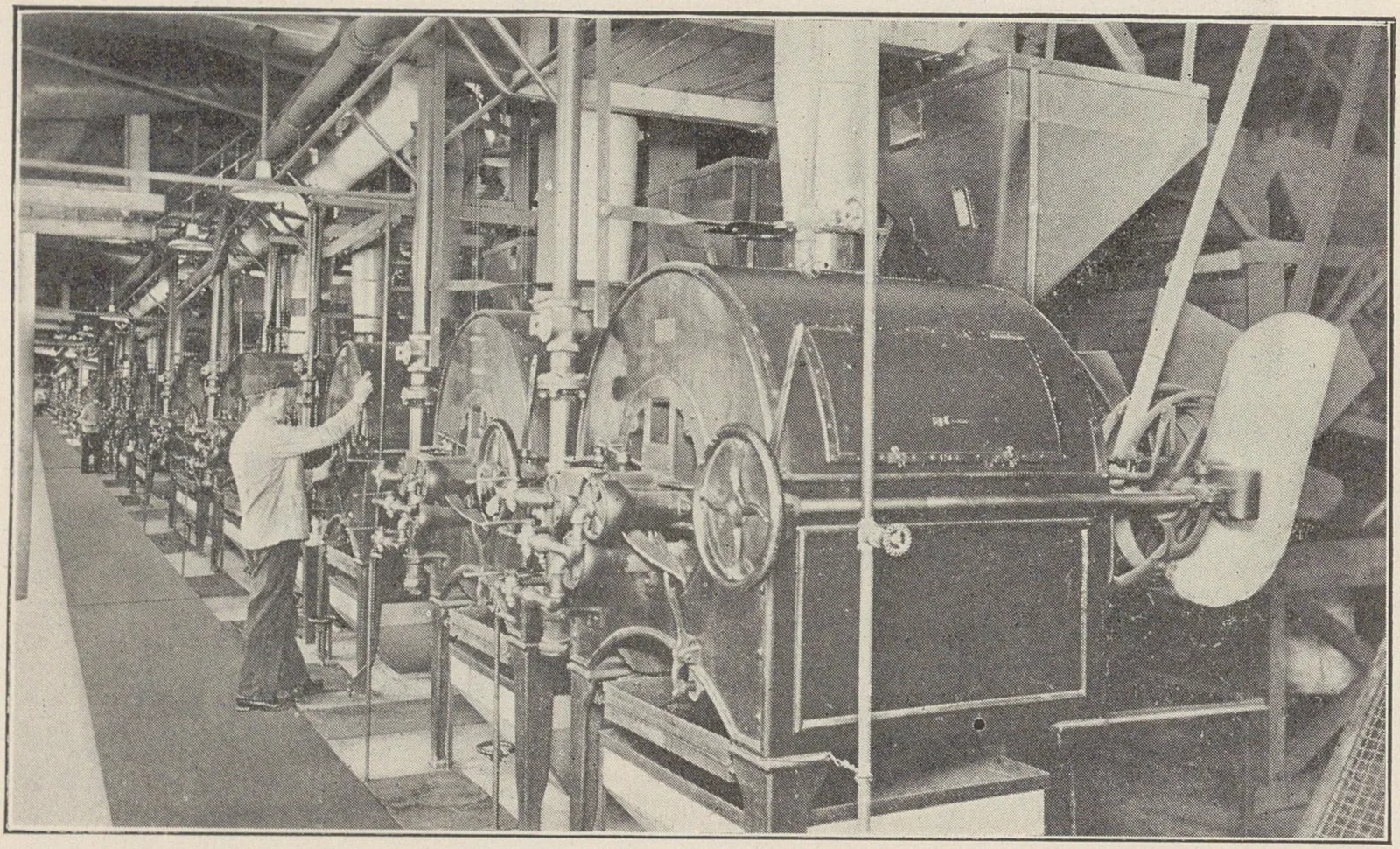
- Direct-heat drum
Principle: a horizontal cylinder, often perforated, turns above a flame, of coal, coke, then gas. Heat enters by two paths, conduction against the wall and air drawn through the drum. Interior paddles lift the coffee and let it fall back.
Lineage: Evans 1824, Carter 1846, Burns 1864 for unloading without removing from the fire, then direct flame with Tupholme 1887 and Henneman 1888.
What it does well: fine control by the roaster, slowness, up to 18 minutes, which gives the reactions time, robustness, and the “tradition” that part of the market expects.
What it does poorly: scorching when the wall is too hot or the drum too slow, that is, when the stirring no longer suffices to keep the bean away from the metal. Then the deposits of oil and carbon on the chamber, which give a smoky taste to the following batches. Finally a strong thermal inertia, and about 75% of the heat lost up the stack.
Measured energy: 1,245 kJ per kg of green for a light-to-medium roast of 613 s in a modern 250 kg drum with a catalytic afterburner. 1,675 kJ/kg for a Probat type R drum with catalyst. And up to 4,060 kJ/kg with thermal afterburning.
- Indirect-heat drum
- Principlethe flame never touches the drum; an exchanger or a separate combustion chamber heats the air that is then sent through the coffee, or the wall is heated by channeled gases; the cylinder is often solid and unperforated.Lineagethe enclosed-cylinder ovens of Dakin (1848), the “indirect” Lambert of 1901, the principle generalized by the Italian manufacturers (IMF since 1994, “vortex” combustion chamber and a single burner also serving as afterburner).Strengthsless contact with an open flame, less scorching, better evenness, fumes treated at the source, up to 30% of energy recovered by recirculation according to the manufacturer.Weaknessesslower response to flame changes, heavier and more expensive machines, and an efficiency that depends entirely on insulation.
- Fluidized bed and hot air
Principle: a strong flow of hot air enters from the bottom of the chamber and makes the beans float. Heat therefore passes almost exclusively by convection, without contact with hot metal. A variant, the spouted bed, fluidizes only a column.
Lineage: Fullard 1919, with a hot-air patent cited by Ukers, then Siemens's domestic Sirocco in the 1970s-80s.
And above all Michael Sivetz, a chemical engineer who passed through General Foods, Folgers and Kaiser. He built in 1974 his gas prototype in his garage in Corvallis (Oregon). On November 11, 1974, he filed patent US 3 964 175 “Coffee roasting system,” issued on June 22, 1976. The air does not exceed 530 °F (277 °C) there and the mass must be “dense and recirculating uniformly.” Neuhaus Neotec has been developing in Germany, for some thirty years, the industrial RFB (30 to 240 kg per batch) on this same principle.
Strengths: short roast, with short times and high temperatures, no scorching, even batch, clean chamber, chaff removed continuously. At very large volumes, recirculation also lowers consumption.
Weaknesses: speed does not make the best coffees (Hoffmann), fan energy climbs fast when the air/bean ratio exceeds 10, and the spouted bed gives uneven batches. Finally Barista Hustle recalls that neither the principle nor the probe was new with Sivetz: only their combination was.
- Tangential
- Principlethe drum turns around a horizontal axis, but hot air is injected tangentially from below through a wall and a helical paddle, so that the mass is stirred by the air as much as by the rotation
- bean-metal contact is reduced and convection dominates.
- it is the machine of the big European industrial players.
Weaknessesheavy machine, reserved for industry, high ventilation consumption.- Single-burner recirculation (Loring type)
- Principlea single burner, placed in a cyclone, heats the roasting air and incinerates the fumes at the same time
- the air is recycled in a closed loop to the drum instead of being discharged
- no external afterburner.
- Loring Smart Roast (Santa Rosa) claims up to 80% less gas and a fleet in more than 60 countries
- IMF (Italy) applies the same single-burner principle with built-in afterburner.
Strengthsconsumption and emissions cut down, clean chamber, highly repeatable profiles.Weaknessesprice, dependence on electronics, and an unsettled debate on the “taste of the machine” (Roast magazine devotes an article to it, “Can you taste the roasting system?”).- Electric: resistance, induction, infrared, halogen
Principle: heat comes from current, and no longer from a flame. Four ways of bringing it in coexist.
- ResistanceThey heat the air or the wall.
- InductionThe drum itself is heated: Aillio Bullet, 1 kg, since 2015-2016, R2 and R2 Pro in July 2024, Gemma Induction from Sweet Coffee Italia.
- Halogen and hot plateHalogen lamps and a plate combined with hot air, at Stronghold, in Seoul: the S7 is announced for the United States in December 2016, the 4.5 kg S8X on May 28, 2025.
- Gas infraredGas infrared burners, at Diedrich, Idaho, which goes all-electric with the DR3-E in April 2024.
The big manufacturers have followed. Probat sells the P05 E (April 2022), the P01 (August 2022) and the P12 E (January 2023), and announces hydrogen trials in November 2022. Giesen announces a 15 kg electric in 2022. Bellwether (California) sells an exhaust-free “Shop Roaster,” 1.5 kg, 14,900 dollars, with a claimed 87% smaller carbon footprint per pound.
Strengths: no flame, no gas connection, hence installation possible in a shop. Control is very fine, induction heating the drum without the inertia of a burner. And local emissions are zero.
Weaknesses: the electrical power required, the limited capacity (1 to 15 kg for most), the cost of the kWh depending on the country. The carbon footprint, above all, depends entirely on the grid. Ukers already ruled out electricity in 1922 for its cost, and the objection remains economic a century later.
- Probe-controlled roasters (automatic profile)
- Principle: the machine itself follows a recorded bean-temperature curve, modulating heat and air by PID control
- the operator choosing a profile rather than driving the batch.
- Ikawa (London) has sold since the 2010s app-controlled fluidized-bed sample roasters (Pro V3 in 2018, Pro100 in 2021, Pro100x in 2023, Pro50X in 2025, Ikawa Go in 2026), Bellwether and Stronghold sell ready-to-use profiles
- Ikawa and Bühler partner in 2023.
Strengthsrepeatability- sharing of profiles between buyer and producer (the 2020 Ikawa-Algrano campaign to equip coffee growers), training.
Weaknessesthe curve describes what happened, it does not say what is good, the author of the book notes having seen, and made, mediocre batches “while following the profile perfectly.”- Home roasters
Principle: from the pan to the countertop machine.
Home roasting is universal until the 1860s. It then recedes with Arbuckle's one-pound package (1865), that is, with already-roasted coffee sold in a package, and almost disappears after the First World War. Burns had predicted it, as we saw above.
It nevertheless survives in places: in rural France until the 1920s, and in the cast-iron pan in the producing countries (photograph on this page, Jamaica 2018).
The revival comes from Siemens's Sirocco (1970s-80s), from the Sivetz patent (1976), then from a wave of home-appliance patents between 1986 and 1999. Then come small electric drums and fluidized beds (Hottop, Behmor, Gene Café, Fresh Roast). Then the sale of green coffee over the internet around 2001, which puts the raw material within reach of the individual. Repurposed popcorn poppers are the cheapest version of it.
Strengths: freshness, cost, learning.
Weaknesses: smoke in the kitchen, batches of 100 to 300 g, and the absence of a reliable probe and of fast cooling on the simple models.
| Technology | Does well | Does poorly |
|---|---|---|
| Drum, direct heat | Fine control, slowness, robustness | Scorching, deposits, inertia, 75% of heat lost |
| Drum, indirect heat | Evenness, fumes treated, recovery | Slow response, weight, price |
| Fluidized bed / hot air | Fast, clean, no metal contact | Costly ventilation, speed judged less fine |
| Tangential | Large even batches | Industrial only, ventilation |
| Recirculation (Loring, IMF) | Reduced gas and fumes, repeatable | Price, electronics, “machine taste” debated |
| Electric (induction, IR, halogen) | Flameless, in-shop, responsive | 1-15 kg, power required, footprint = grid |
| Automatic profile | Repeatable, shareable | Follows the curve, not the coffee |
| Home | Freshness, cost | Smoke, 100-300 g, no cooling |
Conduction versus convection, and two objects that bear the same name
Two points of this section need to be taken up again, and they are linked: the split between the two modes of transfer in a drum, and the part that is invoked to correct it.
The most cited figure in the trade, and where it comes from
The plate writes that conduction and convection share the work in a classic drum. Rao writes something else: classic drums roast mainly by convection and secondarily by conduction, and he puts forward a split of 70 against 30. Münchow goes the same way even in the case least favorable to his thesis, since he notes that even in a machine where the flame licks the drum, the majority of the transfer still comes from the hot air.
Two cautions before correcting the plate, and they weigh heavily. First, Rao's figure is not a measurement. It is, he writes himself, what a representative of a well-known German manufacturer estimated for him in a private conversation, without the company or the person being named. No protocol, no machine, no reading. It is nevertheless the most cited number in the trade, passed from manual to article as if it came from a laboratory. It must be cited with this caution, or not cited.
Next, Rao says two paragraphs later that conduction from the hot drum plays an important role during the first minutes, before the air temperature recovers and convection regains dominance. The split therefore depends on the moment of the roast. The plate's formula, two modes that share the work, is wrong only unless read as an average over the whole batch; it is right at the start and wrong afterward.
This gives, incidentally, its real significance to the dip in the curve at the start of the batch, which the plate explains as the meeting of the cold bean and the hot drum: it is also the moment when the heating regime changes in nature, and not just a probe artifact.
A double drum, or the other
The term double drum is missing from this plate, and it should appear there with its two meanings, because they are opposite.
In Rao, a double drum is made of two concentric layers of metal separated by a space of several millimeters. The flame heats the outer drum, the inner one stays cooler, and the whole reduces conduction transfer to the bean. The gap is an insulator, and the part serves to protect the coffee from the metal.
In the Book of Roast, a part that bears the same name does the opposite. At Probat, the inner wall is perforated and the outer one solid; the fan draws hot air into the space between the two and passes it through the perforations. The gap is a duct, it increases convection, and it incidentally protects the perforated wall from fouling.
A reader who asks a supplier for a double drum will get one or the other without knowing which, and the two modify heat transfer in opposite directions. Both descriptions are exact: these are two different objects under a single word. No measurement will resolve this, since it is not a disagreement over a fact but a collision of vocabulary between manufacturers; the only defense is to ask which of the two, and where the air goes.
The point of agreement is elsewhere and is worth noting: in both senses of the term, the double drum is credited with the same practical merit, reducing surface burns due to overly hot metal. The Book of Roast even specifies that the part was introduced for this, against tipping caused by localized overheating of the perforated cylinder. The defect therefore has a mechanical solution known for a century, which the section on defects did not say.
Scott Rao, The Coffee Roaster's Companion, 2014, p. 19 for the 70/30 split, for its origin and for the role of conduction in the first minutes, p. 22 for the insulating double drum and surface burns; Morten Münchow, Roasting Foundation, CoffeeMind, p. 31 for the share of air even in direct heating; Jens Roelofs, Machinery, Ingenuity, Discovery, in The Book of Roast, 2017, p. 29, for Probat's double drum.In this plateThe 19 sections
- 01What roasting does, and what it does not do
- 02From the brazier to the cylinder, 1200-1800
- 03Industrialization, 1824-1864
- 04Gas, the sphere and “fast roasting,” 1868-1922
- 05The physics: how heat enters the bean
- 06Five stages, two cracks
- 07The chemistry, stage by stage
- 08The technologies, one by one
- 09The manufacturers, one by one
- 10The tools
- 11The profile: charge, time, rate of rise, development time ratio, drop
- 12Colors and scales
- 13Roast defects
- 14Degassing, resting, freshness
- 15Espresso, filter, decaf
- 16Industrial versus artisanal: time, energy, emissions
- 17Roasting at origin
- 18Today
- 19Archive plates
The table of contents, with the first sentence of each section