Air in the drum: what airflow does
What does the air do in the drum?
Start the scene or choose a stage. The animation simplifies the mechanism; what follows gives the details and the available references.
At the end of the circuit, a fan draws. The air enters under the burner, warms up, passes through the drum and the coffee, goes through the cyclone, then leaves by the stack. This flow is set with the damper, a flap placed in the duct, or with the fan speed; one probe reads the incoming air, another the bed of beans.
Read the stages without animation
- The draftAt the end of the circuit, a fan draws. The air enters under the burner, warms up, passes through the drum and the coffee, goes through the cyclone, then leaves by the stack. This flow is set with the damper, a flap placed in the duct, or with the fan speed; one probe reads the incoming air, another the bed of beans.
- Carrying off the waterDuring drying, the air carries off the steam that the bean expels: about 70% of the gases emitted at the start. In a published trial, the damper is open only 25% at the beginning of the roast. Drawing too much air through the drum cools the bed instead of heating it.
- Carrying chaff to the cycloneAt yellowing, the silverskin comes off. The air carries it to the cyclone, which spins it: heavier, it is pressed against the wall and falls into a bin. In one plant studied, the chaff settled in the duct at 12.3 m/s and kept moving at 19.3 m/s: a deposit in a hot duct is a fire waiting to start.
- Carrying the heatHot air heats the bean by convection, especially when it is in flight. Scott Rao puts forward 70% convection and 30% conduction in a drum, an estimate he holds from a manufacturer and not from a measurement. At first crack, the reaction gases rise abruptly; the plant studied by Dimchev then pushes the flow to the maximum.
- What the air costsAll the air drawn carries its heat away: in a direct-heat drum, about 75% of the heat goes up the stack. Setting the flow by fan speed rather than by damper saved 51% of the fan's electricity in the plant studied. And the smoke at the end of the roast must be burned before it leaves.
To remember: Air carries the heat, the water, the chaff and the smoke; too little chokes the roast, too much cools the bed and costs energy.
In history: In 1867, Burns was already drawing air through the coffee to cool it; the same fan now draws the roasting air.
Read the full article and its sources ↓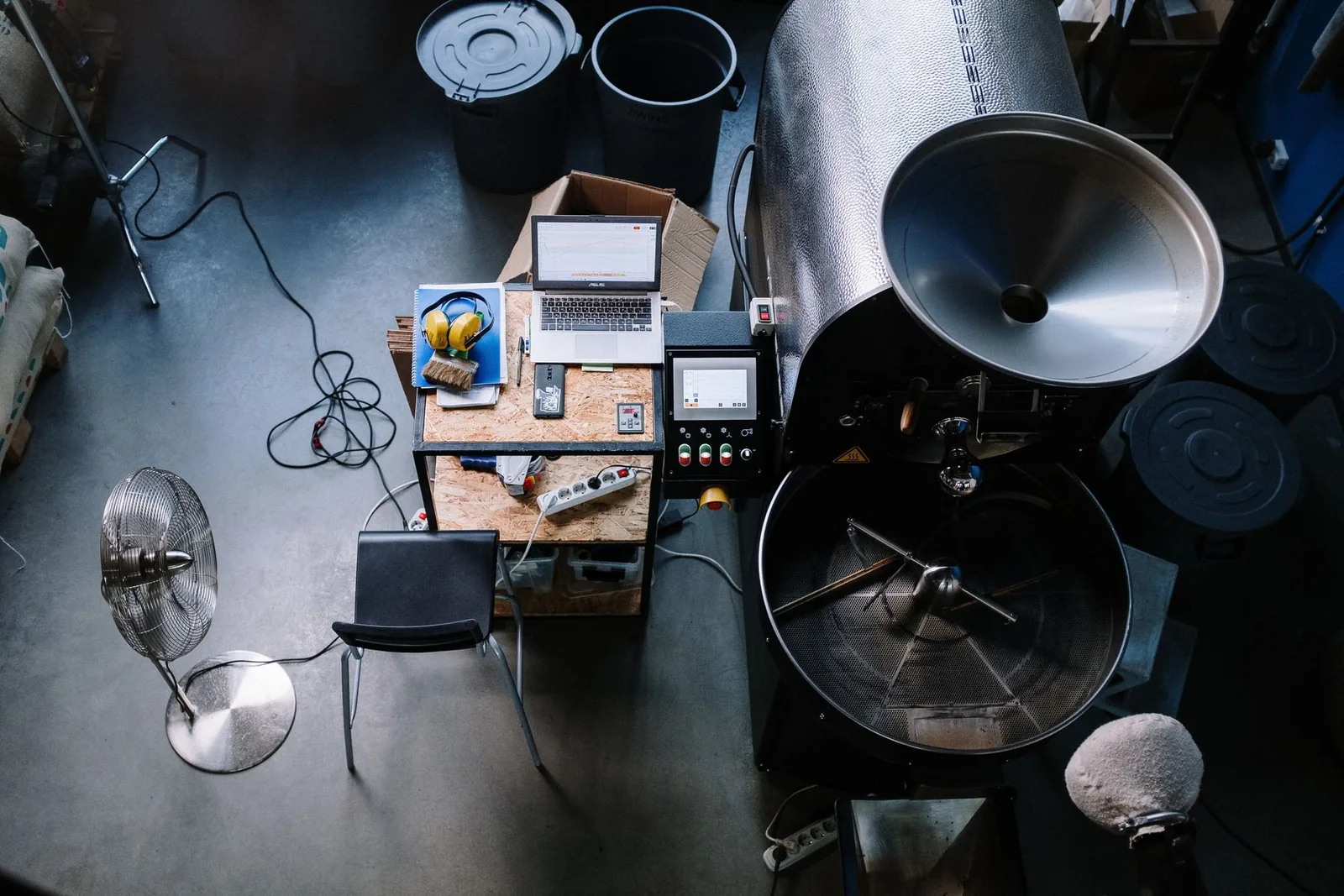
Of the roaster's three levers, airflow is the one about which the section on the profile says the most in a single sentence: it “carries the heat, removes steam, chaff and smoke and cools the bed when it is increased.” Four functions, two of which pull in opposite directions. This sheet takes them one by one, with what the published measurements allow us to quantify, and what they do not.
Plate VII, section 11.A circuit, and a fan at the end
In a drum roaster, the air is not blown: it is drawn. A fan placed at the end of the circuit creates a negative pressure, a pressure slightly lower than that of the room, and outside air enters wherever it can: under the burner, where it mixes with the flame gases, then through the drum and the layer of coffee, into the exhaust duct, the cyclone, and finally the stack. This is what is called the draft. It is set in two ways: with a damper, a flap that pivots in the duct and narrows the passage, or by changing the fan speed. One probe reads the air entering the drum, another the bed of beans, others the air leaving and the duct further along (section 10).
In direct heating, the same air does everything: it enters hot, passes through the coffee and leaves loaded. In indirect heating, a separate combustion chamber heats the air, which is then sent through a solid cylinder; in the fluidized bed, the air is strong enough to lift the beans; in recirculation, the air leaving is cleared of its smoke, reheated and sent back to the drum instead of being discarded (section 08). This sheet is about the drum, where air is one lever among three.
Plate VII, sections 08 and 10.A slow air, which does not carry the bean
A rare measurement gives the order of magnitude. On the small drum roaster studied in Birmingham, an Aillio Bullet with a 16 cm drum, the air left the empty machine at 0.6 to 1.6 meters per second depending on the fan setting, measured in an outlet 5 cm in diameter. At the setting chosen for the study, the one that limits smoke and chaff buildup in the chamber during a real roast, the air left at 1.4 m/s: that makes about 0.13 m/s in the 16 cm chamber, and about 0.22 m/s once the air is heated to 220 °C, because hot air, being less dense, occupies more volume.
That is very little. To make coffee spout in a spouted bed, the variant of the fluidized bed that lifts only a column of beans, 4 to 10 m/s is needed; simulations of heat transfer around a motionless bean use 2 m/s. In a drum, the air therefore does not carry the bean: rotation and paddles move it, the air flows around. The authors conclude that the air in their drum has no effect on the movement of the coffee. In a fluidized bed, by contrast, the air does everything: convection heats the coffee almost alone, and fan energy climbs fast when the ratio of air to bean exceeds 10 (section 08).
Al-Shemmeri et al. 2023, § 2.3; Al-Shemmeri et al. 2021; Alonso-Torres et al. 2013, cited by them; plate VII, section 08.Carrying the heat
Hot air heats the bean by convection. Its share, against conduction through the wall, has a famous figure: Scott Rao writes that conventional drums roast 70% by convection and 30% by conduction. Section 08 showed where this number comes from, an estimate that a representative of a German manufacturer gave him in conversation, without measurement. Rao himself adds that conduction weighs more during the first minutes, when the cold coffee touches the hot metal, before convection takes over again. Morten Münchow goes the same way: even when the flame licks the drum, the air brings the larger share.
The Birmingham study gives the mechanical reason for this split. The bean in flight, surrounded by air, receives its heat by convection; the bean buried in the bed receives very little through the air, and heats through the wall and its neighbors. The more time the coffee spends in flight, the more convection counts. Airflow and mixing therefore answer each other: abundant hot air is useful only to the beans that pass through it, and it is drum speed that decides how many do (see the sheet on mixing).
Increasing the flow means passing more air over the coffee, and so bringing more heat, provided that air is hot. If the burner does not keep up, the extra air drawn through the drum cools the bed instead of heating it: section 11 says so, and Steven Abbott's calculation app sums up the same effect, beyond the normal setting the extra air brings in cold air.
Plate VII, sections 08 and 11 (Rao 2014, p. 19; Münchow, Roasting Foundation, p. 31); Al-Shemmeri et al. 2023, § 3.4.1; Abbott, Coffee Drum Roasting.Carrying off the water, then the smoke
Green coffee contains 7 to 11% water (section 06), and water vapor makes up about 70% of the gases it emits at the start of the roast (section 05). This vapor must leave: it is the air's first job. The reaction gases, for their part, stay weak for about 80% of the roast, then rise abruptly: CO₂, volatile organic compounds, and at the end of the roast carbon monoxide (sections 05 and 10). The air must then carry away much more of them, and faster.
Published practices follow this chronology. In the study by Catão and colleagues, which varies the settings of a professional roaster over 38 profiles, the damper opening follows a ramp during the roast, from 25 to 50 then 100%, or from 25 to 75 then 100%. In the plant studied by Ivan Dimchev, the fan is pushed to the maximum during first crack and slowed in the other phases. These are two examples, not a rule: neither study compares these strategies in the cup.
Plate VII, sections 05, 06 and 10; Catão et al. 2022; Dimchev 2026.The chaff and the cyclone
At yellowing, the bean swells and sheds its silverskin, the very thin skin that covered it (section 06). It leaves with the air, and that is intended: left in the drum, it would burn. The air carries it to the cyclone, a cylinder extended by a cone where the air enters from the side and starts to spin. The chaff, heavier than air, is thrown against the wall, loses its speed and falls into a bin at the foot of the cone, while the air leaves through the top, at the center. It is extremely flammable, and section 10 quotes the saying of the trade: a roaster who does not clean his cyclone will eventually have a fire.
Yet the air must go fast enough to carry the chaff that far. In the roasting plant studied by Dimchev in 2026, the air moved in the duct at 12.3 m/s: the chaff no longer followed, settled in the ducts, increased the pressure drop, that is, the resistance the circuit offers to the air, and the fire risk. At 19.3 m/s, or 5,583 m³ per hour in this installation, it kept moving. These figures hold for that duct, not for all of them; they show that there is a floor speed below which the air no longer cleans.
Plate VII, sections 06 and 10; Dimchev 2026 (abstract).What the air costs
All the air drawn through the drum leaves hot. In a direct-heat drum, about 75% of the heat goes up the stack, and consumption ranges from 1,245 to 4,060 kJ per kilo of green coffee depending on how the smoke is treated (section 08). Recirculation, which sends the air back to the drum after burning the smoke, exists precisely to keep this heat. And the smoke at the end of the roast must be treated before the stack: thermal afterburning at 760 °C at least, catalytic from 400 °C, or an electrostatic precipitator, which burns nothing and retains the particles (section 10).
The fan also costs electricity. In the plant studied by Dimchev, going from damper control, which brakes the air with a flap while the motor runs at full speed, to control by fan speed, with a variable-speed drive, cut the fan's energy by 51%, about 3,713 kWh per year. The damper wastes energy because it forces the fan to push against an obstacle.
Plate VII, sections 08 and 10; Dimchev 2026 (abstract).What is not known
On taste, the evidence is lacking. Practitioners' accounts abound: more air would give cleaner cups, less air more body. The research done for this sheet found no published study that isolates airflow in a drum and measures its effect on aromas and on the cup. The study by Catão and colleagues, which varies the damper opening among other settings, finds that the time elapsed after the crack weighs most on the aromas and on the score. Airflow remains a lever whose physics is clear, the heat, the water, the chaff, the smoke, and whose effect in the cup remains to be measured.
Catão et al. 2022.The sources for this sheet
- Al-Shemmeri M., Windows-Yule K., Lopez-Quiroga E., Fryer P. J., “Coffee bean particle motion in a rotating drum measured using Positron Emission Particle Tracking (PEPT)”, Food Research International, vol. 163, 2023, article 112253, doi:10.1016/j.foodres.2022.112253, CC BY license.
- Al-Shemmeri M., Windows-Yule K., Lopez-Quiroga E., Fryer P. J., “Coffee bean particle motion in a spouted bed measured using Positron Emission Particle Tracking (PEPT)”, Journal of Food Engineering, vol. 311, 2021, article 110709, doi:10.1016/j.jfoodeng.2021.110709.
- Alonso-Torres B. et al., 2013, numerical simulation of heat transfer around the bean; cited by Al-Shemmeri et al. 2023.
- Dimchev I., “Energy and airflow optimization in an industrial roasting system: a case study”, E3S Web of Conferences, vol. 727, 2026, article 01003, doi:10.1051/e3sconf/202672701003 (abstract and introduction).
- Catão A. A., Mateus N. de S., Garcia C. da C., da Silva M. C., Novaes F. J. M., Alves S., Marriott P. J., da Silva A. I., “Coffee-roasting variables associated with volatile organic profiles and sensory evaluation using multivariate analysis”, Applied Food Research, vol. 2, no. 2, 2022, article 100223, doi:10.1016/j.afres.2022.100223 (abstract).
- Abbott S., “Coffee Drum Roasting”, online app from the Practical Mechanical collection, stevenabbott.co.uk, accessed October 21, 2026.
- PXL Roasters, plate VII, sections 05, 06, 08, 10 and 11, and the sources they cite, including Scott Rao, The Coffee Roaster's Companion, 2014, Morten Münchow, Roasting Foundation, CoffeeMind, Schwartzberg, Batch coffee roasting, and Vosloo 2017.
In this plateThe 20 sections
- 01What roasting does, and what it does not do
- 02From the brazier to the cylinder, 1200-1800
- 03Industrialization, 1824-1864
- 04Gas, the sphere and “fast roasting,” 1868-1922
- 05The physics: how heat enters the bean
- 06Five stages, two cracks
- 07The chemistry, stage by stage
- 08The technologies, one by one
- 09The manufacturers, one by one
- 10The tools
- 11The profile: charge, time, rate of rise, development time ratio, drop
- 12Colors and scales
- 13Roast defects
- 14Degassing, resting, freshness
- 15Espresso, filter, decaf
- 16Industrial versus artisanal: time, energy, emissions
- 17Roasting at origin
- 18Today
- 19Archive plates
The table of contents, with the first sentence of each section