From brazier to cylinder, 1200-1800
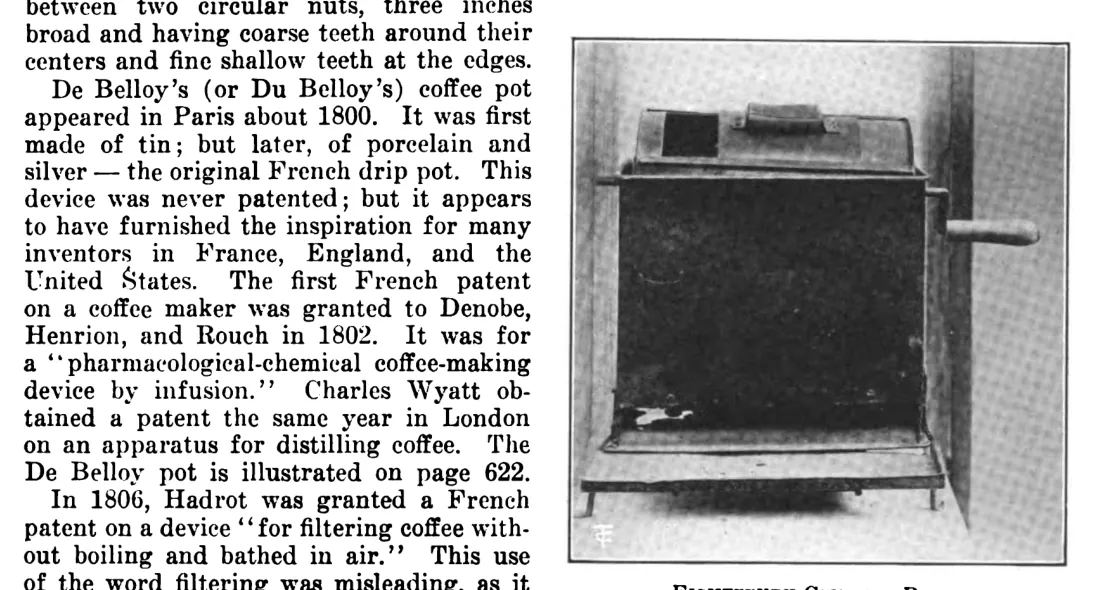
According to Ukers's reconstruction, the first dried seeds and husks were roasted between 1200 and 1300 in dishes of baked clay or stone, over an open fire. There is as yet no machine: the vessel only holds the beans above the fire.
- 1400-1500Turkey and Persia place circular plates of clay or metal on footed braziers. They measure 10 to 15 cm in diameter, are slightly concave and pierced with small holes like a skimmer. Only a few beans are roasted at a time.
- 1500-1600Baghdad and the Arabs of Mesopotamia use shallow iron pans with a handle of about 85 cm, with a spatula to turn the beans.
- Around 1600Comes the iron “spider” on legs, set in the hearth.
- Around 1650The small individual cylinder of tinplate or tinned copper appears, inspired by the Turkish pocket mill and turned over the embers. Ukers sees in it the ancestor of all commercial cylinders: the bean is enclosed and stirred, instead of being moved about in the open in a pan.
Knowing how to use these tools is another matter. Bernier, at the same period, finds among the thousand cafés of Cairo only two people who really know how to roast.
Ukers 1922, ch. XXXIV, p. 615-618In England, around 1660, the Elford machine, of tinned sheet iron “turned on a spit by a turnspit,” enlarges the cylinder for use by households and shops. The gesture does not change, only the quantity increases.
Around 1670 the Dutch combine the long handle of Baghdad with the closed cylinder. The result is a sheet-iron tube 12 cm in diameter and 15 to 20 cm long, mounted on an iron rod one meter long. It is loaded through a sliding door and set in the hook of the fireplace crane. The model is domestic, and it remains in favor in Holland, France, England and the United States until the middle of the 19th century.
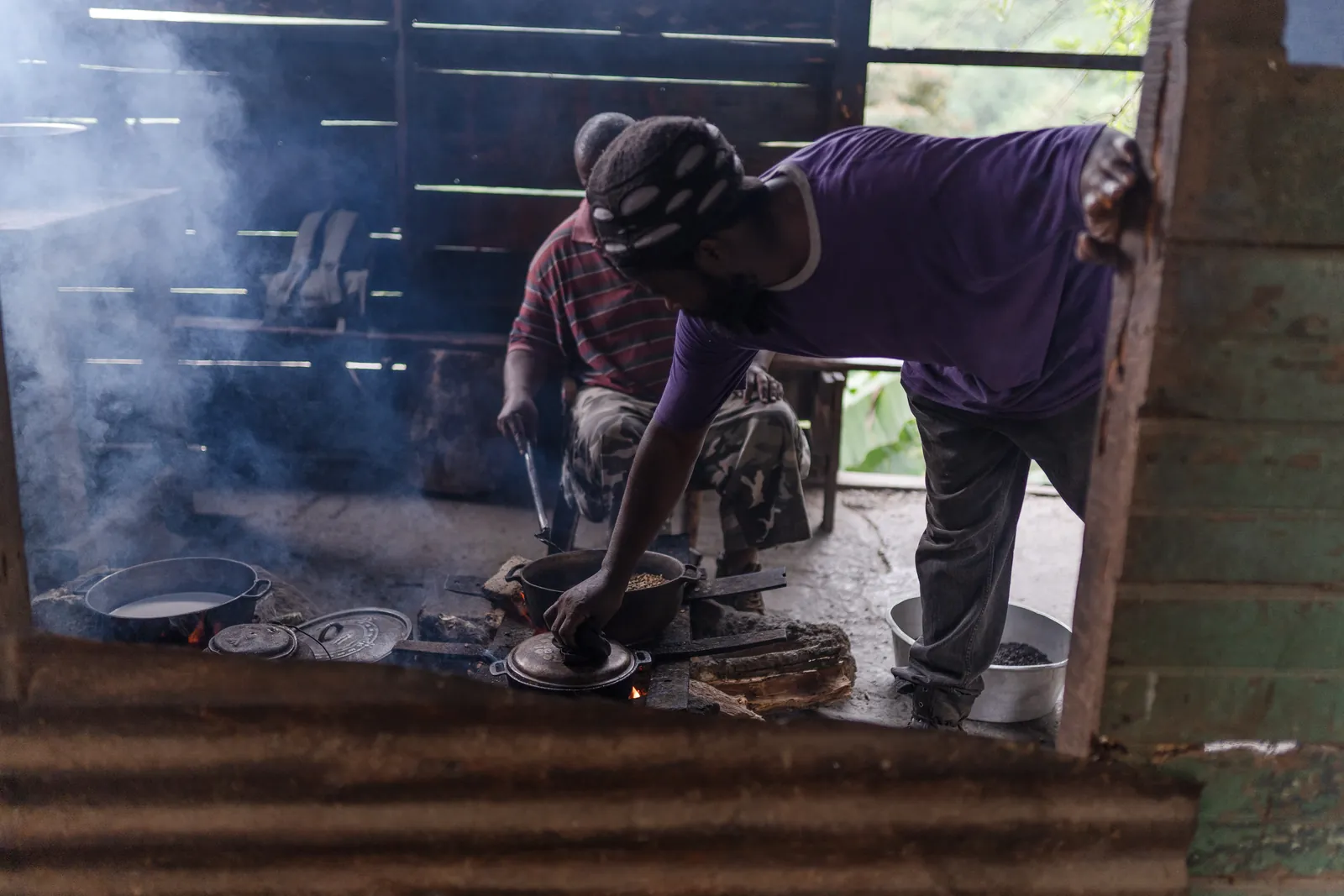
Dufour, in 1685, roasts two or three pounds at most at a time, “for the less there is, the better it is roasted.” He works over live coals without flame, stirring without pause with an iron spoon to a tan color. And he keeps a pinch as a witness of the successful batch to compare the color of the grind: it is the first sample-based quality control.
Broadbent, in London in 1722, recommends a perforated iron vessel turning on a spit, then spreading the coffee immediately on a plate to dissipate the heat. He also advises roasting at home, so as not to be deceived about the goods.
The fuel, for its part, changes. In 1704, the Bull machine, patented in England, probably marks the first use of coal for roasting on a commercial scale. In the 18th century small cast-iron coke stoves carrying a horizontal cylinder appear. And around 1812 the Italians still roast in stoppered glass flasks, shaken over the embers: the old and the new coexist for a long time.
Ukers 1922, ch. XXXIV, p. 618-624; Dufour 1685, p. 46-49 (Dufour-La Roque digest); LC ch. 7In this plateThe 19 sections
- 01What roasting does, and what it does not do
- 02From the brazier to the cylinder, 1200-1800
- 03Industrialization, 1824-1864
- 04Gas, the sphere and “fast roasting,” 1868-1922
- 05The physics: how heat enters the bean
- 06Five stages, two cracks
- 07The chemistry, stage by stage
- 08The technologies, one by one
- 09The manufacturers, one by one
- 10The tools
- 11The profile: charge, time, rate of rise, development time ratio, drop
- 12Colors and scales
- 13Roast defects
- 14Degassing, resting, freshness
- 15Espresso, filter, decaf
- 16Industrial versus artisanal: time, energy, emissions
- 17Roasting at origin
- 18Today
- 19Archive plates
The table of contents, with the first sentence of each section