Today
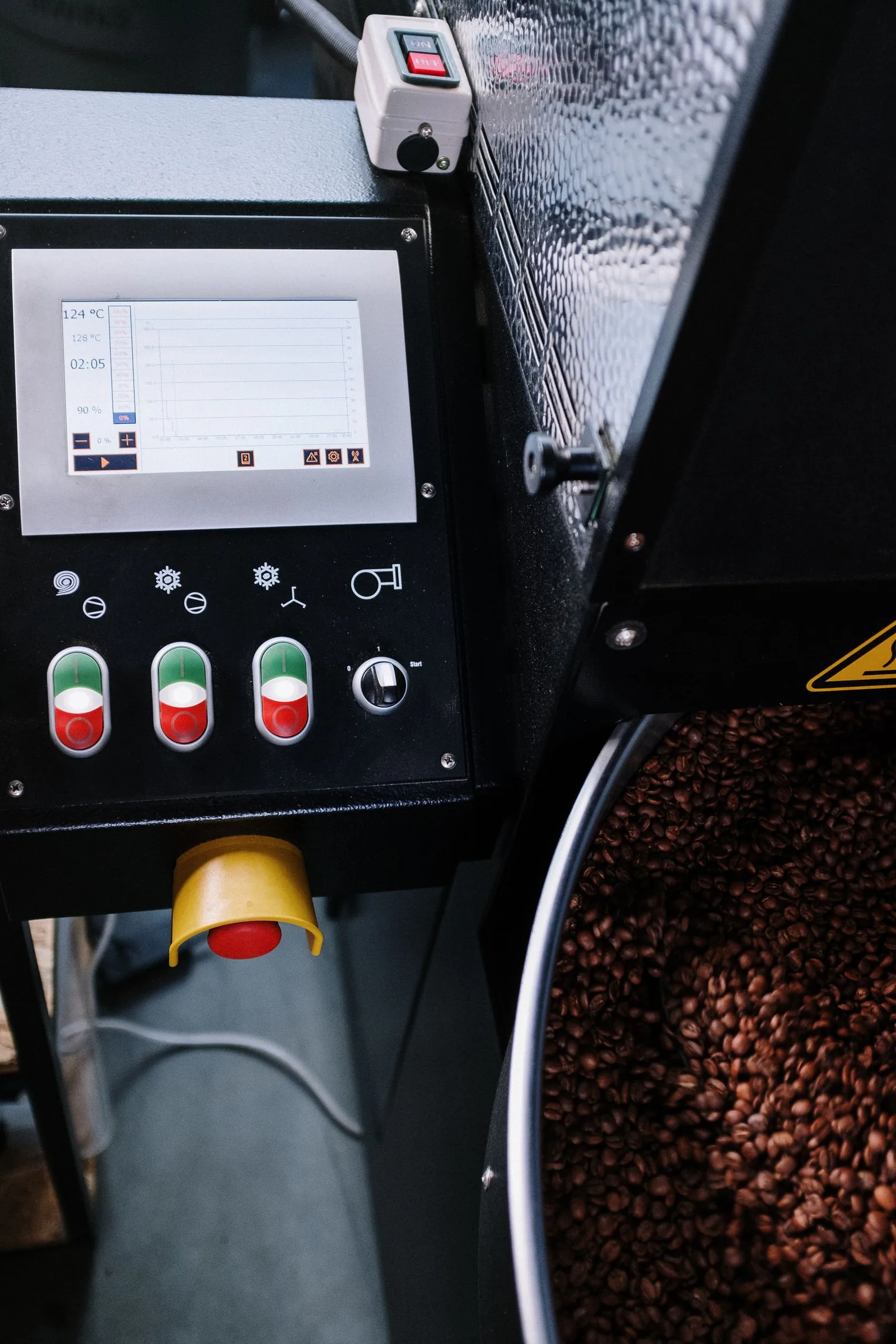
The dominant fact of these last three years fits in one word: electrification.
The Daily Coffee News tally gives the measure of the movement: eight commercial electric machines launched in 2024 alone, from 1 to 15 kg.
The paper cites the Typhoon 10 kg, the Gemma Induction from 2 to 120 kg, the Coffee Crafters Valenta 3 and 15. Then the Diedrich DR3-E, the Bellwether Shop Roaster, the Aillio R2 and R2 Pro, the Roastino.
The list of names counts as much as the number. Diedrich heated its drums with gas, by infrared burners; the DR3-E takes the Idaho house to all-electric. In other words, electric has ceased to be the preserve of newcomers.
The capacities say whom these machines are for. Except the Gemma, none exceeds 15 kg, the upper limit of almost all electric. With no flame or gas connection, a machine can be installed where the coffee is sold. This is what the paper calls a “paradigm shift.”
A year does not make a trend. The next two each add their batch of announcements, and that is what separates a movement from a fad.
- May 2025Stronghold releases the S8X, Ikawa the Pro50X
- July 2025Giesen overhauls its ranges
- April 2026Stronghold S2
- May 2026Ikawa Go
- August 2026Aillio showroom in El Salvador
Two things can be read in this sequence. The same houses come back from one year to the next, which looks like a range being maintained rather than a trial run. And Aillio's showroom opens in El Salvador, that is, in a producing country and not a consuming one.
Probat, which bought A.C. Horn and Royal Duyvis Wiener in 2024 then unified its brands in 2025, sells three electrics and is experimenting with hydrogen.
On the software side, Cropster and Artisan share profiling, and automatically tracked profiles descend to the shop and to the home. What was a craft becomes a setting you download.
How much does this market weigh? Here, caution.
Market research firms value it between 0.5 and 2.6 billion dollars. The gap comes from the perimeter, that is, from what each decides to call a roaster, and not from a disagreement on sales.
IMARC announces 516.5 million for 2025, with growth of 3.8% a year. The firm gives Europe and industrial as dominant, and hot air as the first segment. Market Research Future, for its part, announces 2.58 billion for 2024.
A gap of one to five authorizes no figure. Better to say so than to choose one.
What remains is what frames the trade, upstream and downstream. Upstream, the volume to roast: world consumption reaches 177 million bags in 2023/24 according to the ICO, 30% of it in Europe.
Downstream, regulation, and it is Europe again that sets it. The acrylamide regulation and the 2017 furan opinion frame roasting, because these two compounds are born of the very reactions that make aroma.
Smoke, for its part, is changing treatment: the electrostatic precipitator is gaining ground on the afterburner (STiR, August 2025). One captures the particles instead of burning them, and burning costs gas.
A blind spot remains, and it is considerable. Research always stops at the green bean. The 2026 review “From germplasm to cup” contains no section on roast profiles. And Vosloo was already calling in 2017 for real-time measurement of the roast degree: it still does not exist.
Daily Coffee News, 12/30/2024, 05/28/2025, 05/08/2025, 07/09/2025, 05/12/2026, 04/30/2026, 08/12/2026, 03/14/2024; Probat, history page 2024-2025; IMARC, Coffee roaster market (2025 edition); Market Research Future, Coffee roaster market (accessed 09/07/2026); ICO, Coffee market report, December 2024; STiR, 08/25/2025; Yang et al. 2026; Vosloo 2017, § 6.2, p. 134; Vosloo 2017, § 5.1.1, table 5.2, p. 106; Wilson 2014, Journal of the Acoustical Society of America 135(6), p. EL265; Henry Schwartzberg, Roasting Chemistry and Profile Roasting, slideshow, Sweet Maria's Coffee Library, after Schenker, ETH thesis no. 13620, 2000; survey of plate 06In this plateThe 19 sections
- 01What roasting does, and what it does not do
- 02From the brazier to the cylinder, 1200-1800
- 03Industrialization, 1824-1864
- 04Gas, the sphere and “fast roasting,” 1868-1922
- 05The physics: how heat enters the bean
- 06Five stages, two cracks
- 07The chemistry, stage by stage
- 08The technologies, one by one
- 09The manufacturers, one by one
- 10The tools
- 11The profile: charge, time, rate of rise, development time ratio, drop
- 12Colors and scales
- 13Roast defects
- 14Degassing, resting, freshness
- 15Espresso, filter, decaf
- 16Industrial versus artisanal: time, energy, emissions
- 17Roasting at origin
- 18Today
- 19Archive plates
The table of contents, with the first sentence of each section