Five stages, two cracks
What becomes of the bean during roasting?
Start the scene or choose a stage. The animation simplifies the mechanism; what follows gives the details and the available references.
Green coffee contains 7 to 11% water, and it absorbs a large quantity of energy before evaporation begins. Nothing browns as long as the water is there. Insufficient drying cannot be made up: the outside cooks, the inside stays raw, and the cup is bitter and sour at once.
Read the stages without animation
- Drying: water firstGreen coffee contains 7 to 11% water, and it absorbs a large quantity of energy before evaporation begins. Nothing browns as long as the water is there. Insufficient drying cannot be made up: the outside cooks, the inside stays raw, and the cup is bitter and sour at once.
- Yellowing: smell of breadAround 160 °C on the probe, from 150 to 175 °C depending on sources and machines, chlorophyll degrades, sugars break into acids, and the bean smells of bread. It swells and sheds its silverskin, the chaff, a very thin skin that must be evacuated with the airflow to avoid fire.
- First crackAround 200 °C on the probe on most drums, from 175 to 207 °C depending on the probe, its place in the bed and the machine, the accumulated CO2 and steam burst the bean with a snap. The crack begins slowly, speeds up and lasts up to two minutes. From then on the roaster can stop at any moment; if they do not supply enough energy, the bean stops roasting and “bakes.”
- DevelopingThe time between first crack and the exit sets the degree. At constant heat, the rise in temperature visibly slows. Acids degrade quickly and bitterness climbs.
- Second crackAround 225 °C on the probe, from 200 to 232 °C depending on machines, comes a drier and more discreet cracking, and the oils rise to the surface. Acidity has disappeared: what remains is body, bitterness and a generic roast taste, in which the origin is no longer recognizable.
To remember: The five stages are a simplification: water leaves throughout the roast, and the temperature read at each crack depends on the probe that measures it, its thickness, its place in the bed and the charge of the drum.
In history: In 2007 and then in 2009, Cropster and Artisan made it possible to record the profile of each batch.
Read the full article and its sources ↓- 1400-1500Perforated plates on a brazier, Turkey and Persia
- c. 1650Individual tinplate cylinder, Cairo and Europe
- 1704Bull, England: first patented coal-fired roaster
- 1824Evans, England: vaned cylinder, probe, turning over
- 1846Carter, Boston: the “pull-out”
- 1864Burns, New York: unloading without removing from the fire
- 1868-1870Emmerich (future Probat); spherical roaster
- 1877-1888Gas: Roure, Faulder, Tupholme, Henneman
- 1889-1894Otto, Dresden: continuous spiral in 3 min 30
- 1906-1911Electricity demonstrated (Moegling), patented (Talbutt)
- 1969Probat Jupiter, first industrial tangential
- 1974-1976Sivetz, Corvallis: fluidized bed, US patent 3,964,175
- 1998-2003Loring: single burner and recirculation
- 2007-2009Cropster, Artisan: the recorded profile
- 2015-2016Aillio Bullet (induction), Stronghold S7 (electric)
- 2022-2024Probat P05 E/P12 E, Diedrich DR3-E, Bellwether: electric wave
The stages are a teaching simplification. Water loss, for example, does not stop at drying: it lasts the whole roast.
- DryingThe green bean, which contains 7 to 11% water, absorbs a large amount of energy before evaporation begins. Nothing browns as long as the water is there. And insufficient drying cannot be made up for later: the outside cooks, the inside stays raw, the cup is bitter and acidic at once.
- YellowingAround 160 °C on the probe, from 150 to 175 °C depending on sources and machines, chlorophyll degrades, sugars break into acids, the bean smells of bread. It swells and sheds its silverskin (chaff), which must be evacuated by the airflow to avoid fire.
- First crackAt about 200 °C probe temperature on most drums, from 175 to 207 °C depending on the probe, its place in the bed and the machine, the accumulated CO2 and steam make the bean burst with a snap. It starts slowly, speeds up and lasts up to two minutes, the shorter the higher the temperature. From there the roaster can stop at any time, and at constant heat the rise in temperature visibly slows. If not enough energy is supplied, the bean stops roasting and “bakes.”
- DevelopmentThe time between first crack and the exit sets the degree. Acids degrade quickly, bitterness climbs.
- Second crackAround 225 °C on the probe, from 200 to 232 °C depending on machines, a drier and more discreet cracking, and the oils rise to the surface. Acidity has disappeared. What remains is body, bitterness and a generic roast taste, in which the origin is no longer recognizable.
Four disagreements on how the roast unfolds
The landmarks that the section has just laid down are those of one machine and one school. Confronted with three professional manuals, four of them no longer stand alone: they stand beside other, equally defensible versions. Here they are with both faces, without arbitration, because no source supplies the measurement that would settle it.
At what temperature the bean cracks
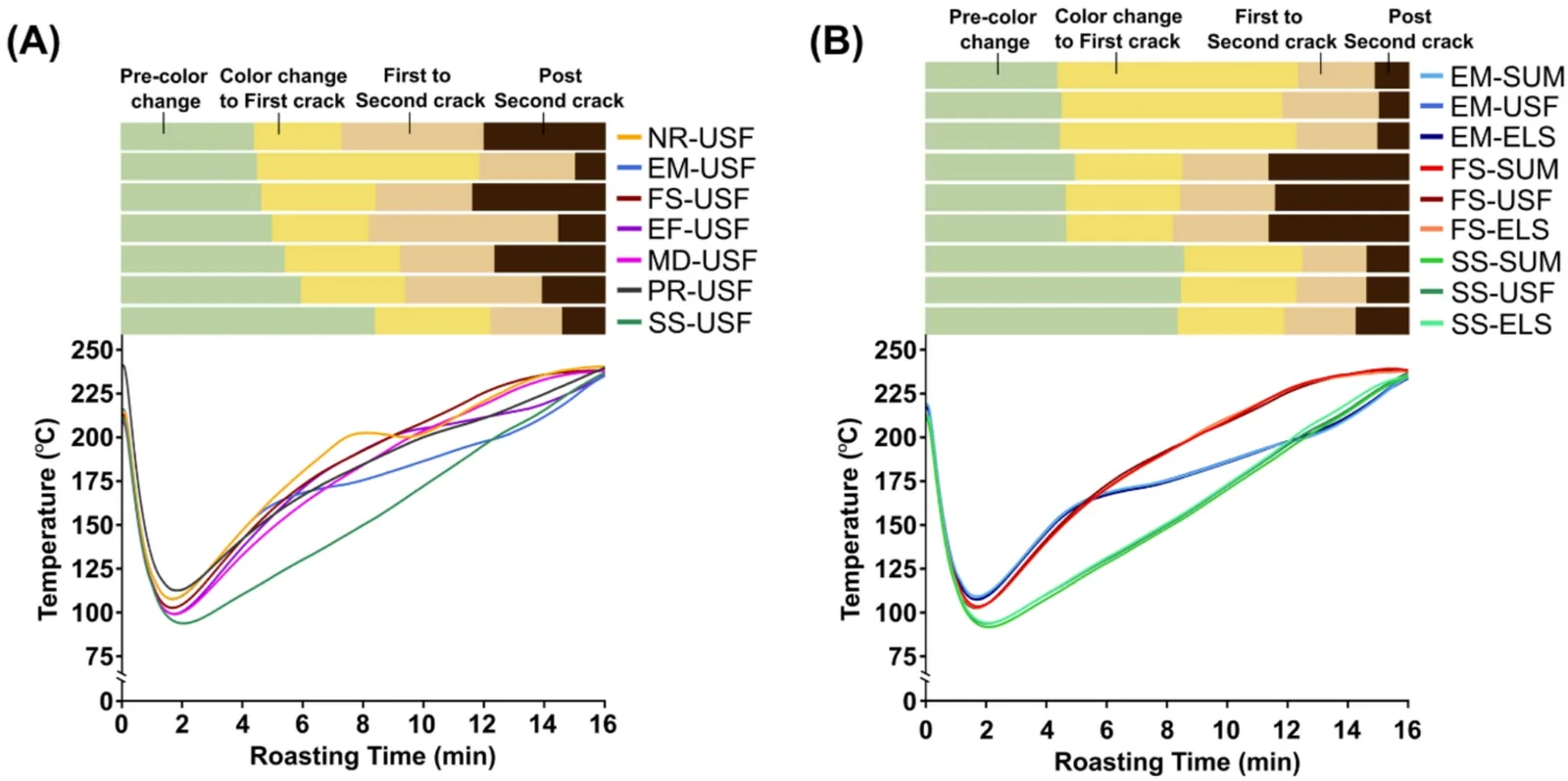
The plate put forward 175 to 185 °C probe temperature for first crack and more than 200 °C for second, the values that Vosloo measures on his Genio 6 and that Gloess gives for his 1 kg Probatino; it now takes about 200 °C for the first and about 225 °C for the second, the medians of the published readings. Münchow, in his worked example, takes a first crack at 190 °C and a second at 210 °C. Davids places the first below 400 °F, that is 205 °C, and the second between 435 and 445 °F, that is 225 to 230 °C. Wilson, who studies the sound of the cracks, writes that the first occurs at about 200 °C inside the bean and the second at about 230 °C. Taken across nineteen sources, manuals, articles and online roasters, the first-crack readings have a median of 200 °C and a mean of 197 °C, from 175 to 207 °C; across ten sources, those of the second have a median of about 226 °C, from 200 to 232 °C. Sweet Maria's reads first crack at 402 to 405 °F, 206 to 207 °C, on its Probat L-12; roasters on Home-Barista read it at about 395 °F, 202 °C, on a Diedrich, and at about 200 °C on a Quest. Thirty degrees of spread on first crack, twenty-five on second: this is no longer an imprecision, it is a disagreement.
The reconciliation is in Münchow himself, and it is unpleasant. The displayed value depends on the probe and its position: the different places in the drum are not at the same temperature, and the length as well as the diameter of the probe change both the value read and the speed at which it moves, a short probe possibly being cooled by the frame to which it is fixed.
The three figures can therefore all be exact, each on its own machine. But one must then give up writing a first-crack temperature without specifying the instrument, and the plate now accepts this: it gives a reference value, about 200 °C probe temperature, with the range of published readings and the reason for the gap. What would settle it does not exist: it would take one and the same batch listened to by a single ear and read at the same instant by several probes of different geometries, and nobody has published that at the moment of the crack. Rob Hoos came close in 2017: three probes of 1.6, 3.2 and 6.4 mm plunged into the same batch do not read the same curve; the thinnest reaches its low point in 47 seconds, the thicker ones clearly later, and the largest still shows ten degrees Fahrenheit more than the others after nearly ten minutes of cooling. The thickness of the sheath, the position of the probe, the mass of beans and the air passing through it make the reading, he writes; he does not publish the temperature each one reads at the crack.
What makes the bean burst
The plate explains that carbon dioxide stays trapped under pressure and that the bean bursts when this pressure exceeds the strength of the walls. Münchow attributes first crack mainly to the pressure of boiling water vapor, and reserves carbon dioxide for the second, which he says is caused by the roasting gases formed during the brown phase.
The difference is not academic, because it changes what a roaster believes he hears. If first crack is a steam event, its timing depends on the moisture of the green and the conduct of the drying, and it shifts when the lot changes. If it is a reaction-gas event, it depends on the progress of the browning reactions, and it shifts when the profile changes. The same sound, two opposite diagnoses. What would settle it is within reach of a laboratory, an analysis of the gases emitted at the moment of the crack, and no source cites one.
When does the bean start producing its own heat
A bean that is heating absorbs energy; at a certain moment, the reactions taking place in it release more than they consume, and it produces some. It is said to pass from endothermic to exothermic, literally from taking heat to giving it. The plate places this switch between 150 and 190 °C, at about 165 °C as the median value of four estimates: about 175 °C by Raemy's calorimetry, from 150 °C in Schwartzberg's model, 165 °C in differential calorimetry for Abdul Ghani, 140 to 190 °C in the estimates that Schenker reports. These are bean temperatures, measured outside the drum; they fall before first crack, which the probe reads at about 200 °C on most machines. Münchow places it after first crack: as long as the bean is wet it can only absorb, and it is only after the crack that the system has two heat sources, the burner and the bean itself, the second starting very slowly and then weighing more and more.
Rao places it much earlier, since he writes that the first two thirds or so of the roast are endothermic, and that according to his own third commandment first crack occurs at 75 or 80 percent of the total time. For him, the bean therefore starts producing its heat before cracking.
The consequence bears directly on the roaster's hand. Münchow recommends reducing the flame several times before first crack to anticipate the exotherm; if Rao is right, this anticipation should begin even earlier. Rao's index suggests, moreover, that he does not reason in terms of a single switch, since he indexes there separately an endothermic flash, that is, a brief episode in which the bean becomes an energy consumer again. What would settle it is a calorimetric measurement on a whole batch; the three sources agree in describing the switch and none puts a figure on it.
Does the drying phase exist
The plate writes that the stages are a teaching simplification and that water loss does not stop at drying. Münchow, on the contrary, teaches drying as a real phase, of a typical duration of nine minutes, and gives it a causal role: certain reactions crucial to aroma do not start until most of the water has evaporated. Rao titles two sections of his chapter eight the illusion of the S-curve and the myth of the drying phase.
We must say here what is missing. These pages of Rao were not read, only their titles noted from the table of contents: one can report that he puts the thing on the side of myth, not report his argument. And we must measure what the disagreement involves. Münchow is the one of the three authors who wrote the SCA's roasting certification program: the drying phase is therefore what is taught to the majority of certified roasters. The plate is on Rao's side, hence with the minority, and it should say so.
Morten Münchow, Roasting Foundation, CoffeeMind, p. 10 for the drying phase, p. 13 for the cause of first crack, p. 17 for the example at 190 and 210 °C, p. 21 for the effect of the probe, p. 33 for the exothermic transition; Scott Rao, The Coffee Roaster's Companion, 2014, p. 19 for the first two thirds endothermic, p. 29 (headings only, noted from the table of contents) for the myth of the drying phase, p. 32 for the endothermic flash, p. 48 for first crack at 75 or 80 percent of the time; Kenneth Davids, Book of Roast, p. 38, for the temperatures of the two cracks; Johandri Vosloo, Heat and mass transfer model for a coffee roasting process, MEng thesis, North-West University, 2017, § 3.2.1-3.2.2, p. 46-49, and § 5.1.1, table 5.2, p. 106; A.N. Gloess et al., International Journal of Mass Spectrometry 365-366, 2014, p. 324, table 1 p. 327, figure 5 p. 331; Preston S. Wilson, Coffee roasting acoustics, Journal of the Acoustical Society of America 135(6), 2014, p. EL265; Rob Hoos, Our World Through a Keyhole, Roast Magazine, September-October 2017, picked up by Daily Coffee News on 07/09/2019; Wikipedia, Coffee roasting, for 196 and 224 °C and for the exothermy at about 175 °C according to Raemy; Bustos-Vanegas et al., Frontiers in Food Science and Technology 5, 2025, after Schwartzberg 2002, for 150 °C; Barista Hustle, after Schenker 2000 and Abdul Ghani 2015, for 140 to 190 °C and 165 °C; Sweet Maria's Coffee Library (Probat L-12, glossary), Home-Barista, Coffee Parts, Bloomvik, Tasting Table, accessed 10/21/2026, for the roasters' readings.In this plateThe 19 sections
- 01What roasting does, and what it does not do
- 02From the brazier to the cylinder, 1200-1800
- 03Industrialization, 1824-1864
- 04Gas, the sphere and “fast roasting,” 1868-1922
- 05The physics: how heat enters the bean
- 06Five stages, two cracks
- 07The chemistry, stage by stage
- 08The technologies, one by one
- 09The manufacturers, one by one
- 10The tools
- 11The profile: charge, time, rate of rise, development time ratio, drop
- 12Colors and scales
- 13Roast defects
- 14Degassing, resting, freshness
- 15Espresso, filter, decaf
- 16Industrial versus artisanal: time, energy, emissions
- 17Roasting at origin
- 18Today
- 19Archive plates
The table of contents, with the first sentence of each section