The physics: how heat enters the bean
How does heat enter the bean?
Start the scene or choose a stage. The animation simplifies the mechanism; what follows gives the details and the available references.
In a drum, heat arrives by three paths at once. Conduction goes by contact, from the hot metal to the bean and from bean to bean. Convection comes from the hot air passing through the mass. Radiation comes from the wall and the flame. In a conventional drum, conduction and convection share the work; in a fluidized bed, convection does almost everything.
Read the stages without animation
- Three paths for heatIn a drum, heat arrives by three paths at once. Conduction goes by contact, from the hot metal to the bean and from bean to bean. Convection comes from the hot air passing through the mass. Radiation comes from the wall and the flame. In a conventional drum, conduction and convection share the work; in a fluidized bed, convection does almost everything.
- Surface first, core afterThe bean heats from its surface, and its core receives only what the surface passes on. The gap between the two, which Scott Rao calls DT, is the engine: heat goes down only a temperature slope, as water flows only downhill. Hence the approach he sums up: open the gap early, then close it up to the drop. A flash roast of under three minutes leaves a burnt surface on a raw center.
- The water leaves, and slows everythingWater vapor leaves first: about 70% of the gases emitted at the start. Turning this water into steam is costly, nearly 300 kJ to drive off the 11% moisture of a kilo of green. As long as this evaporation lasts, the bean absorbs energy: the process is said to be endothermic.
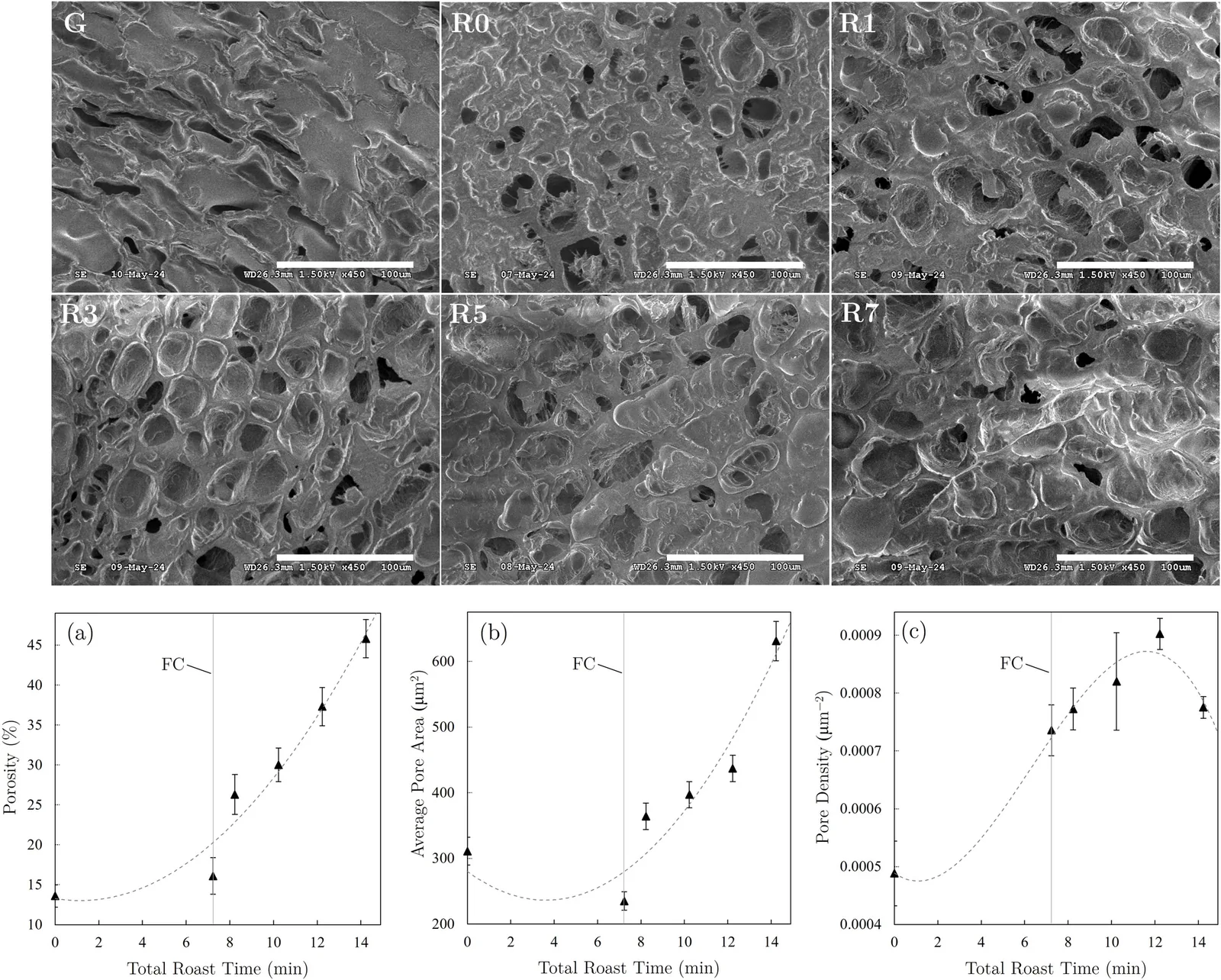
- The bean heats on its own and burstsAround 165 °C, between 150 and 190 °C depending on measurements, the reactions give off their own heat: the bean becomes exothermic, the rise partly happens on its own. The CO2 left trapped under pressure in the cells eventually exceeds the strength of the walls: this is first crack, which the probe reads around 200 °C on most machines, from 175 to 207 °C depending on the probe, its place in the bed and the charge. The bean then doubles in volume and loses half its density as it hollows with pores.
- What the bean has lostRoast loss adds up water, volatiles and dry matter: 10 to 13% in light, up to 22% in very dark. Final moisture falls from 2.8% to 1.4%. And the probe planted in the mass reads neither the surface nor the core, but the mix of beans and air around it.
To remember: Heat enters by the surface and progresses toward the core only as long as a gap exists: this is the only physical justification for a rate of rise that decreases.
In history: Thurber spoke of “thirty to sixty seconds” to decide at the end of the roast: exothermicity is the physical reason for it.
Read the full article and its sources ↓Three modes of transfer coexist. Conduction, by contact of the bean with the hot metal of the drum and from bean to bean; convection, by the hot air passing through the mass; radiation, from the wall and the flame. In a conventional rotary drum, conduction and convection share the work; in a fluidized bed, convection does almost everything. Schwartzberg models the bean with a dry-matter heat capacity of 1.099 + 0.007 T kJ per kg per degree, and a latent heat of water desorption of about 2,760 kJ/kg, 1.2 times that of free water: driving off the 11% moisture of a kilo of green alone costs nearly 300 kJ.
The process is first endothermic, the bean absorbs; between 150 and 190 °C, around 165 °C as a median value and before first crack, it becomes exothermic, the reactions release their own heat, the rise in temperature becomes partly self-sustaining and the decision window narrows: this is the physical reason for Thurber's “thirty to sixty seconds.” This threshold has no single value: Raemy's calorimetry puts it around 175 °C, Schwartzberg's model has the reaction heat start from 150 °C, and Schenker reports estimates of 140 to 190 °C. These are bean temperatures, measured outside the drum; the machine's probe, which reads the mixture of beans and air, does not display them as such.
Vosloo 2017, § 2.2.1-2.2.2, p. 15-19; Schwartzberg, Batch coffee roasting (UMass, undated PDF, 2010s), § Overall enthalpy balances; LC ch. 11; for the exothermic threshold: Wikipedia, Coffee roasting, after Raemy; Bustos-Vanegas et al., Frontiers in Food Science and Technology 5, 2025, after Schwartzberg 2002; Barista Hustle, after Schenker 2000 (accessed 10/21/2026)The mass transfers follow. It is water vapor first, about 70% of the gases emitted at the start, then CO2, whose proportion grows with the degree. The emission of reaction gases stays low for about 80% of the roast, then rises sharply.
Part of the CO2 does not escape: it stays trapped under pressure in the cells. When this pressure exceeds the strength of the walls, the bean bursts. This is first crack, and it is the moment when the bean doubles in volume and loses half its density through pore formation.
The total mass loss, the “roast loss,” adds up water, volatiles and dry matter. It ranges from 10-13% in a light roast to 14-16% in medium, 17-20% in dark, up to 22% in very dark. The final moisture, for its part, falls from 2.8% in light to 1.4% in very dark.
A word on the probe, because it is made to say more than it says. Planted in the mass, it measures neither the core nor the surface of the bean, but the bean-air mixture around it. The sharp dip at the start of the curve is only the cold bean meeting the hot drum.
Vosloo measured experimentally, on a Genio 6 whose thermocouple dips into the bean mass, a consistent first crack at about 175-180 °C probe temperature and a second at about 200 °C. He concludes that a rudimentary prediction of the degree is possible from the exit temperature. This holds only on his machine, because his reading is low: taken across nineteen sources, manuals, articles and online roasters, the first-crack readings have a median of 200 °C probe and range from 175 to 207 °C (plate 06). Gloess, on a 1 kg Probatino, hears it at 184 °C, and the whole scale comes down with it: a medium coffee comes out there between 186 and 196 °C, when Davids's table places medium brown between 215 and 225 °C. The probe, its thickness, its place in the bed of beans and the drum load together shift all the landmarks of a curve.
Vosloo 2017, § 2.2.1.1, p. 16-17; § 2.2.4, p. 22-23; tables 2.4 and 2.5, p. 25; abstract p. ii; § 6.1, p. 133; Schwartzberg, fig. 3; Vosloo 2017, § 3.2.1-3.2.2, p. 46-49, and § 5.1.1, table 5.2, p. 106; Gloess et al. 2014, International Journal of Mass Spectrometry 365-366, p. 324, table 1 p. 327, figure 5 p. 331; Kenneth Davids, Book of Roast, p. 38; survey of first-crack readings, plate 06The internal gradient, and what the rate of rise really commands
The plate has just explained where the heat comes in. What is missing is what it does once inside, and it is the biggest hole in this section, because this is where the only physical justification is at stake for the rule the whole trade recites: the rate of temperature rise must decline. It is repeated, it is plotted on screen, it is watched; why is rarely explained.
Heat moves only down a slope
A coffee bean heats from its surface. Its core receives nothing directly: it receives what the surface passes to it, step by step, through a material that conducts poorly. At every instant there is therefore a gap between the temperature of the surface and that of the center, and Scott Rao notes this gap DT, for delta temperature, delta being the Greek letter that physicists use to say a difference.
This gap is not a flaw, it is the engine. Heat flows only down a temperature slope, as water flows only down a slope of land, and the steeper the slope, the greater the flow. A wide gap means heat entering fast; a closing gap means heat that hardly enters any more. When the surface and the core are at the same temperature, however hot the drum the bean sits in, nothing progresses toward the inside any longer.
Hence the approach that Rao sums up in one sentence: establish a large gap early, then reduce it until it is minimal at the end. The start of the roast serves to dig the slope, the end serves to fill it, and the rate of rise is only the visible trace of this maneuver. A rate that declines steadily is a gap that closes steadily.
A rate that collapses is a gap that disappears too early and a core left behind. A rate that climbs back up is a gap reopened when the surface is already cooked, which amounts to making two different coffees in the same bean.
Two batches that all the figures declare identical
Rao builds on this his first commandment, apply enough energy at the beginning. His wording deserves to be cited in detail, because it contains a concession that is rarely quoted: one can, he says, start with too little heat and still roast the center of the bean correctly, but the roast must then be extended excessively, and it is taste that pays. A soft start is therefore not an absolute fault, it is a fault that is made up for in time, and time has its own cost.
His demonstration sets two deliberately twin batches against each other: same charge temperature, same exit temperature, same total duration. The only difference is that the bean temperature of the first rises faster during the first minutes. In that one, the energy poured in early dug a wide gap, and this gap gave the core the momentum needed to catch up with the surface before the drop.
In the other, the start was soft, and the energy added mid-roast arrived too late for the center to catch up with the surface. Two batches that all the numbers a roaster usually records declare identical, and of which one is developed and the other not.
We must say at once what this demonstration is not. The internal temperature curves that Rao draws are not readings: nobody has planted a probe in the core of a seven-millimeter bean during a batch. It is an illustrated line of reasoning, consistent with the physics of conduction, and nothing more. The distinction matters, because the rest of the trade cites it as if it were a measurement.
Time, in three reasons
Morten Münchow arrives at the same place by another route, and gives three reasons why duration matters and not only the temperature reached. First, the extent of a chemical reaction depends on the time spent at a temperature, not on the value of that temperature alone; this is why the correspondence between exit temperature and color obtained is specific to each profile and does not carry over from one machine to another.
Next, heat takes time to diffuse from the surface to the center, which sustains a gradient, that is, a continuous decrease of temperature as one goes deeper into the bean, as long as it is heating; this is exactly Rao's DT, seen from the side of diffusion rather than from the side of control. Finally, this gradient ends up showing in the color, light and fast roasts showing a more marked one than slow ones.
Münchow takes care not to make it a defect in principle and refers the question to the cupping table, which is honest. He does give a threshold that the plate did not have: a flash roast is a total roast of less than three minutes, in which the surface may be frankly over-roasted while the center stays raw. It is the extreme case that makes the reasoning visible to the naked eye.
Scott Rao, The Coffee Roaster's Companion, 2014, p. 19 and 20 for the internal gradient, p. 42 for the first commandment, p. 43 for the comparison of the two batches; Morten Münchow, Roasting Foundation, CoffeeMind, p. 27 for the three reasons of time and for the flash roast.In this plateThe 19 sections
- 01What roasting does, and what it does not do
- 02From the brazier to the cylinder, 1200-1800
- 03Industrialization, 1824-1864
- 04Gas, the sphere and “fast roasting,” 1868-1922
- 05The physics: how heat enters the bean
- 06Five stages, two cracks
- 07The chemistry, stage by stage
- 08The technologies, one by one
- 09The manufacturers, one by one
- 10The tools
- 11The profile: charge, time, rate of rise, development time ratio, drop
- 12Colors and scales
- 13Roast defects
- 14Degassing, resting, freshness
- 15Espresso, filter, decaf
- 16Industrial versus artisanal: time, energy, emissions
- 17Roasting at origin
- 18Today
- 19Archive plates
The table of contents, with the first sentence of each section