The grind: grinders, fines, retention
What does a grinder do to the bean?
Start the scene or choose a stage. The animation simplifies the mechanism; what follows gives the details and the available references.
In a flat-burr grinder, the bean enters at the center and centrifugal force pushes it between two discs, through three zones: crushing, cutting, finishing. It takes 500 to 1,800 revolutions per minute to deliver 1 to 80 g/s.
Read the stages without animation
- Three zones between two burrsIn a flat-burr grinder, the bean enters at the center and centrifugal force pushes it between two discs, through three zones: crushing, cutting, finishing. It takes 500 to 1,800 revolutions per minute to deliver 1 to 80 g/s.
- A peak, fines, bouldersWhat comes out is not a single size: a peak, the target size, for example 300 to 400 microns for an espresso on a Weber EG-1; a bump of fines, made of broken cells; sometimes boulders. Stacked sieves, laser diffraction or scanned images measure this particle size distribution, the spread of sizes.
- Fines are born of crushingFines come from crushing, not from cutting; each cut produces a few, hence a compromise between the number of cuts and the fines accepted. Misaligned burrs broaden the distribution; cold beans, more brittle, give more fines.
- Blades breakA blade grinder does not cut, it breaks: broad distribution, fines and boulders, size depending on running time. King was already patenting in 1917 a blend of 90% very fine and 10% coarse: a grind is an assortment of sizes.
- What stays in the grinderRetention, in the cracks, the hopper or the auger, mixes old coffee with fresh. Single-dose grinders, with magnet-mounted burrs and no hopper, aim at zero retention; weighing the input and output does not measure it.
To remember: A grind is an assortment of sizes: the grinder decides the peak, the fines and the boulders, and the coffee that stays in it mixes with the next.
In history: Connoisseurs long held the pestle superior to all mills: it crushes without heating.
Read the full article and its sources ↓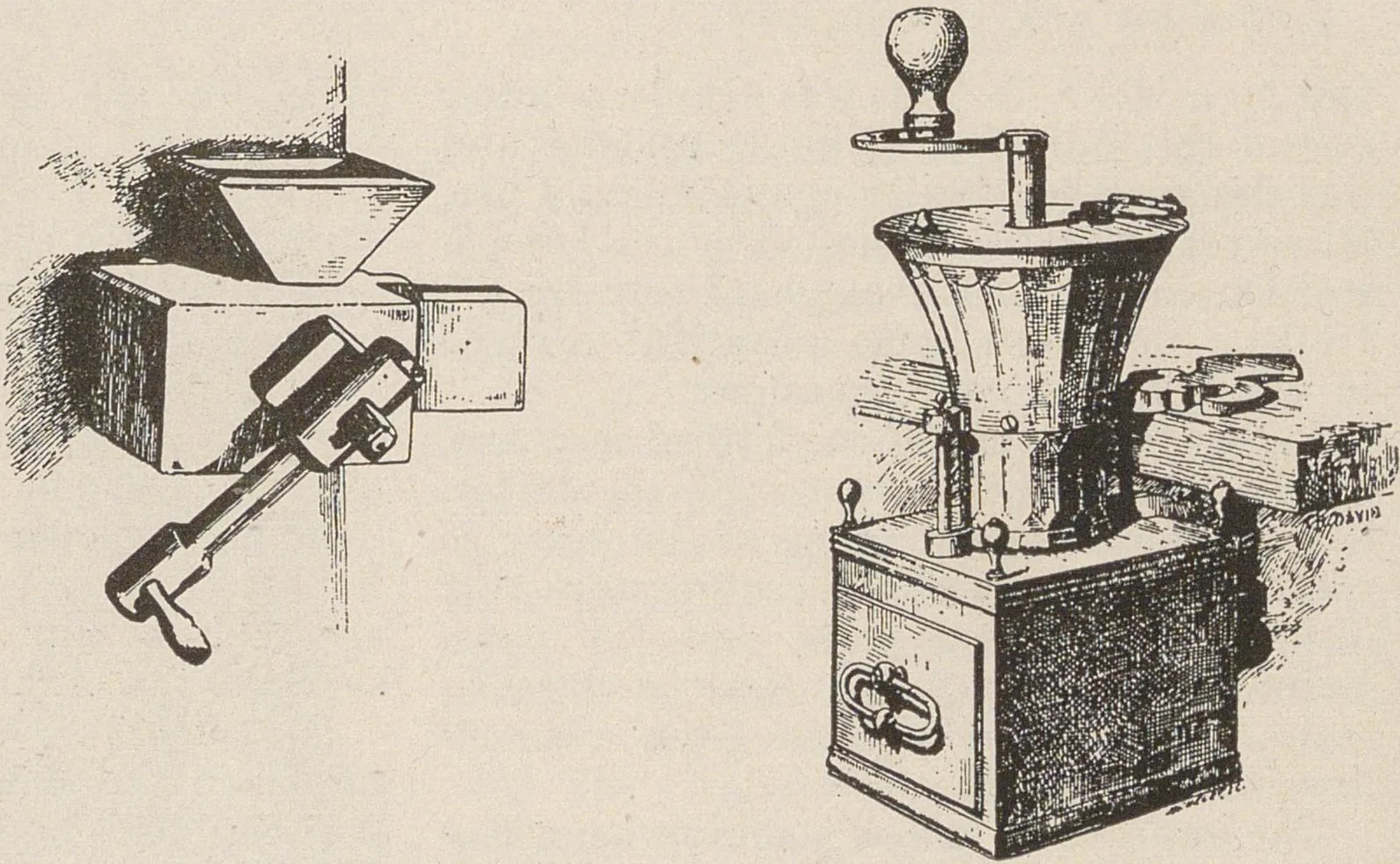
Before coffee can be prepared, it must be reduced to powder, and the history of that tool runs over centuries without ever really settling.
The first mill is a stone mortar. Then come the superimposed millstones, then the conical mill of the Greeks and Romans, whose principle Ukers remarks is exactly “that of the most modern metal mill.” Two thousand years later, we still grind the same way.
After that, the list of variants says mostly where coffee was drunk. It reads like a map: a mill appears where the drink caught on, and it takes the form that local use demands.
The Turkish pocket mill is a cylinder, small enough to be carried on one's person. The Damascus mill of 1665 is the earliest dated on the list.
In France, wall mills are so common in 1720 that they are found at every tinsmith's, those craftsmen who worked sheet metal and supplied the ordinary utensils of the household. In other words, the coffee mill is no longer a rare object: it is common hardware, bought around the corner.
And in 1765, Madame de Pompadour has hers in gold. A gold mill does not grind better than another. It only says that the object had risen as far as the court.
Then industry steps in: Bruff's American patent in 1798, Wilson's wall mill in 1818, Peugeot's pepper mill with a case-hardened steel mechanism in 1842, transposed to coffee, Herbert's first English patent in 1848, and finally the electric geared mills of 1900-1905, sold on credit to retailers.
And all that time, an amusing detail: connoisseurs held the pestle superior to all these mills. They were not entirely wrong, a pestle crushing without heating.
It remained to agree on fineness. In 1915, the American roasters' association defined its grinds by comparison with things everyone had in their kitchen: powder like flour, pulverized like cornmeal, fine like granulated sugar, medium like coarse sugar. It was approximate, but understandable by anyone, which no standard has managed since.
And already the intuition of particle size blends, that is, of the distribution of particle sizes within a single grind. King patented in 1917 a blend of 90% very fine and 10% coarse, “to retain the aroma.”
What matters here is not the recipe, it is what it assumes. A grind is not a single size: it is an assortment of sizes, and one may want to compose it rather than endure it. The idea is a century ahead of the curves we plot today.
Why 90 and 10 rather than other proportions, and why would the aroma be better retained that way? The formula does not say.
Ukers 1922, ch. XXXIV and ch. XXXVI, chronology (1665, 1765, 1798, 1818, 1848, 1900-1905); Wikipedia, Burr mill (Dearmann 1799, Wilson 1818, Peugeot 1842)A grinder is judged by its particle size distribution: a peak (target size, for example 300-400 microns for an espresso on a Weber EG-1, measured by laser diffraction), a bump of fines made of broken cells, sometimes chunks (boulders). Fines come from crushing, not from cutting; each cut produces a few, hence a compromise between the number of cuts and the fines accepted.
Conical burrs (fixed outer, moving inner, gravity) are cheaper, need little force, turn slowly and deliver 1 to 5 g/s: they suit hand grinders. Flat burrs (two discs, central feed, centrifugal force) need 500 to 1,800 rpm and deliver from 1 to 80 g/s, but large discs and strong motors are needed for a long cutting path; their three zones (crushing, cutting, finishing) build the distribution.
| Grinder | Mechanism | Speed | Flow | Advantages | Drawbacks |
|---|---|---|---|---|---|
| Conical burrs | cone in cone, gravity | slow | 1-5 g/s | little force, inexpensive, manual | low flow |
| Flat burrs | discs, centrifugal force | 500-1,800 rpm | 1-80 g/s | high throughput, 3 cutting zones | strong motor, alignment critical |
| Ghost (pegs) | crushing | variable | coarse | uniform peak (anecdotal) | many fines, no fine grinding |
| Blades | propeller that breaks | fast | low | price | fines and boulders, not repeatable |
| Single dose | no hopper, magnet-mounted burrs | same | same | minimal retention | price, one batch at a time |
Blades do not cut, they break: broad distribution, fines and boulders, size depending on running time. “Ghost” burrs with pegs, for very coarse, crush more. Gagné judges the conical versus flat question undecided for lack of systematic studies; burr alignment, often faulty even on expensive grinders, broadens the distribution and prevents grinding very fine.
Gagné 2021, pp. 45-58 (von Blittersdorff and Klatt 2017; Butterworth 2016; Rhinehart 2016)Four practical effects. Cold beans are more brittle and give more fines; Uman et al. (2016) deduced from this that grinding cold suited espresso, Gagné sees no advantage in it for filter but grinds frozen beans without loss of yield; heating them in the microwave gave nothing. Burrs wear: at the same setting, the yield slowly drops, a sign that they need to be sharpened or replaced. Retention (cracks, hopper, auger) mixes old coffee with fresh; single-dose grinders with magnet-mounted burrs and no hopper aim at zero retention, and weighing the input and output does not measure it, because retained beans are swapped for fresh ones. Finally sieving (Kruve, launched in 2015, stacked sets of sieves), the laser diffraction of laboratories and the analysis of scanned images (Gagné's app) measure the distribution; removing the fines changes the flow more than the taste.
Gagné 2021, pp. 61-68, 199-205 (Uman et al. 2016; Klatt 2015; Rao 2015; Hoffmann 2019); Kruve, About usIn this plateThe 17 sections
- 01What is extracted, and how it is measured
- 02Seven centuries of utensils
- 03Decoction: ibrik, cezve, Turkish coffee
- 04Steeping: cloth bag, French press, tasting cup
- 05Gravity percolation, from De Belloy to the V60
- 06Filters: paper, metal, cloth
- 07Percolators and electric coffee makers
- 08The siphon: steam pressure then vacuum
- 09Steam pressure: Rabaut, Loysel, the moka pot
- 10Espresso, from Moriondo to the E61
- 11Espresso today: machines, technique, profiling
- 12The grind: grinders, fines, retention
- 13Milk
- 14Cold coffee and nitro
- 15Measuring: scale, refractometer, thermometer, sieves
- 16Today
- 17Archive plates
The table of contents, with the first sentence of each section