Steam pressure: Rabaut, Loysel, the moka pot
What happens in a moka pot?
Start the scene or choose a stage. The animation simplifies the mechanism; what follows gives the details and the available references.
The lower boiler receives the water and carries a safety valve; the finely ground coffee is in the funnel set above it, for a brew ratio close to 1:10.
Read the stages without animation
- Fill the boiler and the funnelThe lower boiler receives the water and carries a safety valve; the finely ground coffee is in the funnel set above it, for a brew ratio close to 1:10.
- Steam pushes the water upwardAs it heats, the steam pushes the water upward, through the coffee, at 1 to 2 bars, far from the 9 of espresso. This is Rabaut's idea of 1822: force the water upward instead of letting it descend by gravity.
- The coffee fills the topThe coffee rises through the column and fills the upper part. The cup comes in at 3-4% solids, between filter and espresso.
- Cut the heat at the gurgleThe classic error is to let the boiler keep climbing until it spits: the last jets are superheated steam, which burns the bed. Stop at the first gurgle.
To remember: The moka pot pushes the water with steam, at 1 to 2 bars: it is the principle of espresso, without its pressure.
In history: Alfonso Bialetti launches the aluminum Moka Express in 1933; it reaches 220 million units in 2001.
Read the full article and its sources ↓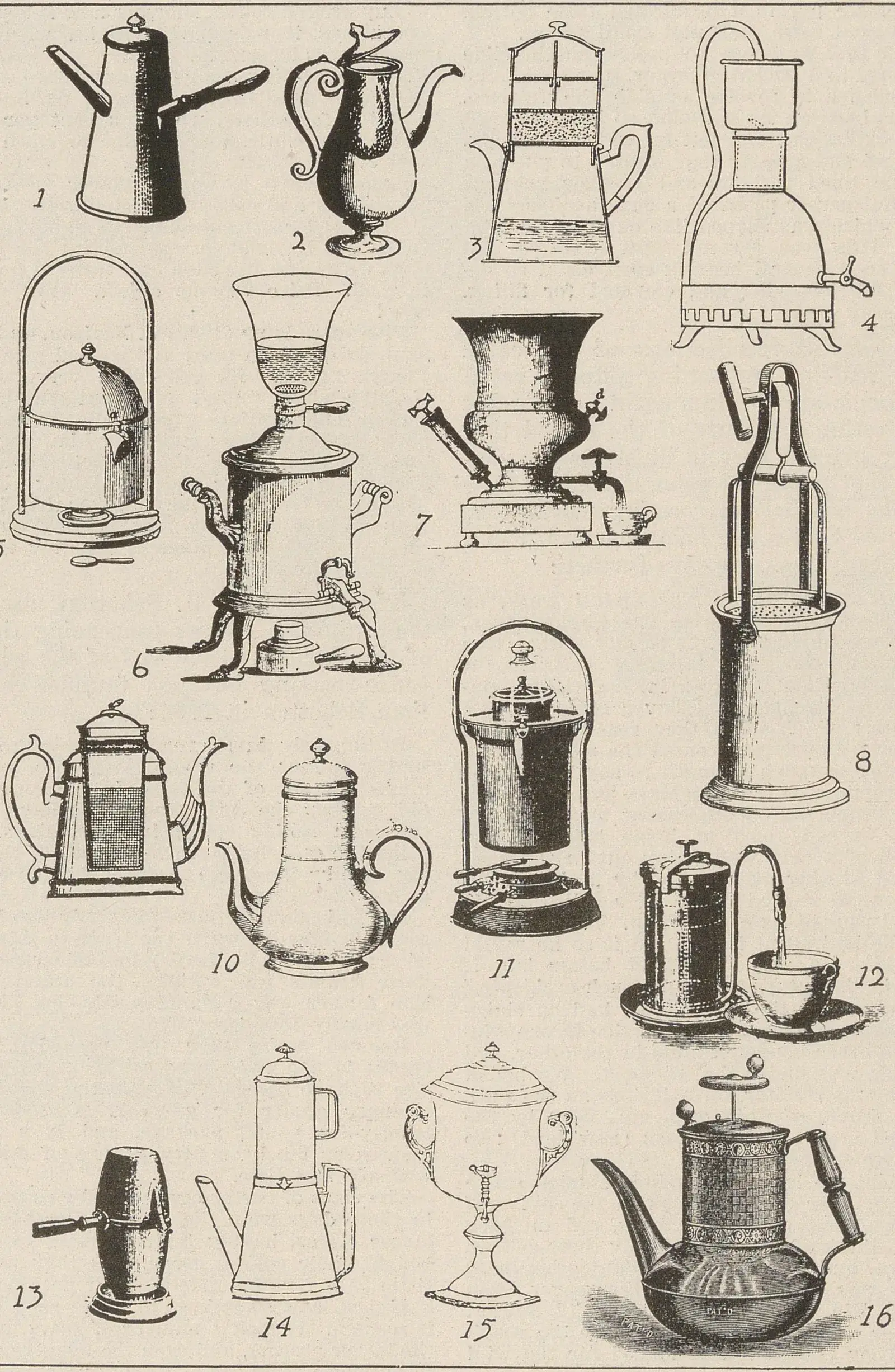
In 1822, Rabaut has a simple idea and literally turns the French coffee pot upside down: instead of letting the water descend by gravity, he uses the pressure of steam to force it upward, through the coffee.
This is the principle that will lead, a century later, to espresso, and it is already there.
The idea is taken up at once, each adding his own piece. Casseneuve patents it in 1824 with a paper filter. Andrews in 1841 with a perforated cylinder screwed to the bottom of the pot. Samuel Parker patents a steam machine on January 11, 1833.
Then, in 1843, Loysel de Santais produces what Ukers calls “the first ideas” of the hydrostatic percolator. The result can be seen at the Exhibition of 1855: two thousand cups an hour. Ukers, cautious, specifies that these were probably half-cups, which is still considerable.
In 1922, he notes that these machines have been overtaken by the “Italian rapid-filtration machines,” which give a thousand large cups an hour. Counter coffee, the kind served quickly to many people, has just been born.
Ukers 1922, ch. XXXIV; Wikipedia, Moka pot (Parker 1833)- The domestic moka pot is the coffee maker of Alfonso Bialetti, Crusinallo workshop, who is said to have observed the central-tube laundry boilers of the washerwomen of Piedmont: aluminum Moka Express, 1933, sold in local markets (about a thousand units a year in the late 1930s, 70,000 in all in 1947), then the only product of the house when Renato Bialetti takes over in 1947 and launches a poster and television campaign with the mustached mascot created in 1952
- 220 million units in 2001. The lower boiler carries a safety valve
- steam pushes the water at 1 to 2 bars, far from the 9 of espresso, toward the funnel of grounds then the column. Brew ratio around 1:10 in practice; at 1:15, the test by Gloess et al. (2013) measures 2.13% solids, between filter and espresso. The classic error is to let the boiler keep climbing in temperature until it spits: the last jets are superheated steam that burns the bed
- stop at the first gurgle.
In this plateThe 17 sections
- 01What is extracted, and how it is measured
- 02Seven centuries of utensils
- 03Decoction: ibrik, cezve, Turkish coffee
- 04Steeping: cloth bag, French press, tasting cup
- 05Gravity percolation, from De Belloy to the V60
- 06Filters: paper, metal, cloth
- 07Percolators and electric coffee makers
- 08The siphon: steam pressure then vacuum
- 09Steam pressure: Rabaut, Loysel, the moka pot
- 10Espresso, from Moriondo to the E61
- 11Espresso today: machines, technique, profiling
- 12The grind: grinders, fines, retention
- 13Milk
- 14Cold coffee and nitro
- 15Measuring: scale, refractometer, thermometer, sieves
- 16Today
- 17Archive plates
The table of contents, with the first sentence of each section