Measuring: scale, refractometer, thermometer, sieves
| Tool | What it measures | Precision / range | Use |
|---|---|---|---|
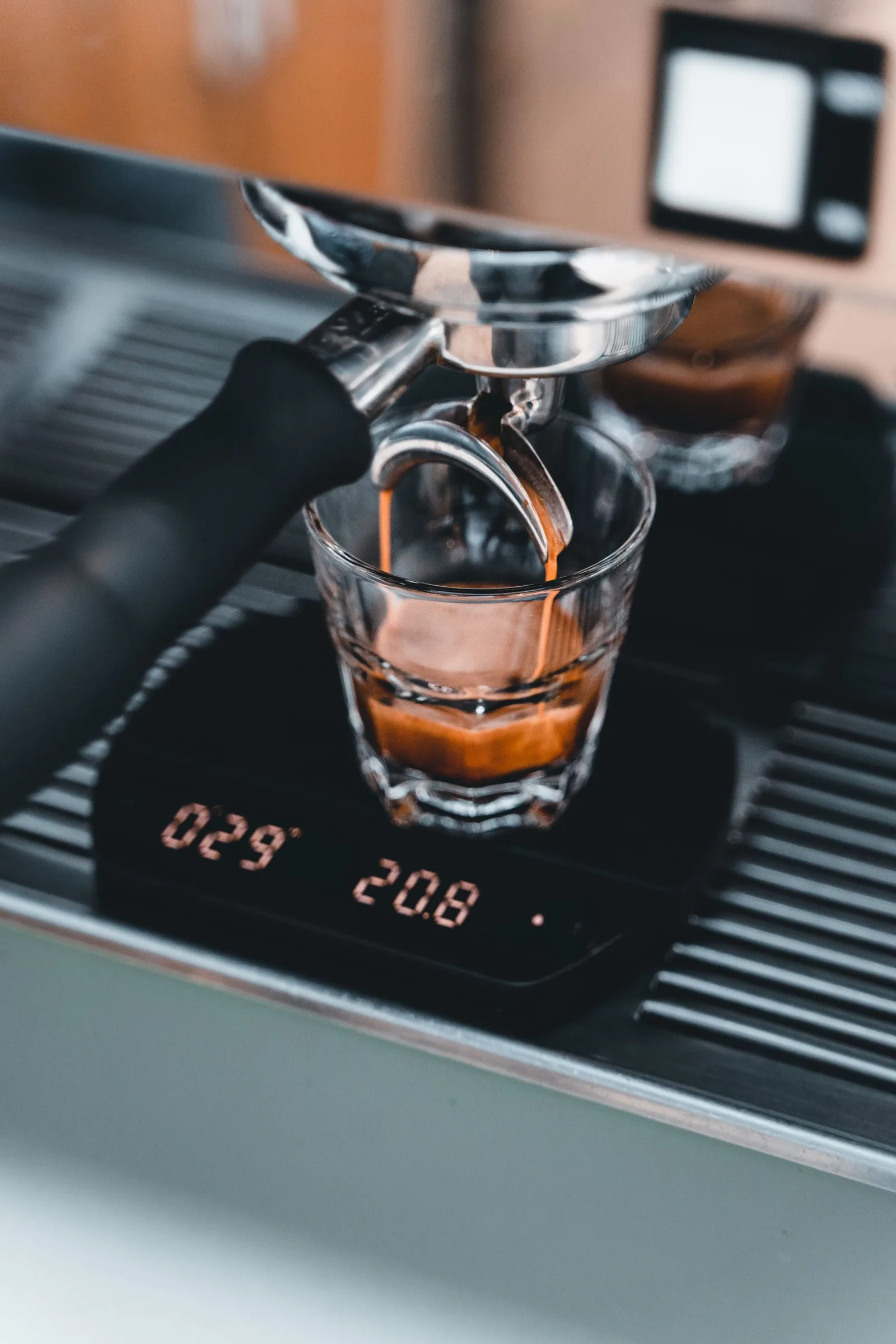
| Scale (Acaia Pearl S) | dose, beverage, flow | 0.1 g, timer | brew ratio, pace, stop by weight |
| Gooseneck kettle | temperature and pour rate | 1-18 g/s (Stagg EKG 0.6 L), 2-35 g/s (Brewista) | agitation controlled by height |
| Refractometer | refractive index, TDS | filter 1.15-1.5%, espresso 7-12% | extraction yield = TDS × beverage ÷ dose |
| Thermometer / probe | slurry temperature | always < kettle | compare cones, materials |
| Sieves (Kruve, 2015) | particle size fractions | stacked sets of sieves | fines and boulders |
| Laser diffraction | full distribution | laboratory | reference |
| Scanned image (Gagné) | distribution | 400 dpi, limit 0.1 mm | free, depends on lighting |
The barista of 2026 weighs everything. The scale reading to 0.1 g with a timer and flow display (Acaia Pearl S) sets dose, brew ratio, pour rhythm and final beverage weight; Gagné has two scales run in parallel by an app to record poured flow and drained flow. The refractometer measures the refractive index of the beverage and converts it into concentration; extraction yield = concentration × beverage weight ÷ dry dose, a simple formula to use when communicating, whereas more precise formulas take into account the water retained in the grounds.
Its pitfalls: prism at the temperature of the sample, zeroing with distilled water just before, cleaning with alcohol, evaporation of the sample that distorts the reading; and above all, the same average yield says nothing about uniformity. The thermometer is worth less than the kettle with a setpoint: what matters is the slurry temperature, lower than that of the poured water, different depending on whether the cone is plastic, ceramic or stainless steel. Particle size distribution is measured with a sieve, by laser or by an image scanned at 400 dpi (limit 0.1 mm).
Gagné 2021, pp. 13-17, 46-47, 173-176, 185-190, 199-205In this plateThe 17 sections
- 01What is extracted, and how it is measured
- 02Seven centuries of utensils
- 03Decoction: ibrik, cezve, Turkish coffee
- 04Steeping: cloth bag, French press, tasting cup
- 05Gravity percolation, from De Belloy to the V60
- 06Filters: paper, metal, cloth
- 07Percolators and electric coffee makers
- 08The siphon: steam pressure then vacuum
- 09Steam pressure: Rabaut, Loysel, the moka pot
- 10Espresso, from Moriondo to the E61
- 11Espresso today: machines, technique, profiling
- 12The grind: grinders, fines, retention
- 13Milk
- 14Cold coffee and nitro
- 15Measuring: scale, refractometer, thermometer, sieves
- 16Today
- 17Archive plates
The table of contents, with the first sentence of each section