Filters: paper, metal, cloth
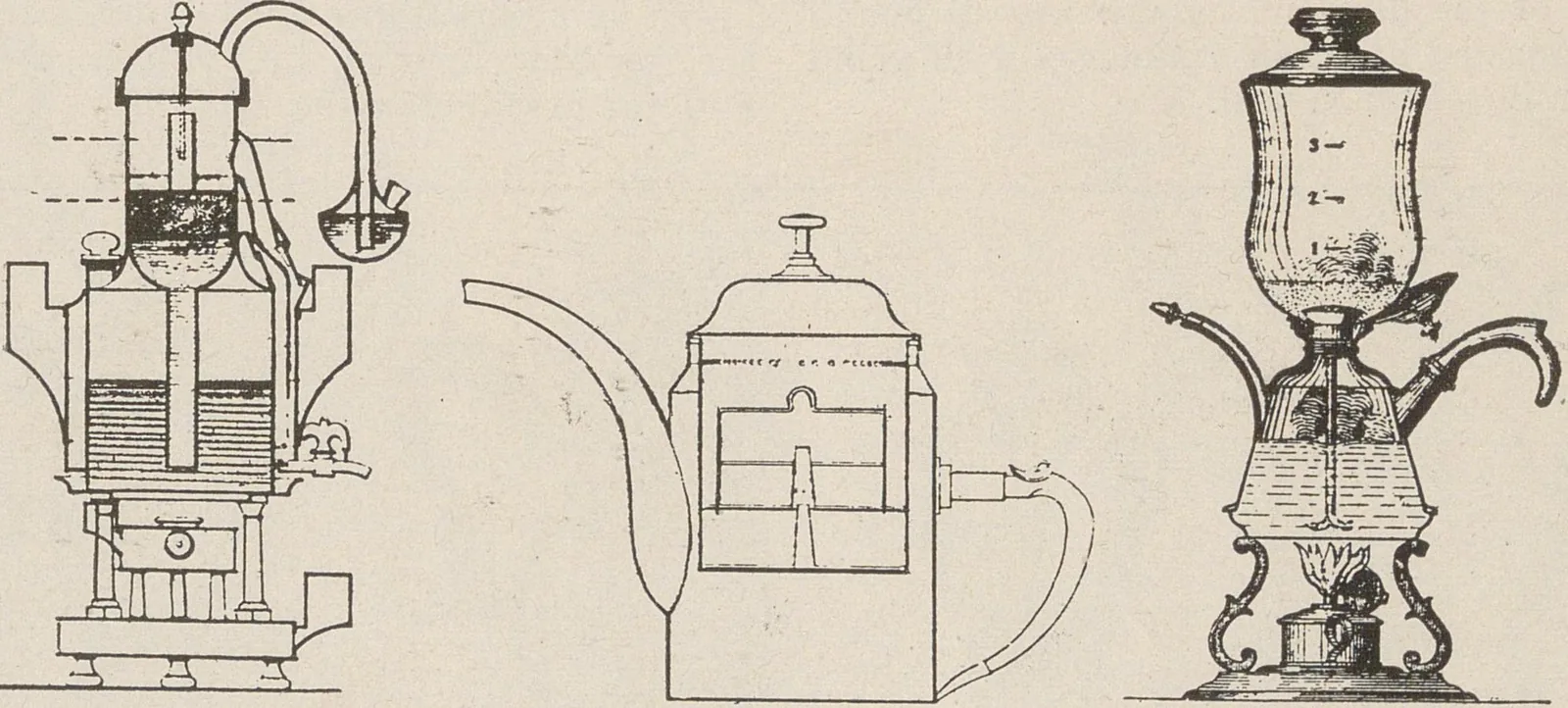
The filter decides what ends up in the cup. Metal has enormous pores: fast flow, almost no retention of oils or fines, body and sediment. Paper slows the flow, absorbs a share of the oils and a share of the migrating fines, depending on its thickness; the pores of cone papers resemble one another, with a peak at 45 to 50 microns, unbleached papers having more uniform pores but a cardboard taste that must be rinsed out at length (5 ppm of solids released by a natural Hario against 0 for a bleached Hario, in Gagné's measurement).
| Filter | Pores | Oils | Fines | Flow | Maintenance | Drawback |
|---|---|---|---|---|---|---|
| Bleached paper | peak 45-50 µm | partly absorbed | retained depending on thickness | slow | disposable, rinse | paper taste if not rinsed |
| Natural paper | more uniform | same | same | slow | long rinse (5 ppm released) | cardboard |
| Chemex | slow paper, usual thickness (210 µm) | better retained | better retained | very slow | disposable | clogging, small surface |
| Metal | enormous | pass through | pass through | fast | washable | cloudy, sediment, cafestol |
| Cloth | medium | absorbed then rancid | partly pass through | fast | washing, freezing, boiling | rancid, mold |
Bleaching is done with chlorine or oxygen. Cloth, common on siphons and in Tokyo cafés, gives a cup that is fast and cloudy like metal but absorbs the oils, which go rancid; Gagné judges it “a nightmare” to maintain: immediate washing, freezing, boiling in unscented detergent then in clear water, hanging to dry. The useful indices of a paper are its hydraulic resistance, its capacity to load fines before clogging (the Cafec “dark roast” papers are among the quickest to clog), its uniformity and its wet strength.
Gagné 2021, pp. 105-125 (Rao 2010)The idea is not new. In 1915, at the request of Ukers, the Mellon Institute of Pittsburgh compares nine appliances: the boiled pot gives the most “caffetannic acid” and caffeine, the French drip the least, and the best cup is obtained between 195 and 200 °F (90 to 93 °C) rather than at boiling. In 1916, the University of Kansas concludes that filtration gives the best brew. The first committees of American roasters recommended keeping muslin bags “in cold water” between uses, because drying makes them break down.
Ukers 1922, ch. XXXVI (Bacon, Mellon Institute, 1915; Home Economics Laboratories, Kansas, 1916; The Coffee Book, 1915)In this plateThe 17 sections
- 01What is extracted, and how it is measured
- 02Seven centuries of utensils
- 03Decoction: ibrik, cezve, Turkish coffee
- 04Steeping: cloth bag, French press, tasting cup
- 05Gravity percolation, from De Belloy to the V60
- 06Filters: paper, metal, cloth
- 07Percolators and electric coffee makers
- 08The siphon: steam pressure then vacuum
- 09Steam pressure: Rabaut, Loysel, the moka pot
- 10Espresso, from Moriondo to the E61
- 11Espresso today: machines, technique, profiling
- 12The grind: grinders, fines, retention
- 13Milk
- 14Cold coffee and nitro
- 15Measuring: scale, refractometer, thermometer, sieves
- 16Today
- 17Archive plates
The table of contents, with the first sentence of each section