Steeping: cloth bag, French press, tasting cup
What happens in a French press?
Start the scene or choose a stage. The animation simplifies the mechanism; what follows gives the details and the available references.
The grind is coarse, like coarse salt: 30 g for 500 mL, a brew ratio of 1:16 to 1:17. Water at 93-96 °C is poured over the whole dose at once.
Read the stages without animation
- Pour the water over a coarse grindThe grind is coarse, like coarse salt: 30 g for 500 mL, a brew ratio of 1:16 to 1:17. Water at 93-96 °C is poured over the whole dose at once.
- Four minutes of immersionFor four minutes, the ground coffee bathes in all the water, which loads up. Broadbent was already advising in 1722 two ounces of powder per quarter gallon, about 50 g per liter: the ratio recommended today by the SCA.
- Lower the plunger slowlyThe plunger is lowered slowly: its metal mesh presses the grounds to the bottom. Everything depends on sealing the edge: without it, the grounds pass around instead of being held back. The defect of the 1852 patent only disappears in 1929, with a spring that presses the filter against the wall.
- Serve: fines and oils get throughThe mesh lets fines and oils through: heavy body, sediment, and cafestol. Urgert and Katan (1997) established that boiled or unfiltered coffee raises serum cholesterol, and that coffee filtered through paper does not: that is the health reason for the paper filter.
- The grounds keep extractingServing must be immediate: the grounds left at the bottom keep extracting, and what remains in the carafe becomes astringent.
To remember: The French press is an immersion without paper: everything that passes through a metal mesh, fines and oils included, ends up in the cup.
In history: It took a century and four nationalities to seal the edge of the filter, from Mayer and Delforge (1852) to Bodum's Chambord.
Read the full article and its sources ↓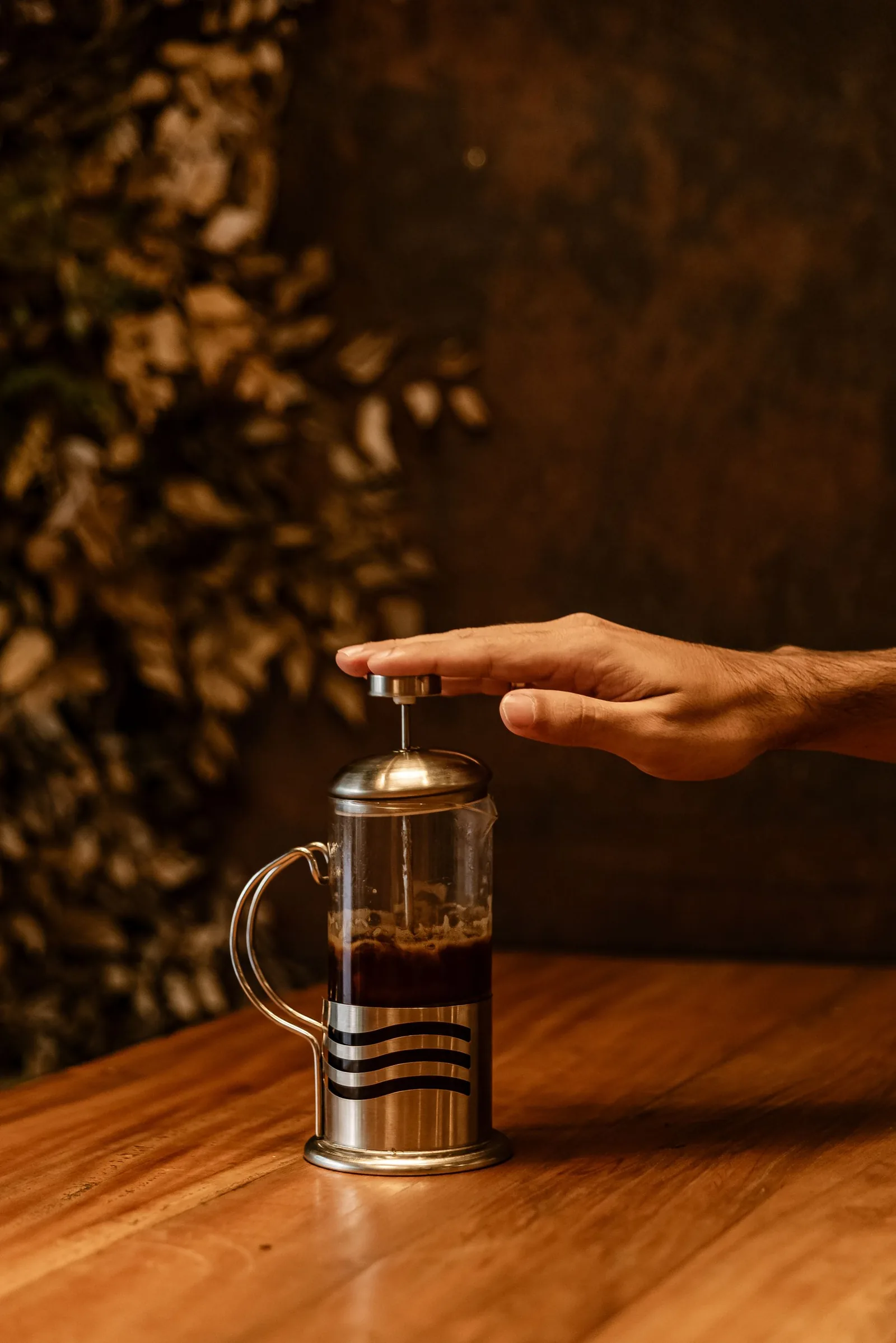
An idea we find obvious took a century to establish itself: do not boil coffee.
Steeping without boiling was born in France in 1711, with the fustian bag, a cloth in which the grounds are placed. It spreads slowly in England and America, where whole beans are still boiled.
One must read what Broadbent, a London coffee merchant, writes in 1722, because everything is already there. He will not use less than two ounces of powder per quarter gallon, which comes to about 50 grams per liter. In other words: exactly the ratio the SCA recommends today. Three centuries without moving.
He adds two pieces of advice. A stoneware or silver pot rather than tin or copper, which “rob it of its flavor,” and he is right, these metals react with the acids of coffee. And a spoonful of cold water to precipitate the grounds, which also works, by simple difference of density.
The French press descends from that lineage, that of steeping without boiling. It would take a century and four nationalities to be perfected. The obstacle is always the same: sealing the edge of the filter. Without that, the grounds pass around it instead of being held back.
- 1852Mayer and Delforge patent. The filter does not meet the wall, so there is no real filtration: the device separates the grounds from the liquid poorly.
- 1924Paquet patent. The sealing problem is still not solved.
- 1929Ugo Paolini, of Milan, files in the United States a filtering plunger mounted on a rod, whose rights he assigns to Calimani and Moneta; its spring holds the filter at the desired height, it does not yet make a seal.
- 1934Bruno Cassol, also a Milanese, lines the filter with a helical spring covered in gauze, which follows the variations in the diameter of the glass: the 1852 defect finally disappears.
- 1955Faliero Bondanini files in Switzerland a “filter coffee maker” that cites Cassol's patent (US patent of 1959); according to Wikipedia, the French clarinet maker Martin produces it under the Melior brand.
- 1974-1991Bodum launches its first French press in 1974, buys the rights to the Chambord in 1983, then in 1991 the Martin company, according to Wikipedia.
Usual French press settings: coarse grind (the size of coarse salt), 30 g for 500 mL (1:16 to 1:17), water at 93-96 °C, four minutes, plunger lowered slowly, and above all immediate serving, because the grounds left at the bottom keep extracting and make the cup astringent. The metal mesh lets fines and oils through: heavy body, sediment, and cafestol. The work of Urgert and Katan (1997) established that boiled or unfiltered coffee raises serum cholesterol whereas coffee filtered through paper does not; that is the health reason for the paper filter, not only a reason of taste.
Wikipedia, French press; Wikipedia, Cafestol, citing Urgert and Katan, Annual Review of Nutrition, 1997| Method | Principle | Grind | Brew ratio | Water | Time | Pressure | In the cup |
|---|---|---|---|---|---|---|---|
| Cezve | hot immersion, no filter | 75-125 µm | ~1:10 | slow heating | 2-3 risings | atm. | thick body, grounds, cafestol |
| French press | immersion, metal mesh | coarse | 1:16 (30 g/500 mL) | 93-96 °C | 4 min | atm. | body, sediment, oils |
| Cupping | standardized immersion | coarse filter grind | 1:18 (8.25 g/150 mL) | 93 ± 3 °C | 3-5 min | atm. | comparison |
| AeroPress | immersion, then plunger | medium-fine | variable | 80-95 °C | 1-2 min | manual | clean, calculated as percolation |
| V60 / cone | gravity percolation, paper | medium | 1:16-1:17 | 88-99 °C | 2.5-4 min | 0.008 bar | clean, bypass possible |
| Kalita / flat bottom | gravity percolation | medium | 1:16-1:17 | same | 3-4 min | gravity | slightly higher yield |
| Chemex | percolation, thick paper | medium-coarse | 1:16-1:17 | same | 4-5 min | gravity | very clean, slow |
| Electric coffee maker | gravity percolation | medium | 55 g/L | 92-96 °C | 4-8 min | gravity | Golden Cup standard |
| Siphon | steam then vacuum | medium | 1:15-1:17 | < 100 °C | 1-2 min | vapor | hot, cloth or paper |
| Mocha | steam over the bed | fine | ~1:10 to 1:15 | below 100 °C | approx. 4 min | 1-2 bar | 2.1% TDS at 1:15 |
| Espresso | pump on tamped bed | very fine | 1:2 (18 g / 36 g) | 90-96 °C | 25-30 s | 9 bar | 7-12% TDS, crema |
| Cold brew | cold immersion | coarse | 1:8 concentrate | ambient | 8-24 h (plateau around 6-7 h) | atm. | low acidity, keeps well |
The professional tasting cup (cupping) is a standardized immersion. Everything is fixed in advance for a simple reason: if the protocol does not move, the only thing that changes from one cup to the next is the coffee itself.
The protocol comes down to a few numbers. 8.25 g of ground coffee for 150 mL of water at 93 °C, to within 3 °C, a brew ratio of 1:18. The crust, that layer of grounds gathered at the surface, stays intact for three to five minutes, then is broken with a spoon by stirring about three times.
The grind is coarser than for filter. It is ground cup by cup, at most fifteen minutes before the water. The grinder is purged with a few beans between two samples, to empty what is left of the previous one.
This cup is for comparing coffees, not for drinking them.
professional training document, tasting guide, pp. 4-5Two hybrid devices have reconciled immersion and paper. Abid's Clever Dripper (Taiwan), present in North American cafés from 2008-2009, is a paper-filter cone whose valve opens only once it is set on the cup: one steeps for three to four minutes, then drains. Hario answered in 2019 with the Switch, a glass V60 on a silicone base whose steel ball closes or opens the orifice.
Alan Adler's AeroPress, presented at the Coffee Fest in Seattle in November 2005 after two years and about thirty prototypes, adds manual pressure: Adler sought to reduce bitterness by shortening contact. Gagné showed that the AeroPress's extraction formula is that of a percolation and not an immersion, because the plunger expels the water held between the particles; calculated wrongly, it gave overestimated yields while its cups were underextracted, and the correction consisted of grinding finer or using less coffee.
Prima Coffee, Abid Clever Coffee Dripper; Coffeeness, Hario Switch Review; AeroPress Inc., About; Perfect Daily Grind, The History of the AeroPress (2019); Gagné 2021, p. 17In this plateThe 17 sections
- 01What is extracted, and how it is measured
- 02Seven centuries of utensils
- 03Decoction: ibrik, cezve, Turkish coffee
- 04Steeping: cloth bag, French press, tasting cup
- 05Gravity percolation, from De Belloy to the V60
- 06Filters: paper, metal, cloth
- 07Percolators and electric coffee makers
- 08The siphon: steam pressure then vacuum
- 09Steam pressure: Rabaut, Loysel, the moka pot
- 10Espresso, from Moriondo to the E61
- 11Espresso today: machines, technique, profiling
- 12The grind: grinders, fines, retention
- 13Milk
- 14Cold coffee and nitro
- 15Measuring: scale, refractometer, thermometer, sieves
- 16Today
- 17Archive plates
The table of contents, with the first sentence of each section