Espresso today: machines, technique, profiling
What happens in the portafilter?
Start the scene or choose a stage. The animation simplifies the mechanism; what follows gives the details and the available references.
The dose is weighed to within 0.1 g. The grounds are distributed with fine needles, a method called WDT, to break up the clumps that would send the water through unevenly.
Read the stages without animation
- Weigh, break up the clumpsThe dose is weighed to within 0.1 g. The grounds are distributed with fine needles, a method called WDT, to break up the clumps that would send the water through unevenly.
- Tamp, then wet gentlyFlat tamping, then pre-infusion: a gentle rise in pressure wets the bed before compressing it, which limits channeling, exactly like pre-infusion in filter.
- Under 9 bars, the bed compactsUnder 9 bars, the bed compacts and its permeability drops, a reversible effect; the fines fill the voids. Classic espresso relies on these fines to slow the water and build body.
- Too fine: zones clogCameron, Hendon and their coauthors (Matter, 2020) show that a very fine grind creates clogged zones, hence uneven extraction. Their remedy, tested in cafés: less coffee, a coarser grind, time brought down from 25-35 s to 10-15 s.
- Profile, stop by weightProfiling makes pressure follow a curve instead of a constant 9 bars: Slayer in 2007, the Strada EP in 2009, the Decent DE1 in 2017. Shots are stopped by beverage weight rather than by time.
To remember: In the portafilter, the grounds slow the water: every gesture at the counter serves to make them slow it equally everywhere.
Read the full article and its sources ↓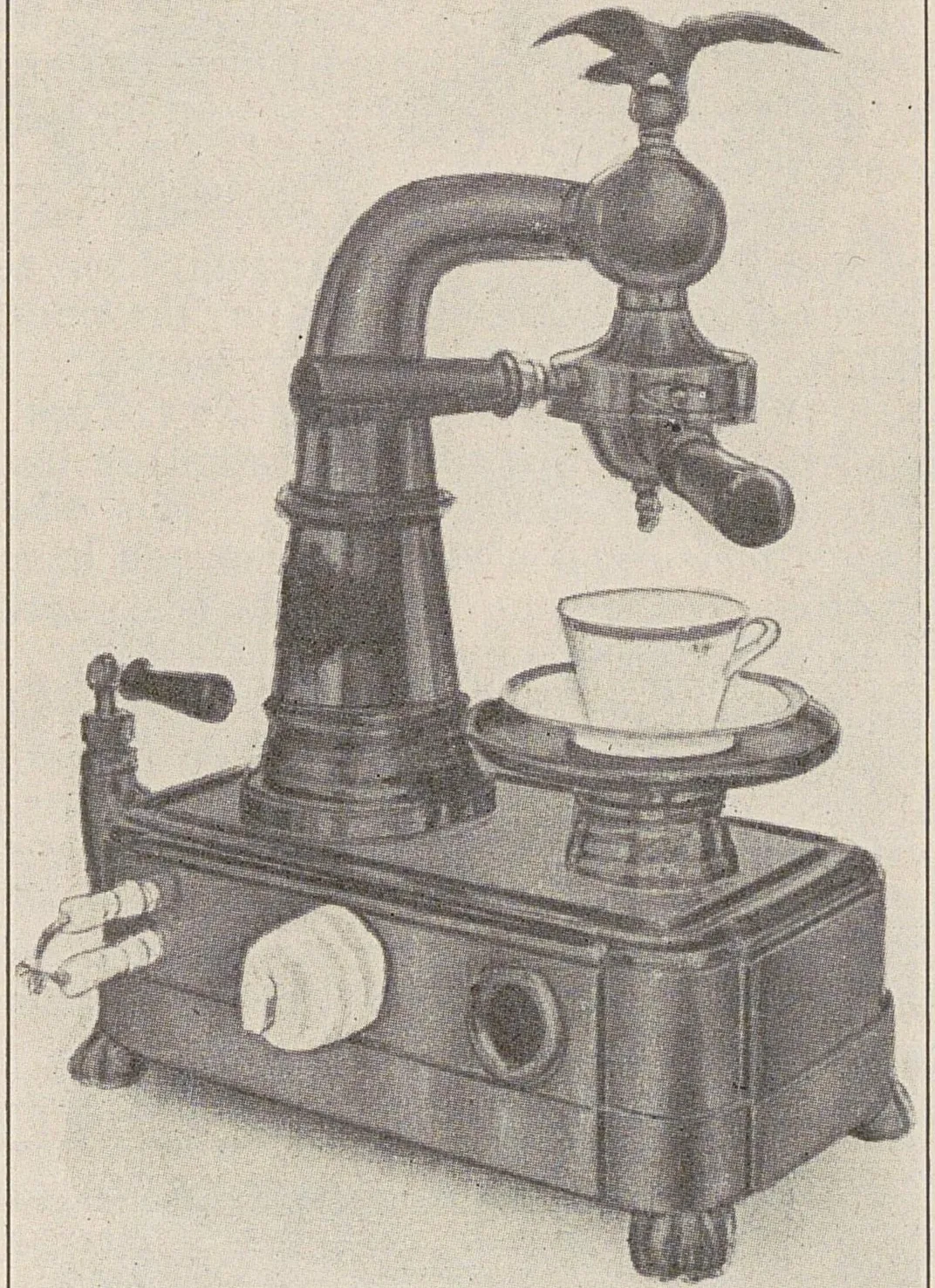
Machines are classified by the way they heat and push. A single boiler serves brewing or steam, not both at the same time; the heat exchanger (HX, E61) brews with water from a coil immersed in the steam boiler and requires a flush of 4 to 6 seconds to evacuate the overheated water; the dual boiler (La Marzocco GS, 1970) separates the two circuits and gives the most stable temperature; the thermoblock or thermocoil heats water on demand in an aluminum block, without a reserve, which equips most home machines and the Decent. The vibratory pumps (solenoid-piston) of home countertop machines deliver 9 bars in pulses; the rotary vane pumps of bar machines hold a continuous pressure and feed several groups. PID controllers, adopted from the late 1980s, hold the setpoint to the degree.
Wikipedia, Espresso machine (boiler types, pumps); Perfect Daily Grind 2024 (PID)Profiling has made pressure variable, that is, it no longer equals 9 bars from the beginning to the end of extraction but follows a chosen curve.
Slayer (Seattle, 2007, marketed after two years of development) controls the flow with a needle valve, with three stages and a long pre-infusion. La Marzocco's Strada EP (2009) is the first with variable pressure, by gear pumps and an electronic paddle. Decent's DE1, launched in early 2017, is the first home machine to control temperature, pressure and flow by phases from a tablet, with curves displayed in real time.
| Espresso machine | Date | Pressure | Heating | Advantages | Drawbacks |
|---|---|---|---|---|---|
| Steam (Bezzera, Pavoni) | 1901-1905 | 1.5-2 bar | boiler | fast, one cup at a time | water too hot, no crema |
| Spring lever (Gaggia) | 1948 | 3-12 atm, variable | boiler | crema, naturally declining profile | effort, flow tied to the arm |
| Pump + heat exchanger (E61) | 1961 | 9 bar | coil in steam boiler | constant 9 bar, thermosiphon | 4-6 s flush before each cup |
| Dual boiler | 1970 (LM GS) | 9 bar | two circuits | stable temperature, PID | cost |
| Thermoblock / thermocoil | home | 9 bar, vibratory pump | on demand | fast heating, compact | stability, pulsations |
| Profiling (Strada EP, Decent) | 2009, 2017 | 0-12 bar variable | gear pumps / thermoblock | pre-infusion, curves, data | price, complexity |
| Super-automatic (Saeco) | 1985 | 9-15 bar | thermoblock | grinds, tamps, brews on its own | grind and tamp not finely adjustable |
| Capsule (Nespresso, Keurig) | 1986, 1998 | up to 19 bar | thermoblock | consistency, cleanliness | price per gram, aluminum (1 g/capsule, 24.6% recycled) |
The meaning of all this is physical. The bed compacts under 9 bars and its permeability drops, a reversible effect; the fines fill the voids. A gentle rise in pressure wets the bed before compressing it, which limits channeling, exactly like pre-infusion in filter.
Cameron, Hendon and their coauthors (Matter, January 22, 2020) modeled espresso extraction. They show that a very fine grind creates clogged zones, hence uneven extraction. Their recommendation is counterintuitive and was tested in cafés: less coffee, coarser grind, time brought down from 25-35 s to 10-15 s. The cup gains in consistency, and less coffee is wasted.
Gagné points out for his part that classic espresso relies on fines to slow the water and build body. Fewer fines gives a cleaner cup with less chew. One must then make up for the lost resistance: grind finer, lower the pressure or restrict the flow.
Prima Coffee, Slayer; La Marzocco, Strada EP; Espresso Outlet, History of the Decent Espresso Machine; Cameron et al., Systematically Improving Espresso, Matter 2020 (ScienceDaily, Jan. 22, 2020); Gagné 2021, p. 57The technique at the counter is a series of precautions, each aimed at a known defect. The dose is weighed to within 0.1 g. The grind, for its part, is adjusted during the day. Two reasons for that. Beans become more ductile when the room warms up, that is, they yield by deforming instead of breaking cleanly. And cafés tighten the grind as service goes on.
The grounds are then distributed with fine needles, a method called WDT, to break up the clumps that would send the water through unevenly. Flat tamping, pre-infusion, then stopping by beverage weight rather than by time.
Two families took espresso out of the bar, by two opposite paths.
The first automates the barista. Saeco, founded in 1981 in Gaggio Montano, launches in 1985 the Superautomatica, the first home machine that grinds, doses, tamps, brews and ejects the puck of spent grounds. The cappuccinatore follows in 1996, the takeover of Gaggia in 1999, the sale to Philips in 2009.
- The second removes the adjustment by enclosing the dose. Éric Favre, a Nestlé engineer
- patents the Nespresso system in 1976, ten years before Helmut Maucher authorizes the launch. The product is tested in Japan, then sold in Switzerland, in France
- in Italy and in Japan in 1986, first to offices and hotels. Keurig
- 1992founded
- launches in 1998 its B2000 and its K-Cups for offices
- then home machines in 2004. Vertuo arrives in 2014. European protection for Nespresso capsules expires in May 2011, and the system ceases to belong to a single manufacturer; a more recent patent is judged not infringed and invalid in London on April 22, 2013.
Success is counted, and so is its downside. The global pods and capsules market reaches 29.6 billion dollars in 2024. Each capsule leaves 1 g of aluminum behind it, and only 24.6% are recycled.
Gagné 2021, p. 63 (Cameron 2016); Wikipedia, Saeco; Wikipedia, Nespresso; House of Switzerland, Éric Favre; Wikipedia, Keurig; IMARC, Coffee Pods and Capsules Market (2024)In this plateThe 17 sections
- 01What is extracted, and how it is measured
- 02Seven centuries of utensils
- 03Decoction: ibrik, cezve, Turkish coffee
- 04Steeping: cloth bag, French press, tasting cup
- 05Gravity percolation, from De Belloy to the V60
- 06Filters: paper, metal, cloth
- 07Percolators and electric coffee makers
- 08The siphon: steam pressure then vacuum
- 09Steam pressure: Rabaut, Loysel, the moka pot
- 10Espresso, from Moriondo to the E61
- 11Espresso today: machines, technique, profiling
- 12The grind: grinders, fines, retention
- 13Milk
- 14Cold coffee and nitro
- 15Measuring: scale, refractometer, thermometer, sieves
- 16Today
- 17Archive plates
The table of contents, with the first sentence of each section