Espresso, from Moriondo to the E61
Where does espresso pressure come from?
Start the scene or choose a stage. The animation simplifies the mechanism; what follows gives the details and the available references.
In 1902 Bezzera patents the cup served one at a time, with groups and portafilters; Pavoni adds a release valve and a steam wand. In these boiler machines, it is steam that pushes the water, at only 1.5-2 bars: the water arrives too hot, the cup is burnt, and without crema.
Read the stages without animation
- Steam pushes the waterIn 1902 Bezzera patents the cup served one at a time, with groups and portafilters; Pavoni adds a release valve and a steam wand. In these boiler machines, it is steam that pushes the water, at only 1.5-2 bars: the water arrives too hot, the cup is burnt, and without crema.
- A spring pushes the waterGaggia separates pressure from temperature. His 1948 lever machine compresses a spring that the barista cocks by pulling the lever; the spring pushes the water at 8 to 10 bars, on water kept below boiling. Hence the crema, a foam unknown until then.
- A pump holds 9 barsIn 1961, the Faema E61 replaces the arm with an electric volumetric pump that holds a constant 9 bars. A heat exchanger draws the brew water from a coil running through the steam boiler: a single heat source supplies both uses.
- A definition in numbersIlly and Viani codified Italian espresso: 6.5 ± 1.5 g of ground coffee, water at 90 ± 5 °C, 9 ± 2 bars, 30 ± 5 seconds, 25 to 30 mL. The modern bar has doubled the dose: 18 to 20 g for 36 to 40 g of beverage, a brew ratio of 1:2 in 25 to 30 s.
To remember: Espresso is born when pressure stops coming from heat: the spring, then the pump, push the water without boiling it.
In history: The E in E61 comes from the solar eclipse visible in Italy in 1961.
Read the full article and its sources ↓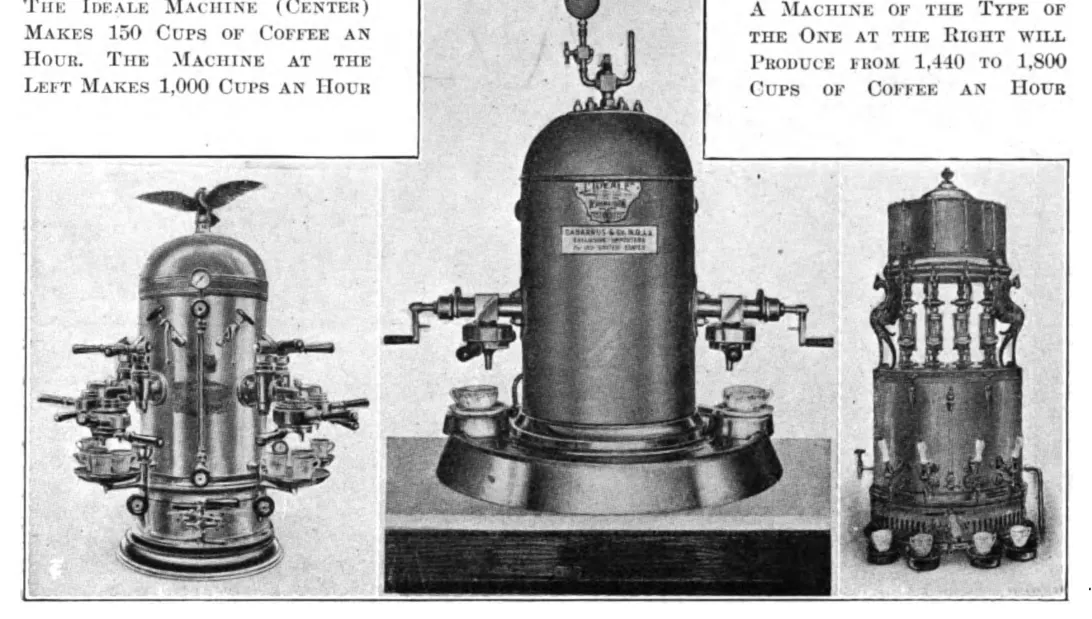
Angelo Moriondo, a café owner in Turin, patents on May 16, 1884 (No. 33/256) a steam apparatus for “instantaneous” coffee. The historian Jonathan Morris, for his part, takes as the reference the patent that Moriondo registers in France in 1885. It produces in volume, not by the cup, and had no commercial sequel.
The decisive step falls to Luigi Bezzera, a Milanese mechanic. On December 19, 1901 he files the application for a system that serves one cup at a time, with groups and portafilters. Patent No. 153/94 is granted to him on June 5, 1902. Serving one cup at a time changes trade as much as technique, since each customer receives a coffee made for him, on the spot.
- Desiderio Pavoni buys the rights in 1903 and founds La Pavoni. He adds a release valve and a steam wand
- then obtains in 1907 an Italian patent for an improvement of the “Bezzera system.” The Tipo Gigante appears at the Milan Exhibition in 1906. Victoria Arduino and La Cimbali are born within the decade
- 1927La Marzocco
- 1939where Giuseppe Bambi patents the horizontal boiler
All these boiler machines share the same limit. It is steam that pushes the water, at only 1.5-2 bars, and the water therefore reaches the grounds too hot. The cup is quickly made, but burnt, and without crema.
Wikipedia, Espresso machine (Sept. 7, 2026); Perfect Daily Grind, A history of the espresso machine (June 2024); Ukers 1922, chronology 1907Achille Gaggia separates pressure from temperature, and it is at that moment that espresso becomes what we know. His 1938 patent covers a piston. His 1948 lever machine, developed after 1945, compresses a spring that the barista cocks by pulling the lever.
The spring then pushes the water under a pressure that rises then falls, from 3 to 12 atmospheres according to the historian Jonathan Morris, on water kept below boiling. Pressure no longer comes from heat, so one can raise one without raising the other. Hence the expression “pulling a shot,” which literally describes the gesture. Hence also a foam unknown until then, the crema, which Gaggia had to sell as a quality.
In 1961, the Faema E61 replaces the arm with a mechanism, the E coming, according to the manufacturer, from the solar eclipse of that year, which no period document found confirms. An electric volumetric pump holds a constant 9 bars, with nothing to pull. A heat exchanger draws the brew water from a coil running through the steam boiler, so that a single heat source supplies both uses. Its thermosiphon group, still copied, becomes the standard of bars.
Illy and Viani codified the Italian definition of espresso.
- Dose6.5 ± 1.5 g of ground coffee per cup.
- Water90 ± 5 °C.
- Pressure9 ± 2 bars.
- Time30 ± 5 seconds.
- Volume25 to 30 mL.
The modern bar standard has doubled the dose: 18 to 20 g for 36 to 40 g of beverage, a brew ratio of 1:2 in 25 to 30 s. One last figure puts things back in perspective. A cup of espresso is made of more than nine tenths water, which makes water the most neglected variable of the counter.
Wikipedia, Espresso machine; Perfect Daily Grind 2024; Coffeeness, History of the Espresso Machine; Illy and Viani, Espresso Coffee: The Science of Quality, 2nd ed. (2005); LC ch. 00a for the water proportionIn this plateThe 17 sections
- 01What is extracted, and how it is measured
- 02Seven centuries of utensils
- 03Decoction: ibrik, cezve, Turkish coffee
- 04Steeping: cloth bag, French press, tasting cup
- 05Gravity percolation, from De Belloy to the V60
- 06Filters: paper, metal, cloth
- 07Percolators and electric coffee makers
- 08The siphon: steam pressure then vacuum
- 09Steam pressure: Rabaut, Loysel, the moka pot
- 10Espresso, from Moriondo to the E61
- 11Espresso today: machines, technique, profiling
- 12The grind: grinders, fines, retention
- 13Milk
- 14Cold coffee and nitro
- 15Measuring: scale, refractometer, thermometer, sieves
- 16Today
- 17Archive plates
The table of contents, with the first sentence of each section