Gravity percolation, from De Belloy to the V60
What happens in a cone?
Start the scene or choose a stage. The animation simplifies the mechanism; what follows gives the details and the available references.
Pre-infusion, or bloom, wets a dry bed, which resists water far more than a wet bed; without it, water carves out paths and keeps them. The roasting gas escapes in bubbles. Gagné blooms for 45 seconds in general, and measures that two to three minutes gain up to a point of yield on light roasts.
Read the stages without animation
- The bloom: wetting the dry bedPre-infusion, or bloom, wets a dry bed, which resists water far more than a wet bed; without it, water carves out paths and keeps them. The roasting gas escapes in bubbles. Gagné blooms for 45 seconds in general, and measures that two to three minutes gain up to a point of yield on light roasts.
- Crossing the bedClean water crosses the bed and leaves it loaded. Darcy's law sets the flow: it increases with the permeability of the bed and the water height, it decreases with bed thickness and viscosity. A column of 8 cm of water pushes with 0.008 bar, a thousand times less than the 9 bars of an espresso machine: one must grind much coarser.
- The fines migrate, the swirl puts them backFines, smaller than the voids between the large particles, descend and clog the bottom of the bed or the paper. Swirling the cone after each pour, the swirl, closes up the channels and returns the fines to the mass.
- Channel and bypassA channel is a region of large pores, carved by a jet that is too fast, where the water runs through: it overextracts this corridor and underextracts the rest. Bypass lets water pass between the paper and the wall without crossing the bed; it dilutes the cup, randomly, especially in ribbed cones like the V60.
- What drips, and at what heatUsual brew ratios of 1:16 to 1:17, water near boiling (99 °C) on light roasts, 88 to 96 °C on dark. The slurry, the mixture of grounds and water in the cone, always stays clearly cooler than the kettle, and its temperature depends on the material of the cone.
To remember: In filter brewing, water pushes only with its weight: everything depends on how it crosses the bed, without channeling or bypass.
In history: Melitta Bentz files her blotting-paper filter on June 20, 1908; Hario launches the V60 in 2004 and its redesign, the V60 NEO, in May 2026.
Read the full article and its sources ↓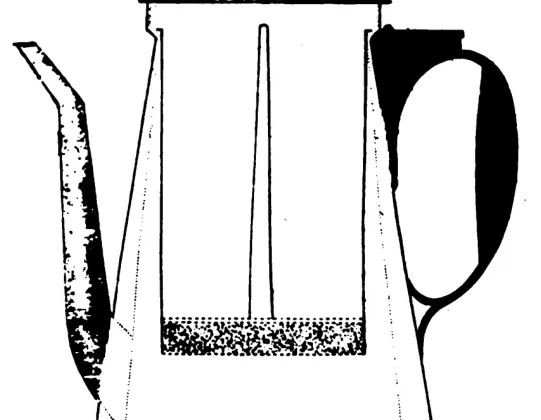
Ukers distinguishes three words that patents have confused. Infusion is extraction without boiling, water poured over the grounds. Percolation is draining through fine openings of porcelain or metal, as in De Belloy's coffee pot: boiling water passes through the grounds held back by a grid and a perforated spreader. Filtration is draining through a porous body, cloth or paper.
Rumford, who passes for the inventor of the percolator, mainly added in 1806-1812 a double wall of hot water and a four-legged tamper that compresses two thirds of an inch of grounds into a half inch of definite thickness; De Belloy had preceded him by about six years. Hadrot, in 1806, already held his perforated tamper half an inch from the powder so that the water falling from above would not disturb it. The inventors who followed made fun of this exactness; Ukers notes in 1922 that nearly all their ideas survive in modern appliances.
Ukers 1922, ch. XXXIV, pp. 619-622, and ch. XXXVI (definitions)- The paper filter has two commercial births. In the United States
- Frederick A. Cauchois sells in 1905 his Private Estate coffee maker with Japanese paper, Finley Acker patents the same year a percolator with “porous paper or blotting paper”
- 1908Richheimer launches the Tricolator
- 1911Aborn the Make-Right
- King a paper-filter accessory in 1912. In Dresden, Melitta Bentz, who pierced a brass cup with a nail and set in it the blotting paper from her son's notebook
- June 20, 1908files her “coffee filter with a domed underside, a hollow bottom and inclined drain holes”
- July 8, 1908the utility model is registered at the Kaiserliches Patentamt in Berlin
- and the company entered in the commercial register on December 15. In 1917, a comparative test organized by the Tea and Coffee Trade Journal, and tasted by the chemist E. M. Frankel and by William B. Harris, coffee expert at the US Department of Agriculture, ranks paper first, ahead of cloth, glass, the percolator and the boiled pot.
Three cones remade the method. Peter Schlumbohm's Chemex, a German chemist who emigrated, patented in 1941 (US 2 241 368, “Filtering device”, filed April 13, 1939, issued May 6, 1941), fuses funnel and carafe into a single piece of glass and imposes a slower paper than the others: 7.2 mL per second for the bleached Chemex against 11.0 for a Hario paper with a tab, for an almost equal thickness, 210 microns against 206. Hario's V60, launched in 2004 according to Hario UK, in 2005 according to the manufacturer's global site, is a 60° cone whose spiral ribs lift the paper off the wall and whose orifice is large.
The Kalita Wave (around 2010 according to resellers; the manufacturer does not date the model) has a flat bottom, three holes and pleated paper. The Origami (pleated ceramic, wider orifice than a V60) and the Fellow Stagg X are recent variants. In May 2026, Hario presented the V60 NEO, the first redesign in twenty years: 72 fine ribs at the top of the cone converging toward 9 deep ribs at the base, Tritan resin to stand up to the temperature, compatible with Switch bases; early users describe a cleaner cup, “closer to tea”.
Google Patents US2241368A; Chemex, About; Hario UK, Birth of the Hario V60; Corner Coffee Store, When Was the Kalita Wave Invented; Gagné 2021, pp. 154-157; Yanko Design, May 12, 2026Darcy's law governs the flow: the flow rate increases with the permeability of the bed (coarser, less compacted grind), the filter cross-section, the water height and the density of the liquid; it decreases with bed thickness and viscosity. The orders of magnitude explain everything: a column of 8 cm of water, a full V60, pushes with 0.008 bar, a thousand times less than the 9 bars of an espresso machine; one must therefore grind much coarser.
Four departures from Darcy make or break a cup. The migration of fines, smaller than the voids between large particles, clogs the bottom of the bed or the paper. Channeling, caused by a jet that is too fast or by localized flow, creates regions of large pores where the water runs through, overextracting one corridor and underextracting the rest. The compaction of the bed under pressure, reversible, matters in espresso but has not been observed in filter.
And bypass, when water passes between the paper and the wall without crossing the whole bed: it dilutes the cup and lowers the yield, it is unpredictable, and it is a trait of ribbed cones like the V60, especially when the water column is high and the bed resistant.
Gagné 2021, pp. 72-76 and 147-148 (Yang 2016; Rosti et al. 2020)Hence the technique. Pre-infusion (bloom) wets a dry bed that resists water far more than a wet bed; without it, water carves out paths and keeps them. Capillarity spreads water in all directions and draws water into the particles; the CO2 from roasting escapes in bubbles, more numerous with more alkaline water. Gagné blooms for 45 seconds in general, but measures that a bloom of two to three minutes gains up to a point of yield on light roasts, and makes dark roasts bitter.
Swirling the cone after each pour closes up the channels and returns the fines to the mass. Agitation increases extraction and makes it more uniform in the layers it reaches; removing it with a stream breaker such as the Melodrip makes the yield drop, unless one grinds finer. A fine, smooth gooseneck allows pouring from higher without the stream breaking into drops; measured flow rates range from 1 to 18 g/s for a 0.6 L Stagg EKG and from 2 to 35 g/s for a Brewista Artisan.
Usual brew ratios from 1:16 to 1:17, up to 1:18 for the best grinders; water near boiling (99 °C) on light roasts, lowered to between 88 and 96 °C on dark roasts; the temperature of the slurry is always clearly below that of the kettle, and depends on the material of the cone.
Gagné 2021, pp. 82-90, 132-134, 144, 153, 185-198 (Motoyoshi 2019; Easthope 2015)Cones are compared on three axes. Flat bottoms extract more uniformly across the plane but less in depth, the bottom layer always receiving water that is already loaded; the cone compensates by passing more water near the bottom. The cone is more tolerant of dose variations beyond 10 g; the flat bottom sees its bed depth vary more.
The Chemex, without ribs, has almost no bypass but a tiny effective filter surface, a glass that cools the slurry, and a cone-carafe joint that can block the flow if the paper sags into the spout; it requires a coarser grind. The stainless steel Kalita Wave, little prone to bypass, has three small holes that slow the flow and a metal that conducts heat; its air-filled pleats partly insulate.
Gagné finds that flat bottoms give a slightly higher yield and a greater perceived sweetness, and attributes the difference to the partial bypass of V60s, which underextracts the bottom of the bed.
Gagné 2021, pp. 145-148, 154-157 (Moroney et al. 2019)In this plateThe 17 sections
- 01What is extracted, and how it is measured
- 02Seven centuries of utensils
- 03Decoction: ibrik, cezve, Turkish coffee
- 04Steeping: cloth bag, French press, tasting cup
- 05Gravity percolation, from De Belloy to the V60
- 06Filters: paper, metal, cloth
- 07Percolators and electric coffee makers
- 08The siphon: steam pressure then vacuum
- 09Steam pressure: Rabaut, Loysel, the moka pot
- 10Espresso, from Moriondo to the E61
- 11Espresso today: machines, technique, profiling
- 12The grind: grinders, fines, retention
- 13Milk
- 14Cold coffee and nitro
- 15Measuring: scale, refractometer, thermometer, sieves
- 16Today
- 17Archive plates
The table of contents, with the first sentence of each section