Milk
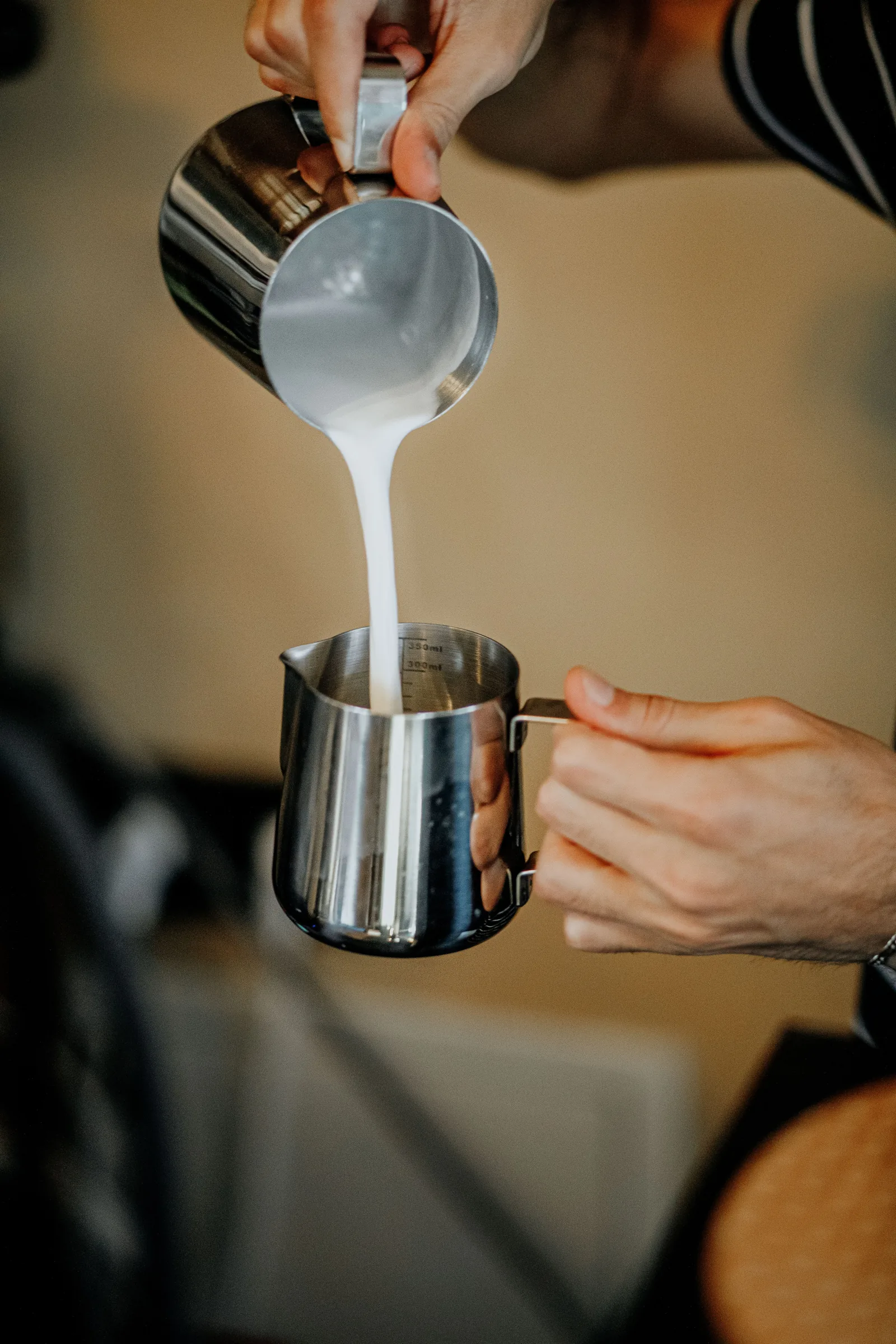
The steam wand enters the bar with Pavoni, around 1905 according to the history of the trade; the only dated act is his Italian patent of 1907, which improves the Bezzera system according to Ukers, without mentioning a wand. Its principle is twofold, and it is often forgotten: it injects steam, which heats the milk, and it incorporates air into it, which makes it foam. Heating and frothing at the same time.
Milk is worked at around 60 °C, and this window is not a barista's whim: steam-frothed from 30 to 80 °C, it gives its best foam between 50 and 60 °C, and it is at 60 °C that the bubbles of pasteurized milk are best distributed. Beyond that, the whey proteins denature, the foam collapses, and the milk sugar loses its perceived sweetness. Too hot, it is literally less sweet.
The same study adds that a panel distinguishes, moderately to strongly, the aroma of pasteurized milk from that of UHT milk, that is, milk sterilized at very high temperature.
When the bubbles become too small for the eye to distinguish, it is called microfoam. It pours, therefore it can draw, and that is how latte art is born.
The scene takes place in Seattle, in the late 1980s, at David Schomer's Espresso Vivace. A manager raised in northern Italy describes to him a figure he had seen there, the rosetta. Schomer does not work from a model: he reconstructs it from that account.
The detail is worth keeping. The rosetta that spread from Seattle comes from a description, not from an image before the eyes: it is a reconstruction, not a copy.
And Schomer is not alone in searching. Sarah Hunting's bee in 1988 and Lisa Persons's heart in 1989 precede it by a little. The rosetta therefore does not open the series: three figures appear within a few years, among different people.
Perfect Daily Grind, A history of the espresso machine (steam wand); Perfect Daily Grind, Understanding the history of latte art (Jan. 2022); International Dairy Journal, Effect of steam frothing on milk microfoam (2022); Wikipedia, David SchomerIn this plateThe 17 sections
- 01What is extracted, and how it is measured
- 02Seven centuries of utensils
- 03Decoction: ibrik, cezve, Turkish coffee
- 04Steeping: cloth bag, French press, tasting cup
- 05Gravity percolation, from De Belloy to the V60
- 06Filters: paper, metal, cloth
- 07Percolators and electric coffee makers
- 08The siphon: steam pressure then vacuum
- 09Steam pressure: Rabaut, Loysel, the moka pot
- 10Espresso, from Moriondo to the E61
- 11Espresso today: machines, technique, profiling
- 12The grind: grinders, fines, retention
- 13Milk
- 14Cold coffee and nitro
- 15Measuring: scale, refractometer, thermometer, sieves
- 16Today
- 17Archive plates
The table of contents, with the first sentence of each section