The counter is a stage
Why automation works in the kitchen and stalls at the bar
In this text
- What the kitchen has already accepted without flinching
- The proof by tamping
- Exactly where the line falls
- What the gesture guarantees, and which is not the coffee
- Why the grinder always loses the argument
- The object reassures, the system tires
- And what if the folklore were part of the job?
- What happens when you win
- The question I ask now
- Notes and sources
There is a conversation I have several times a year, and it almost always unfolds in the same order.
Someone opens an establishment, or takes over someone else's, and asks me what the best coffee machine is. I answer with questions: how many cups a day, at what time of day, prepared by whom, with what shift rotation, for what clientele, with how much time available at the peak of the rush. We move forward. We look at the volumes. We look at who will be behind the counter in August when half the team has gone. And regularly a moment arrives where the coherent answer is to automate part of the extraction, sometimes a small part, sometimes all of it.
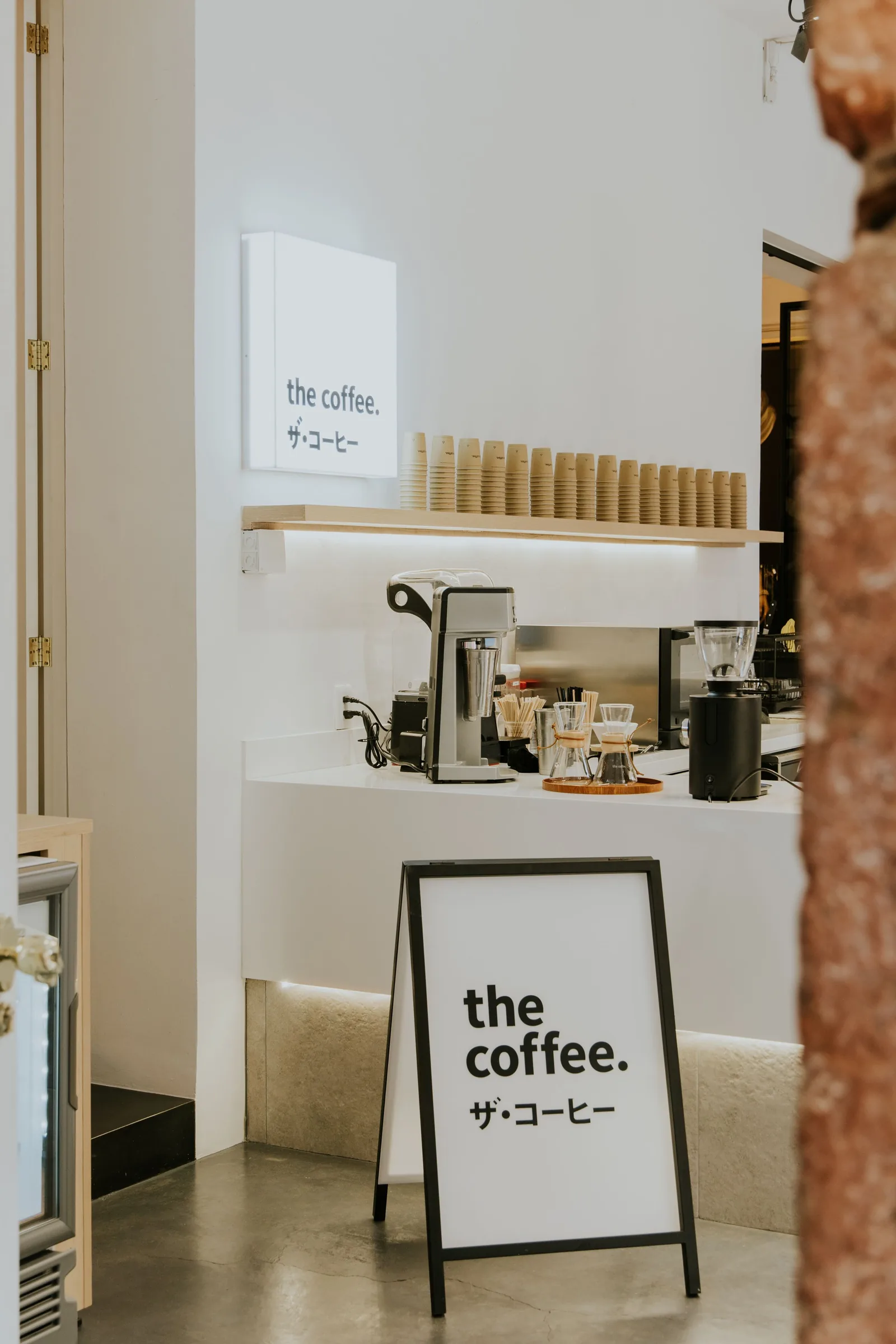
That is where the conversation changes in nature. The objection that comes up is almost never “the coffee will be worse.” It is “it will look less serious,” “we're not a gas station,” “customers wouldn't understand.” Sometimes simply a grimace, which is even more interesting, because a grimace doesn't need an argument.
For a long time, I filed that under whim. It was comfortable and it was wrong. This reflex is not a quirk, it is a line of reasoning, and a rather well constructed one. It simply isn't about the coffee. It is about something else, and I think it is worth looking at what, because as long as we don't name that something else, we spend two hours discussing extraction while the decision is being made elsewhere.
What the kitchen has already accepted without flinching
Let's start with the most troubling part, because it is what put me on the trail.
The same establishment that refuses an automatic coffee machine has, eight meters away, a kitchen stuffed with automation that nobody finds degrading.
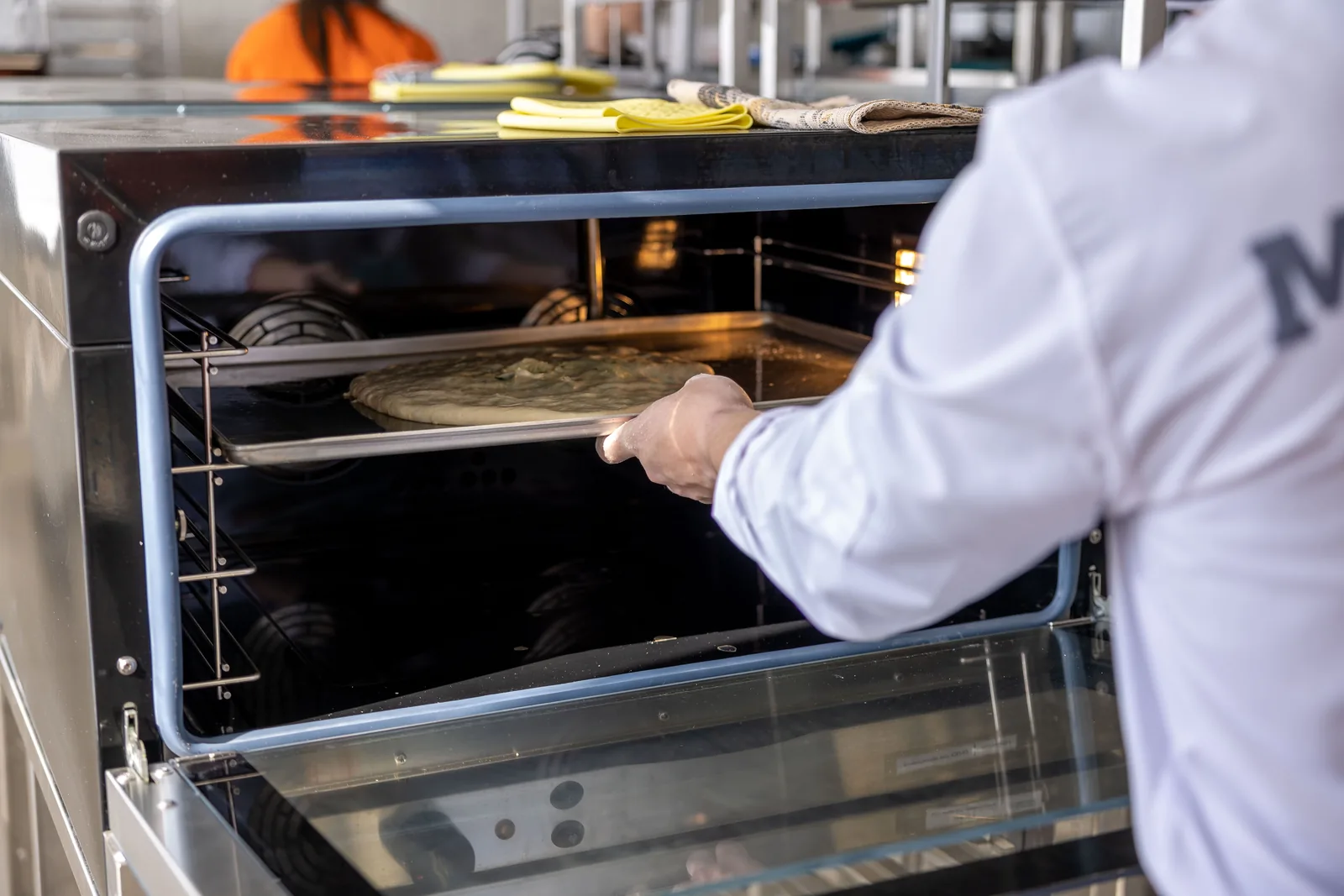
A combi oven, that is, an oven that controls steam, temperature and ventilation by itself, cooks a piece of meat on a stored program, with a probe stuck in the heart of the cut that decides on its own when to stop. An immersion circulator, that cylinder you clip to the edge of a water bath, holds 63.0 °C for six hours, which no cook can do by hand, and that is precisely why it was bought.
The blast chiller brings the product down through the dangerous temperature range faster than any human gesture. The glasswasher doses its own detergent. The till calculates the VAT. The syrup dispenser behind the bar pours 2 centiliters, always the same.
Nobody considers that the kitchen has lost its soul. Nobody wonders whether the cook is still a craftsperson. We even say the opposite: we find it serious equipment, a sign of a well-run house, reassuring about hygiene.
Same person, same establishment, same day, same money. The variable that changes is therefore not automation. It is where it is placed.
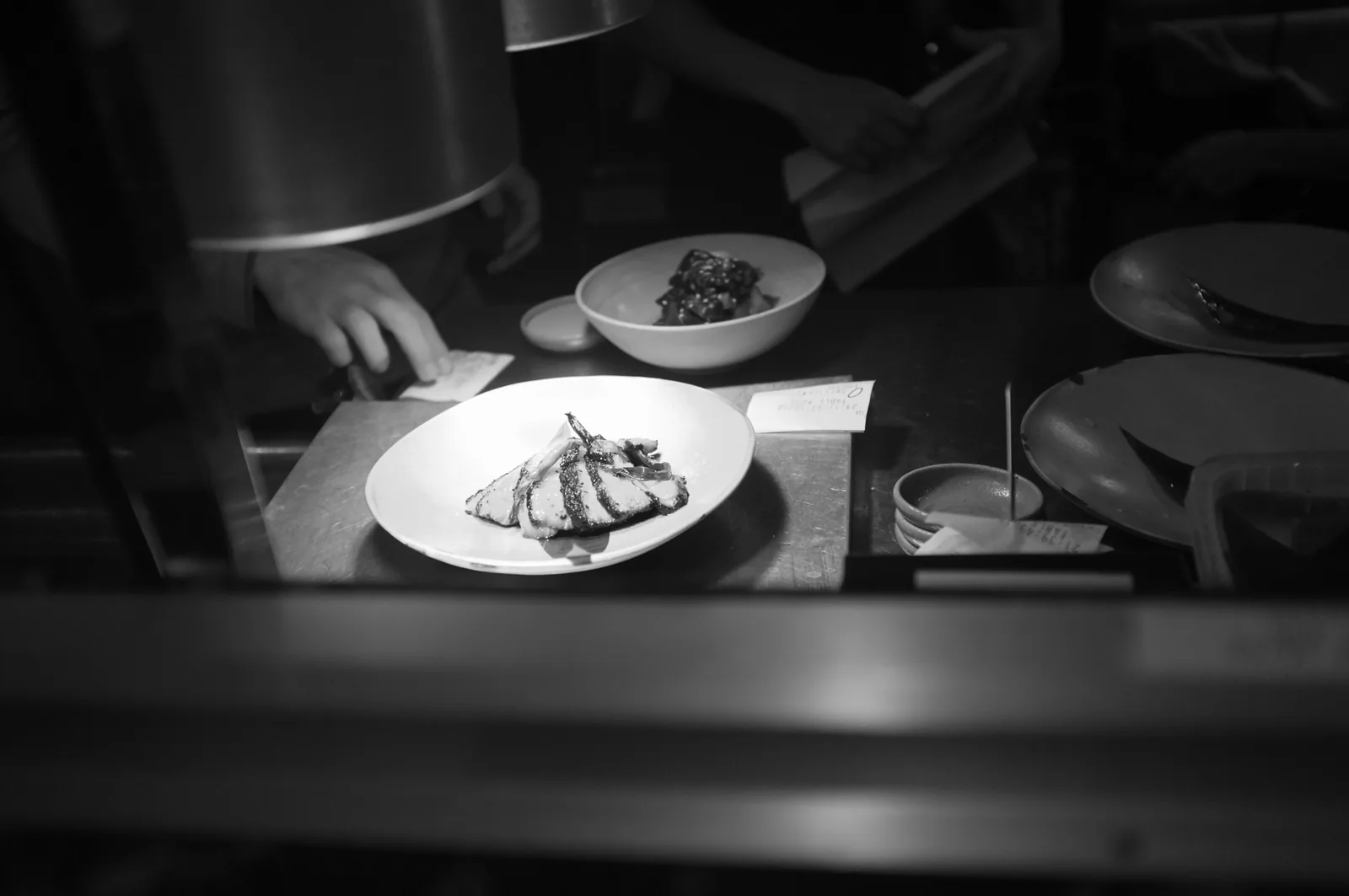
Erving Goffman, a sociologist who spent his life observing social life the way one watches a play, distinguished two regions in every establishment: the front region, the stage, where one stands before the audience and takes care over what one gives to be seen, and the back region, backstage, where one prepares, where one fails, where one swears, where one smokes. Restaurants literally build this boundary: there is a kitchen door, there is a pass, and everyone knows which side they are on.
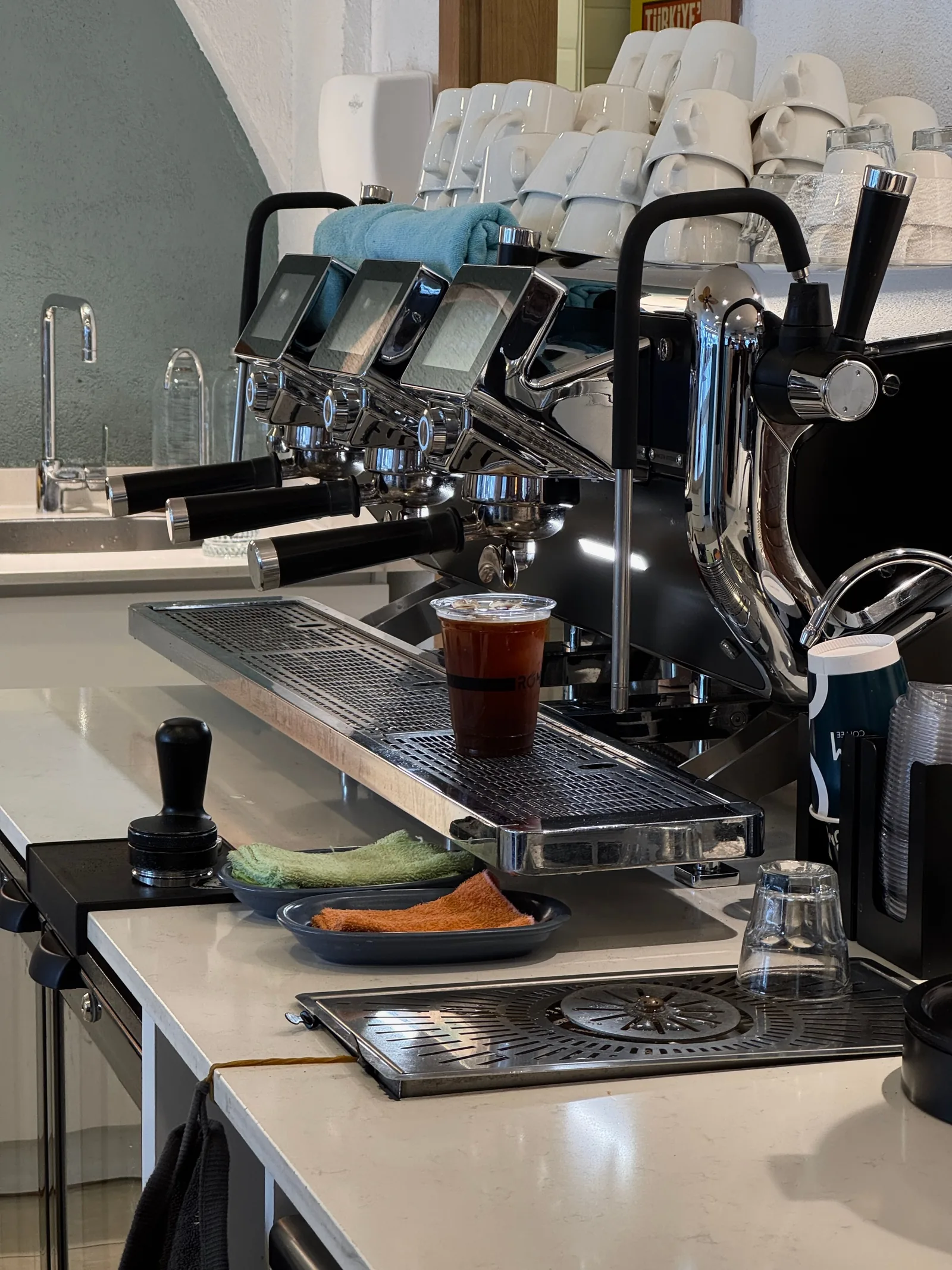
Now the coffee counter is an anomaly in this plan. It is the only production station that we deliberately install in the dining room. Lit. At eye level. In the center, often. The room is designed around it. When we automate in the kitchen, we take a task away from someone who isn't being watched. When we automate at the counter, we take a line away from an actor on stage, in front of the audience, during the performance. It is not the same operation, and it is fairly logical that it doesn't trigger the same reaction.
The proof by tamping
If this hypothesis is right, it must be verifiable. It must predict what the profession accepts and what it refuses. It happens that there is a textbook case, and it is spectacular.
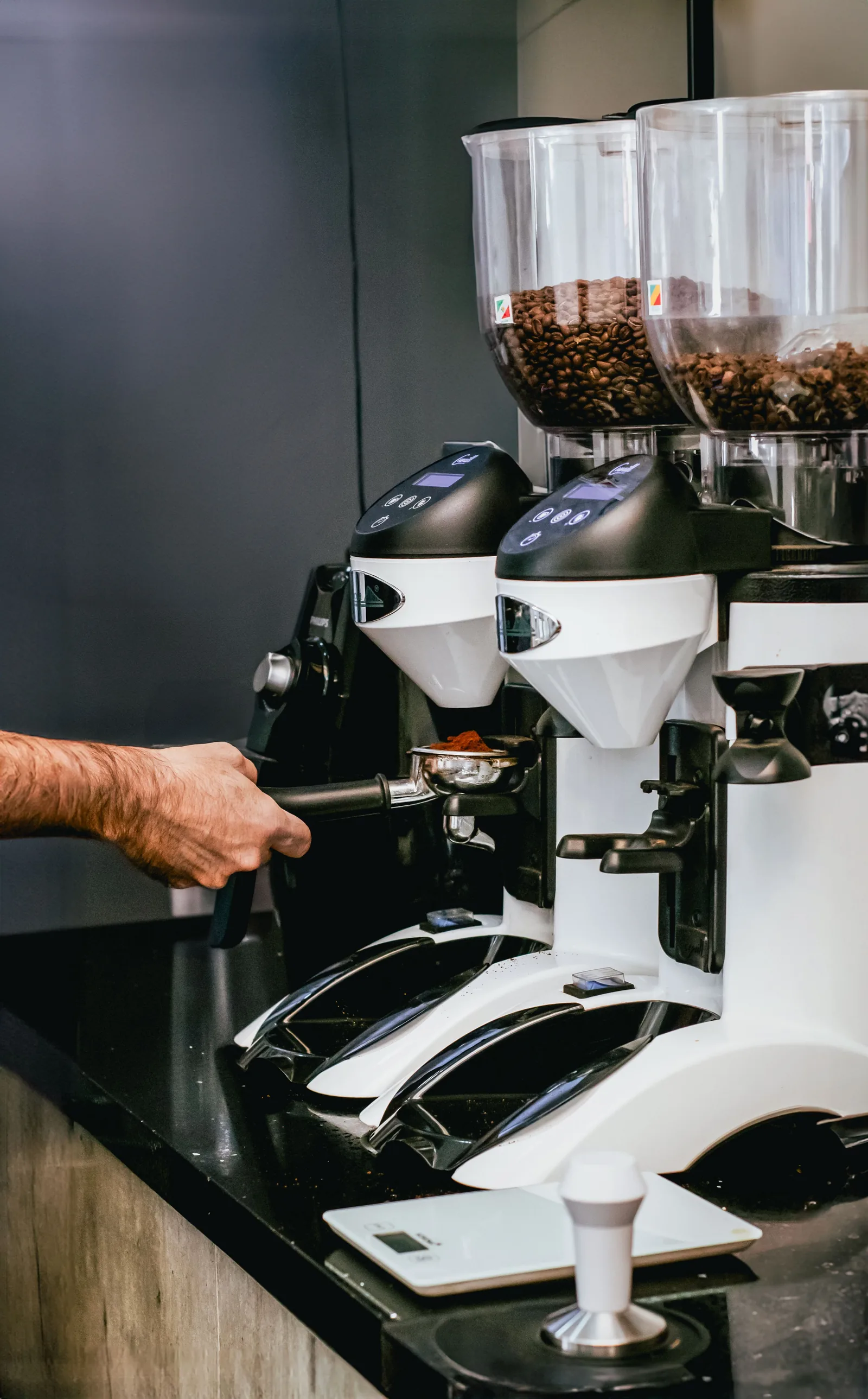
Tamping is the gesture by which the grounds are pressed into the portafilter. It is the iconic gesture of the trade, the one in all the photos, the one customers imitate when they get home. It occupied the profession for twenty years: what pressure, 15 kilos, 20 kilos, should you twist at the end, do you need a calibrated tamper, should you give a little tap on the side.
And then the automatic tamper arrived. A box placed on the counter, into which you slide the portafilter, and which presses with constant force, to within a few newtons, the same thing from the first to the last coffee of the day. Adopted within a few years, it became standard in a large part of specialty establishments in Europe. With no existential crisis, no manifesto, no debate comparable to the one surrounding the automatic machine.
Why did that one get through?
Two reasons, and they say everything. First, the choreography survived. The barista still picks up the portafilter, still makes a movement, sets it down somewhere, waits a second, picks it up again, locks it in. The scene is unchanged, the tempo of the counter is unchanged, the customer sees exactly the same thing: someone is taking care of their coffee. Second, the selling point was not “you will make a better coffee,” it was “it will hurt you less.” Repeated tamping is a major cause of musculoskeletal disorders, those injuries to tendons and joints that come from a gesture repeated hundreds of times per shift, wrist, elbow, shoulder. You can give up a gesture that is wrecking you without giving up your status. The way out was honorable.
And in the meantime, the heart of the question was settled elsewhere. In 2020, a team of mathematicians and chemists published in the journal Matter a complete model of espresso extraction, compared with measurements made in a real café in service. To measure anything, human variability had to be eliminated, so they used an automatic tamper.
They varied the tamping pressure over the whole useful range. They write that they observed no appreciable variation either in flow time or in extraction yield, that is, in the proportion of dry matter actually dissolved in the cup. And in the summary of their work, they write a sentence I find remarkable: the irregularity of espresso has been “traditionally, and incorrectly, attributed to human variations.” According to them, it is the grinder and the water pressure that govern reproducibility.
I don't want to make this study say more than it says. It measures a yield, not a taste, and its authors honestly note that they perceived differences in flavor that they did not quantify. An identical yield does not guarantee an identical cup. But it is amply sufficient for what concerns us here: the profession has already given up its most photographed gesture, it went very well, and it went well because this gesture weighed little on the cup and a great deal on the show, and the show was kept.
Exactly where the line falls
Once you hold this thread, you can pull on it, and the entire history of the equipment comes with it.
The espresso machine was invented to go faster. That is its birth certificate, not a late betrayal. After that, each generation removed one human decision from it. The lever, where the barista compressed the spring himself and felt the resistance in his arm, was replaced by the electric pump in the early 1960s. Then came volumetric dosing: you program the volume, the machine counts the water and stops by itself.
Then the PID, an electronic controller that holds the temperature to within half a degree instead of letting it swing with the thermostat. Then pressure profiling, where the machine follows a recorded curve instead of pushing at 9 bars from start to finish. Then built-in scales, which stop the shot to the gram. Then on-demand grinders that dose to a tenth of a gram. Then the tamper.
A so-called traditional setup today is already an automaton that leaves the operator four or five real decisions. All of that was accepted, and better than that: all of it is sold as a sign of professionalism. The PID is put forward on product sheets. The competition grinder is photographed.
So what is the technical difference between a machine that stops the shot by itself, accepted for sixty years, and a machine that, in addition, grinds and tamps by itself, refused today? It is marginal. We have gone one notch further down a slope we have been descending since 1961.
The difference is not technical. It is scenic. In the first case, someone still presents the portafilter. In the second, there is nothing left to present.
The rule I draw from it, and which has the merit of correctly predicting the reactions I encounter: we accept automation that replaces labor, we refuse the kind that replaces a presence.
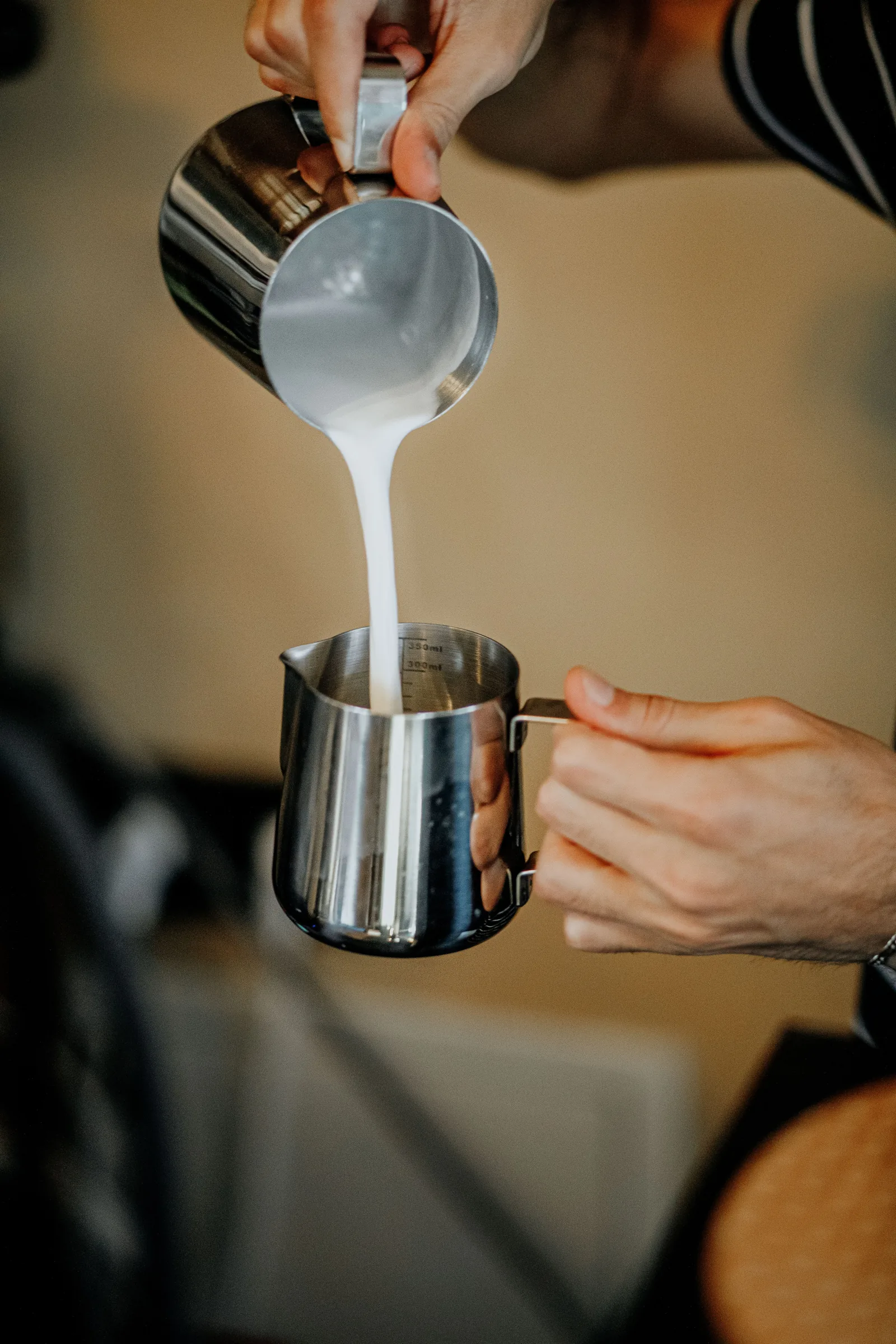
Which also explains why milk has become the last defended territory. The automatic steam wand exists, it works, it is widespread in hotels, and it remains snubbed wherever the image of the trade matters, because milk carries the last truly virtuoso and truly visible gesture: the drawing on the surface of the cup. Here again, there is a documented irony.
A 2015 study published in the Journal of Sensory Studies showed that people do agree to pay more for a decorated milk drink. But when the researchers looked for where this premium came from, it was not the perceived difficulty of the gesture that stood out, it was simply that the cup was pretty. The profession has concentrated its proof of manual know-how on the one operation a machine cannot yet copy, and the public, for its part, mostly buys the aesthetic result.
What the gesture guarantees, and which is not the coffee
So far, one might think all this is a matter of decor. That would be missing the most serious, and most legitimate, layer.
The visible gesture is not only an image. It is the economic justification of a job. It is what proves, live, that a human being was needed. It carries the salary, the title on the contract, the job ad, the competition circuit, the internal hierarchy between the person who runs the machine and the person who clears the tables, and the training market. I am inside it, not above it: I also sell training, I have a stake in the gesture continuing to mean something, and that doesn't disqualify me from saying so, it just obliges me to say so.
When someone refuses the automatic machine, they are perhaps defending an image. They are also defending, often, a definition of their trade and a ladder of skill. That is perfectly respectable, and it would deserve to be put on the table under that name rather than disguised as a technical argument, because disguised as a technical argument, it always loses, and we end up defending the absurd idea that a manual tamp beats a calibrated press.
The unpleasant question the machine poses is not, moreover, “is it as good.” It is: if this part of your work can be reproduced without loss, what exactly was this part of your work worth?
There is an answer, and it is a solid one. What cannot be reproduced is the judgment call. Choosing the recipe. Hearing from the sound of the grinder, or seeing from the flow time, that the grind has drifted since this morning because it is more humid than yesterday. Tasting at three in the afternoon when nobody asks. Deciding that this coffee, this week, needs two grams less. Understanding why the second machine of the evening service puts out something different from the first. This work is real, it is difficult, it is learned slowly.
It has just one flaw: it is invisible. It is done before opening, between two customers, in silence, and nobody photographs it. The trade's problem is not that the machine threatens its know-how. It is that its most precious know-how was never on stage, and that it left the stage to the most automatable part of its work.
Why the grinder always loses the argument
This sheds light on another scene I live on repeat, that of the budget.
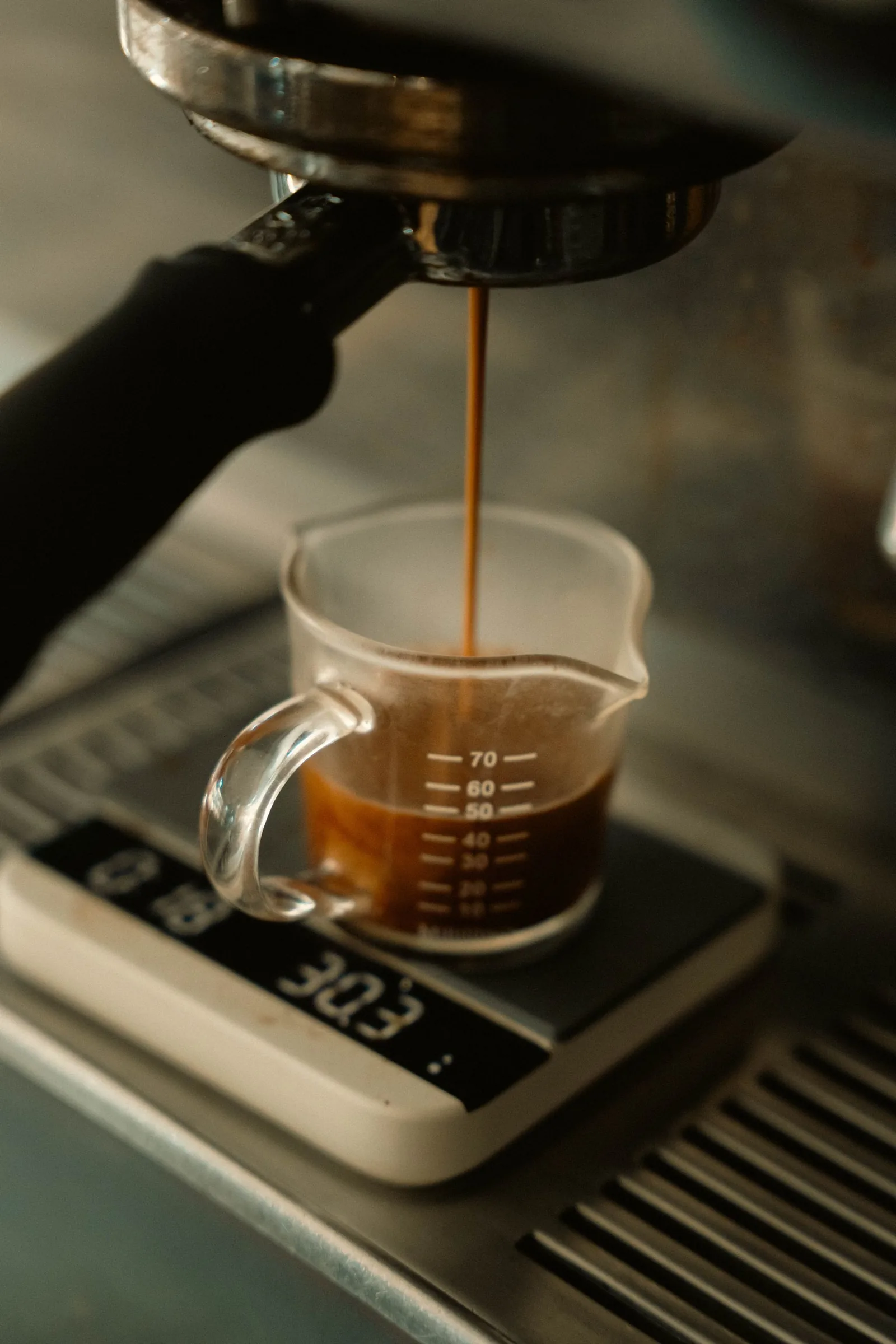
The grinder is the variable that research puts first. Its particle size distribution, that is, the spread of particle sizes it produces, decides the permeability of the coffee bed and therefore how water passes through it. A grinder that drifts means different cups all day long. And it is almost always the grinder that gets cut when something has to be traded off, or more exactly, it is the grinder that gets what is left after the machine.
It is not stupidity. It is a direct consequence of everything that precedes. A sign produces value only if it is legible to those it is addressed to. A whole room knows how to read an espresso machine: the size, the chrome, the number of groups, sometimes the brand. Almost nobody knows how to read a grinder. The customer doesn't know what it costs, what a set of burrs is, the difference between a doser grinder and an on-demand grinder. A sign nobody deciphers produces nothing on stage, whatever it produces in the cup.
Putting the money where it shows is therefore perfectly rational if what you are buying is a sign, and perfectly irrational if what you are buying is consistency. Both lines of reasoning are valid. They simply don't answer the same question, and the misunderstanding comes from the fact that nobody said out loud which of the two was being addressed.
And if we look for one last proof that this trade runs partly as a performance, the same 2020 study provides a nice one. It observes that the profession often grinds finer than the optimum, partly to hit the flow times written into the canonical definition of espresso, those twenty-five seconds everyone recites. Yet past a certain point of fineness, the water stops passing through the bed homogeneously: it carves channels for itself, part of the grounds is overextracted while another part is barely touched, and the cup can then be bitter and sour at the same time, a sensation everyone in the trade knows.
In other words, a numerical convention, inherited from a definition, pushes technique against physics. That happens in every trade in the world. It is just worth knowing that it happens to us too.
The object reassures, the system tires
There remains a question I long asked myself badly: why is it so natural to buy an object, and so hard to organize a system?
There is an accounting reason, and it is stronger than all the psychological ones. The machine is an investment. It goes on the balance sheet, it is financed, it is amortized, it is insured, it is resold. Training is an expense. It disappears the month it is paid for, it leaves no trace on the balance sheet, and it walks out the door the day the trained person finds better elsewhere. These are two ways of buying quality, and only one of them leaves a trace on paper. It would be strange if people chose the other.
There is also a simpler reason, almost physical. An object is a decision you make once. A system is a decision you have to make again every morning, with people who change. When you open an establishment and have three hundred decisions to make, the machine has an enormous advantage over training: it can be settled today, definitively, with a purchase order. It turns a permanent uncertainty into a line on an invoice.
That is a real service. It is simply not the one written on the invoice.
And what if the folklore were part of the job?
For a long time I wanted to conclude that all this was a confusion to be dispelled. I no longer believe it, and for a reason that took me some time.
If the machine makes the room believe, if it holds the price of an espresso at 2.20 instead of 1.50, if it gives the venue a recognizable identity and the team a pride that makes it stay, then it produces something. That something is not espresso, but it is counted in euros and it shows in foot traffic. In a trade that never sells only a liquid, that is not parasitic folklore, it is part of the production.
There is even better, and it is the best argument I know against my own thesis. In 2015, three researchers published in the Journal of Marketing a series of experiments on what they call the handmade effect. The same object is judged more attractive when told it was made by hand, and the mechanism they identify is not the supposed performance: it is that the object seems to contain attention, they even write love.
If that is true of a scarf or a soap, there is no reason for it to be false of a cup. Which means the visible gesture is not a decorative lie added to the product: it changes what the customer feels while drinking. By automating, we therefore really do remove something real, even when the liquid is strictly identical.
We then leave the lazy opposition between prestige and quality. There are two products in the same cup, and the only question worth asking is in what proportion we sell one and the other, and whether we know it.
One detail finishes convincing me that the decision was never economic: serious automatic solutions cost as much as, often more than, equivalent traditional machines. We do not automate here to spend less. The best-known Swiss maker of these machines says as much almost in plain words in its communication: its customers switch once “the fear of perception” is lifted. A manufacturer who has to sell against a perception rather than against a competitor's performance tells you very precisely where the real ground of the discussion lies.
What happens when you win
There is a neighboring trade that fought exactly this fight, and won it. It is worth looking at what exactly it got.
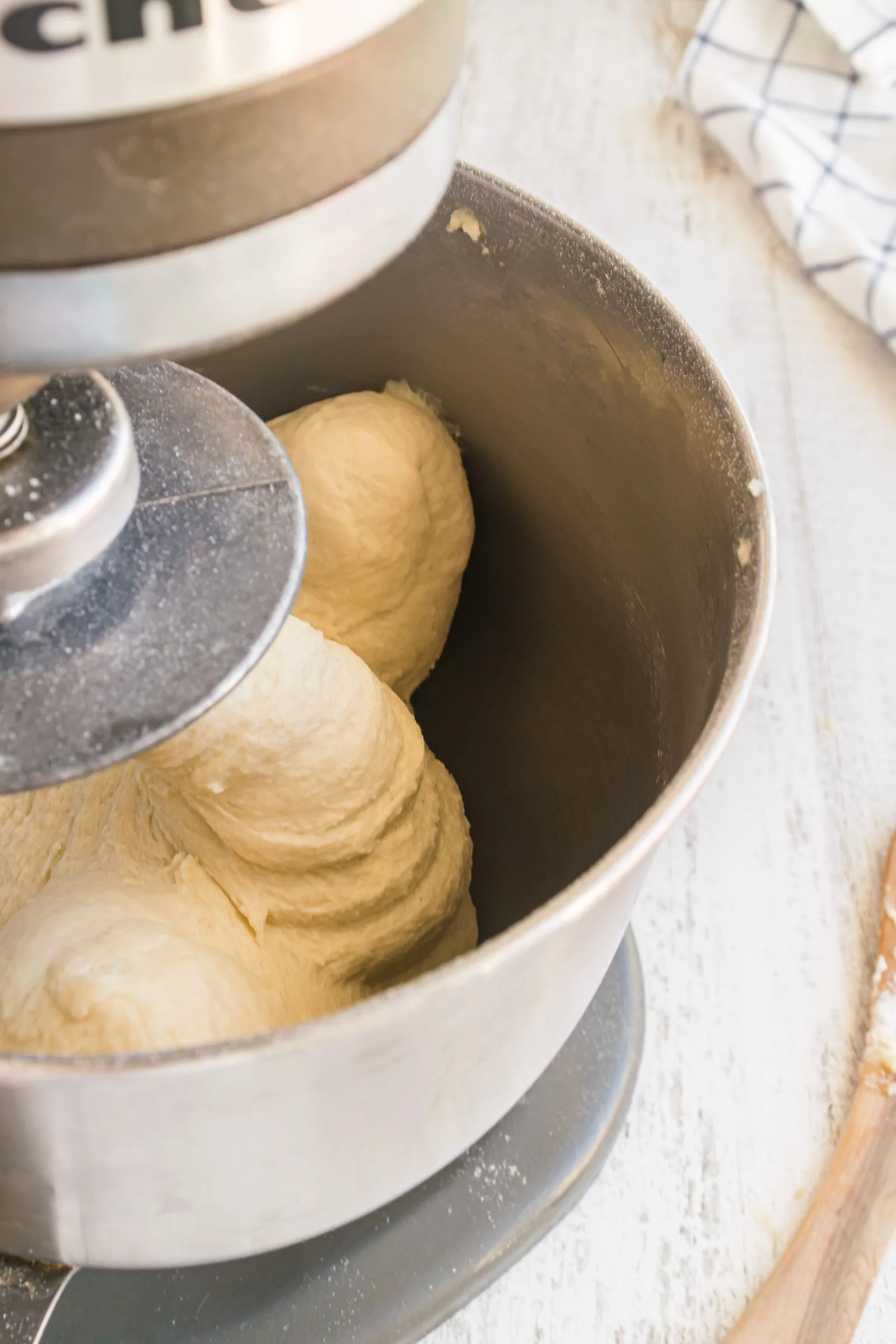
In France, the law of May 25, 1998 reserves the title of baker and the bakery sign for those who themselves ensure, on the point of sale, from selected raw materials, the kneading of the dough, its fermentation, its shaping and its baking. No freezing at any stage. The legislator therefore wrote in black and white that it is the gesture done on the spot that defines the trade. It is word for word what the coffee profession defends at the counter, except that in bakeries it has the force of law and the sign shouts it to the street.
And this is where it becomes instructive. There are in France tens of thousands of perfectly compliant bakeries, which knead, which let the dough rise and which bake on the spot, and whose bread is mediocre. Not illegal. Not dishonest. Just mediocre. The sign tells the truth and says nothing.
The reason is simple, and it holds for any rule: you cannot legislate on a result. An inspector can verify that there is a kneading machine, an oven, and no frozen dough in the cold room. They cannot verify that a bread is good. The rule therefore rested on what is verifiable, that is, on the presence of the gesture.
And a market always learns to satisfy exactly the criterion it is faced with, no more, no less. You can start from a ready-to-use mix, knead quickly and hard, push fermentation to three hours with a lot of yeast, bake short, and turn out a mediocre bread while respecting every word of the law.
France, moreover, clearly sensed the hole, since a second text was needed for the other half of the subject. The decree of September 13, 1993 on traditional French bread (pain de tradition française) does not speak of the gesture at all: it speaks of the material. Wheat flour, water, salt, yeast or sourdough, no freezing, and a very short list of tolerated additives, such as fava bean, soy and malt.
Two instruments, two objects: a text that protects the gesture, a text that protects the recipe. You only have to look at a shopfront to see which of the two is written in big letters.
What this foretells for us seems fairly clear to me. Suppose the coffee profession wins its arm wrestle and manages to make the visible gesture the official definition of the trade. It will get what the bakery got: the guarantee that a human did something here, and strictly no guarantee about the cup. One day we will read “espresso prepared on site” the way we read “bread baked on site,” and it will say nothing about what is inside.
That is not an argument against the gesture. It is an argument against the idea that the gesture can stand in for proof. A gesture proves a presence, it has never proved a quality. As soon as we make it carry that load, two things happen at once, and they are equally awkward: we let in everyone who does the gesture and nothing else, and we shut out those who get the result by other means.
The question I ask now
I will keep answering “what is the best machine,” because it is an honest question and it often has a practical answer. But I ask one before it, and it looks like nothing.
If the counter were closed, if the machine were in a room next door and nobody in the dining room could see it, would you choose the same one?
Both answers are good, and that is why the question works. If it's yes, we are talking about the cup, and then the money must go where the research puts it: the grinder, the water, stability, the morning adjustment time, the training you can actually sustain over time with the team turnover you have. If it's no, very well, but we have just discovered together that part of the budget is a stage budget, and we can finally size it as such, instead of smuggling it through in a discussion about extraction.
My job is not to arbitrate between the two. Both are real, both sell, and an establishment that embraced only the first would be as badly off as one that embraced only the second.
My job is to prevent someone from paying for one while thinking they have bought the other.
Notes and sources
- On extraction and tamping: M. I. Cameron et al., “Systematically Improving Espresso: Insights from Mathematical Modeling and Experiment,” Matter 2, 631-648, March 2020. Tamping with no appreciable effect on flow time and yield, dominant role of the grinder and water pressure, grind too fine tied to target times, possible material savings of up to 25%.
- On milk art: J. van Doorn et al., “Latté Art Influences both the Expected and Rated Value of Milk-Based Coffee Drinks,” Journal of Sensory Studies, 2015.
- On the handmade: C. Fuchs, M. Schreier, S. Van Osselaer, “The Handmade Effect: What's Love Got to Do with It?” Journal of Marketing 79(2), 98-110, March 2015.
- On the stage and backstage: E. Goffman, La mise en scène de la vie quotidienne, 1959.
- On the automatic tamper: manufacturer documentation and trade press, arguments of consistency (force variation on the order of one percent) and of preventing musculoskeletal disorders.
- On the gesture written into law: law no. 98-405 of May 25, 1998, title of baker and bakery sign, kneading, fermentation, shaping and baking on the point of sale, no freezing at any stage, codified in the consumer code.
- On the recipe written into law: decree no. 93-1074 of September 13, 1993, pain de tradition française, wheat flour, water, salt, yeast or sourdough, no freezing, limited additives (fava bean 2%, soy 0.5%, wheat malt 0.3%).