Cold coffee and nitro
How does cold extract?
Start the scene or choose a stage. The animation simplifies the mechanism; what follows gives the details and the available references.
Cold drip, called Kyoto-style or Dutch coffee, drips water onto the grounds drop by drop for hours. Without heat to hurry things along, extraction drags, and it takes that time to draw anything from the bean.
Read the stages without animation
- Kyoto cold dripCold drip, called Kyoto-style or Dutch coffee, drips water onto the grounds drop by drop for hours. Without heat to hurry things along, extraction drags, and it takes that time to draw anything from the bean.
- Immersion for 12 to 24 hoursCommercial cold brew is American: Todd Simpson patents the Toddy system in 1964, a coarse grind immersed for 12 to 24 hours.
- What cold changesAt low temperature everything diffuses more slowly: over a given time, it is the fast compounds that arrive in quantity, the others stay partly in the bean. Rao and Fuller find a lower titratable acidity, the total quantity of acids, for a similar pH; and more caffeine after 24 hours cold than after 6 minutes at 98 °C.
- Filter, dilute, keepThe coffee passes through a felt; the concentrate is then diluted to 1:1 or 2:1 and keeps for up to eight weeks, which makes it possible to prepare in advance and in volume.
- NitroNitro is a cold brew saturated with nitrogen and drawn from a tap like a stout, hence its tight dark-beer foam. It appears around 2013, and Starbucks rolls it out in 500 stores in the summer of 2016.
To remember: Cold does not extract less, it extracts differently and for much longer: a round, low-acid, not very aromatic cup.
In history: Todd Simpson, a chemical engineer from Cornell, had tasted a cold concentrate in Latin America in 1964.
Read the full article and its sources ↓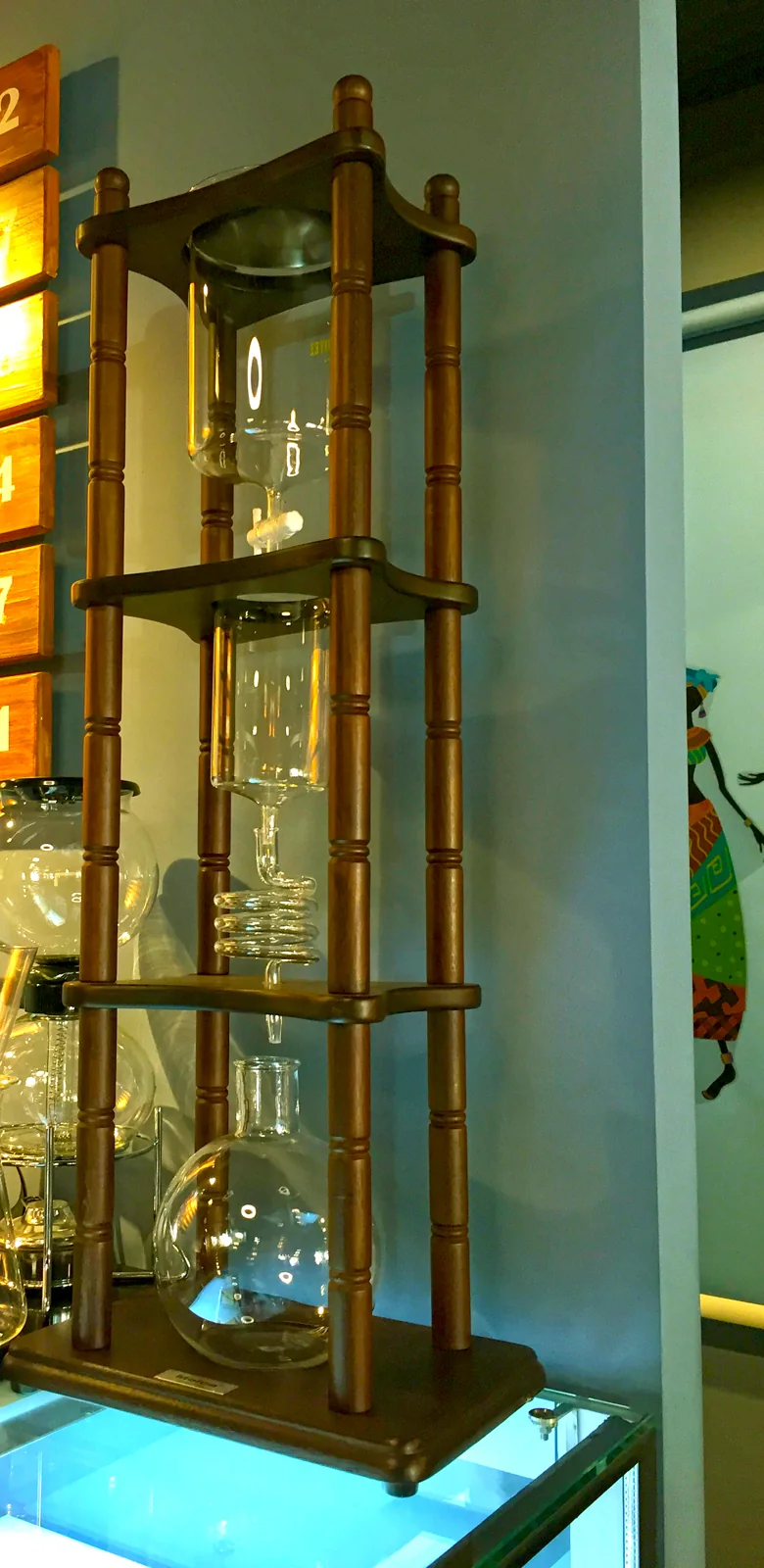
Cold drip, called “Kyoto-style” or “Dutch coffee,” drips water onto the grounds drop by drop for hours. The apparatus is traditional in Japan. The slowness is not a pose: without heat to hurry things along, extraction drags, and it takes that time to draw anything from the bean.
The commercial cold brew, for its part, is American. Todd Simpson tastes in Peru, in 1963 according to the manufacturer, a cold-steeped coffee served hot, then launches the Toddy system, protected by design patents of 1967 and 1973: immersion of a coarse grind for 8 to 24 hours, filtration through felt, concentrate then diluted to 1:1 or 2:1.
The concentrate keeps for more than a week in the refrigerator, according to the manufacturer. It is this detail that makes the method workable in a shop: one prepares in advance and in volume, instead of making the cup on demand.
Two measurements frame what cold changes. Rao and Fuller (Scientific Reports, 2018) find a lower titratable acidity when cold, for a similar pH. Titratable acidity counts the total quantity of acids present, measured by neutralizing the sample; pH, for its part, only tells their activity at the moment of reading. The two can therefore diverge, and that is the case here.
Fuller and Rao (2017), who steep at room temperature, between 21 and 25 °C, see caffeine plateau between 6 and 7 hours; they measure more of it after 24 hours cold than after 6 minutes at 98 °C, at the same brew ratio, clearly for the coarse grind, with no significant difference for the medium. Cold therefore does not extract less: it extracts differently, and for much longer.
The physics is that of immersion, slowed by the cold. At low temperature everything diffuses more slowly, and over a given time it is the fast-diffusing compounds that arrive in quantity. The others stay partly in the bean. Hence the cup we know: round, low in acidity, not very aromatic.
Nitro is a cold brew saturated with nitrogen and drawn from a tap like a stout, which gives it the tight foam of a dark beer. It appears in 2012-2013, and three houses dispute its paternity: Cuvee in Austin, which serves it to the public in the summer of 2012 according to the roaster, Stumptown in Portland, which installs its taps in June 2013, and The Queens Kickshaw in New York. Starbucks rolls it out in 500 stores in the summer of 2016, and thereby moves it from the neighborhood counter to the chain.
How big is this market? Cold brew was worth 3.87 billion dollars in 2025 according to Fortune Business Insights, 3.43 according to Market Research Future. Two firms, the same object, a gap of several hundred million: caution is called for with these figures. Ready-to-drink makes up more than 60% of sales, and North America 35.8%.
Toddy, The Toddy story and What is cold brew (toddycafe.com, accessed Oct. 21, 2026); design patents US D208 032 (1967) and D229 530 (1973); Wikipedia, Cold brew coffee and Coffee preparation (Sept. 7, 2026); Fortune Business Insights, Cold Brew Coffee Market (2025); Market Research Future (2025)In this plateThe 17 sections
- 01What is extracted, and how it is measured
- 02Seven centuries of utensils
- 03Decoction: ibrik, cezve, Turkish coffee
- 04Steeping: cloth bag, French press, tasting cup
- 05Gravity percolation, from De Belloy to the V60
- 06Filters: paper, metal, cloth
- 07Percolators and electric coffee makers
- 08The siphon: steam pressure then vacuum
- 09Steam pressure: Rabaut, Loysel, the moka pot
- 10Espresso, from Moriondo to the E61
- 11Espresso today: machines, technique, profiling
- 12The grind: grinders, fines, retention
- 13Milk
- 14Cold coffee and nitro
- 15Measuring: scale, refractometer, thermometer, sieves
- 16Today
- 17Archive plates
The table of contents, with the first sentence of each section