The siphon: steam pressure then vacuum
How does the siphon make coffee rise and then fall back?
Start the scene or choose a stage. The animation simplifies the mechanism; what follows gives the details and the available references.
In the lower globe, which is heated, the steam pressure adds to that of the air expanded by the heat.
Read the stages without animation
- Heat the bottom globeIn the lower globe, which is heated, the steam pressure adds to that of the air expanded by the heat.
- The water rises through the tubeWhen this pressure exceeds atmospheric pressure, it pushes the water up the tube into the upper globe, where the grounds wait.
- Steep for one to two minutesOne steeps for one to two minutes at a little under 100 °C. The heat, which stays on, compensates for losses: it is a hot, stable method.
- Cut the heat: the vacuumThe heat is cut: the steam condenses, the pressure falls, and the atmosphere sends the coffee back down through a filter of cloth, metal or paper, or a simple glass rod. The spent grounds stay at the top.
To remember: The siphon is a physics apparatus: steam makes the water rise, its condensation makes the coffee come back down.
In history: Nörrenberg describes it in 1827; Japan, with Hario and Yama, has kept the tradition and the manufacture.
Read the full article and its sources ↓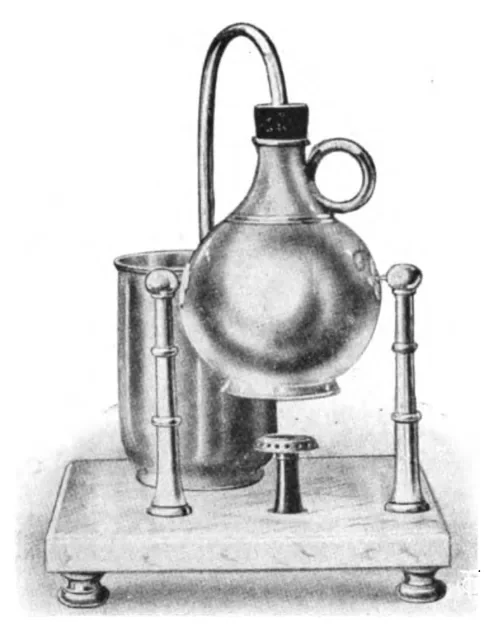
The siphon is a physics apparatus. In the lower globe, heated, the vapor pressure added to that of the expanded air exceeds atmospheric pressure and pushes the water into the upper globe where the grounds wait; one steeps for one to two minutes at a little under 100 °C, cuts the heat, the vapor condenses, the pressure falls, and the atmosphere sends the coffee back down through a filter of cloth, metal, paper or a simple glass rod. Nörrenberg describes it in 1827; Vardy and Platow patent in England in 1839 the glass globe urn; Robert Napier, of the Clyde engineering firm, presents in 1840 his distillation and filtration machine, never patented; Mme Vassieux, of Lyon, obtains in 1842 the first French patent for a glass coffee maker. The “double glass globes” were very popular in Europe until the end of the 19th century, then enjoyed a revival in the United States in 1914-1916 (Silex), with two survivors still made in 1922, with alcohol lamp, gas or electricity; Inez Peirce of Chicago files in 1930 the first automatic siphon. Japan (Hario, Yama) has kept the tradition and the manufacture. The constant heat compensates for losses, which makes the method hot and stable; Gagné recommends replacing the cloth with a paper adapter.
Ukers 1922, ch. XXXIV, ch. XXXVI and chronology (1839, 1840, 1842); Wikipedia, Vacuum coffee maker and Coffeemaker (Sept. 7, 2026); Gagné 2021, pp. 124-125, 153In this plateThe 17 sections
- 01What is extracted, and how it is measured
- 02Seven centuries of utensils
- 03Decoction: ibrik, cezve, Turkish coffee
- 04Steeping: cloth bag, French press, tasting cup
- 05Gravity percolation, from De Belloy to the V60
- 06Filters: paper, metal, cloth
- 07Percolators and electric coffee makers
- 08The siphon: steam pressure then vacuum
- 09Steam pressure: Rabaut, Loysel, the moka pot
- 10Espresso, from Moriondo to the E61
- 11Espresso today: machines, technique, profiling
- 12The grind: grinders, fines, retention
- 13Milk
- 14Cold coffee and nitro
- 15Measuring: scale, refractometer, thermometer, sieves
- 16Today
- 17Archive plates
The table of contents, with the first sentence of each section