Decoction: ibrik, cezve, Turkish coffee
How is Turkish coffee made?
Start the scene or choose a stage. The animation simplifies the mechanism; what follows gives the details and the available references.
Water, sugar and coffee go together into the cezve, the small long-handled pot. The powder is very fine, 75 to 125 microns, finer than for espresso. The modern version starts from cold water, unlike the old practice where the powder was thrown into water already boiling.
Read the stages without animation
- Everything in the pot, coldWater, sugar and coffee go together into the cezve, the small long-handled pot. The powder is very fine, 75 to 125 microns, finer than for espresso. The modern version starts from cold water, unlike the old practice where the powder was thrown into water already boiling.
- Heat slowly, let it riseHeating is slow, until the foam rises. It is a short immersion at high temperature: the particles are so fine that they give up almost everything, and that they stay in suspension instead of falling to the bottom.
- Off the heat, two or three timesIt is taken off the heat and left to rise two or three times. Never a hard boil: it destroys the foam and cooks the grounds. Around 1650, the tinned copper pot went back on the fire a dozen times, and Dufour forbade stirring.
- Serve unfilteredIt is served unfiltered: the grounds fall to the bottom of the cup, the fines stay in suspension and make the thick body. As in any unfiltered beverage, the diterpenes of coffee, cafestol and kahweol, end up in the cup: paper would retain them, the grounds that settle retain nothing.
To remember: Decoction is the only method where the grounds stay in the cup: everything the powder contains, or nearly, ends up drunk.
In history: Sugar enters coffee in Cairo around 1625; UNESCO inscribes Turkish coffee culture as intangible heritage in 2013.
Read the full article and its sources ↓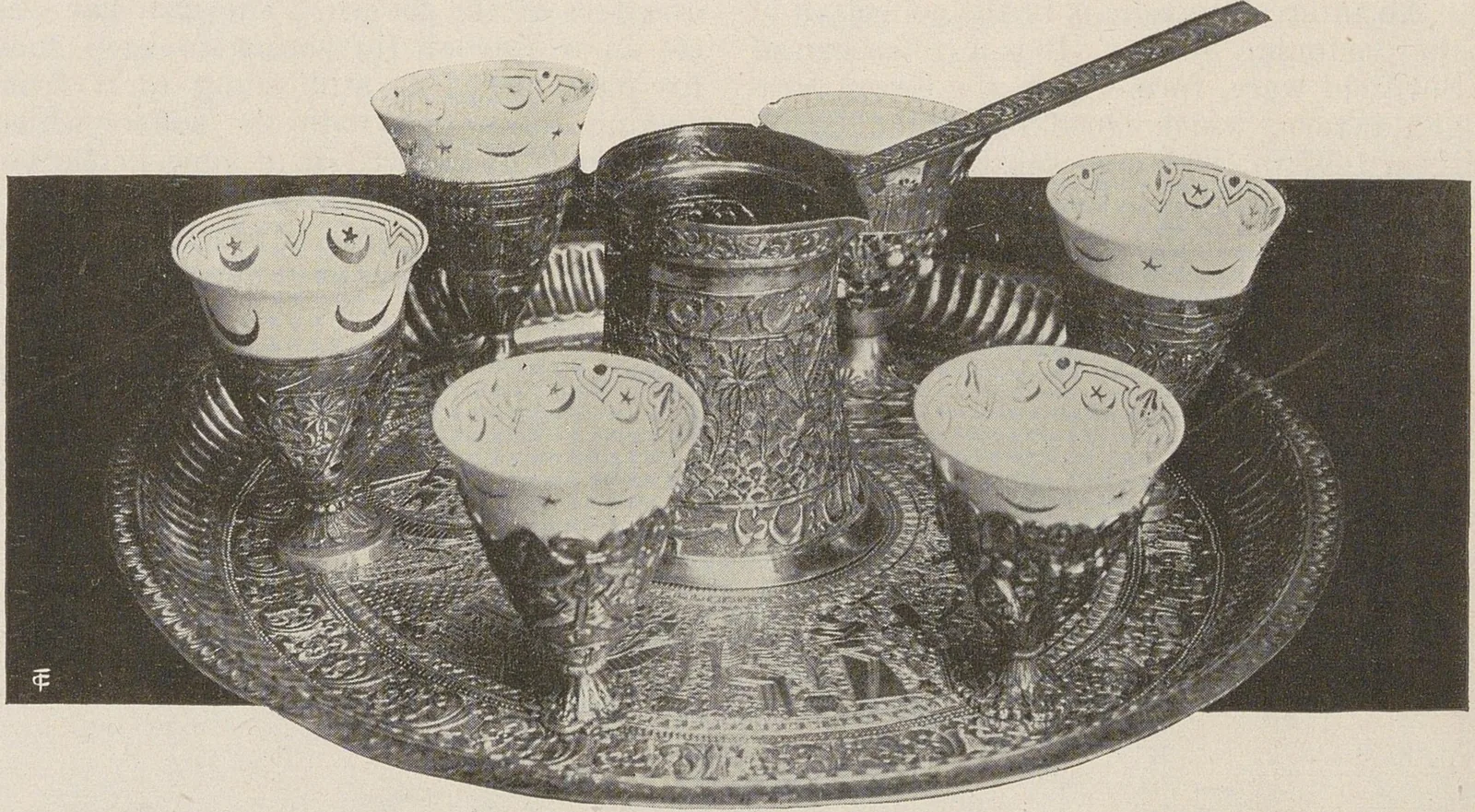
The oldest method is also the only one where the grounds stay in the cup. In the 16th century, the common Levantine practice was to soak the powder for a day, reduce the liquor by half by boiling, filter it and keep it in earthenware pots; the ibrik replaces it with an on-the-spot preparation. Around 1650 appears the covered pot of tinned copper, with a swollen body and a narrow neck, into which one pours one and a half times the volume of the cup, throws in the powder at the boil, takes it off the fire and puts it back a dozen times, then sets the pot in hot ashes so that the grounds settle.
Dufour prescribes sipping the scalding coffee from the edge of the cup without dipping the tongue in it, and forbids stirring: “the grounds are worth nothing.” La Roque describes the gesture of the Arabs who wrap the pot in a wet cloth as it comes off the fire: the grounds fall all at once, a cream rises, and they breathe in its vapor. Sugar enters coffee in Cairo around 1625.
Ukers 1922, ch. XXXVI, citing Dufour 1685 and La Roque 1716; Dufour, De l'usage du caphé (1685) via LC ch. 7 and the Dufour-La Roque digestThe modern version was inscribed by UNESCO as intangible heritage in 2013, under the name Turkish coffee culture. It starts from cold water. Both practices are old: Thevenot and Dufour describe the powder thrown into boiling water, but Rambaldi notes as early as 1691 that in Arabia, in Turkey, among travelers and in the armies, the powder is put into cold water before boiling.
The powder is very fine, 75 to 125 microns, finer than espresso. Water, sugar and coffee go together into the cezve, the small long-handled pot. Heating is slow, until the foam rises. It is taken off the heat, left to rise two or three times, and served unfiltered.
Never a hard boil: it destroys the foam and cooks the grounds.
The physics is that of a short immersion at high temperature. The particles are so fine that they give up almost everything, and that they stay in suspension instead of falling to the bottom. Hence the thick body, and a bitterness that is corrected with sugar rather than by extracting less.
A consequence goes more unnoticed. As in any unfiltered beverage, the diterpenes of coffee, cafestol and kahweol, end up in the cup. Paper retains them. The grounds that settle at the bottom retain nothing.
UNESCO, Turkish coffee culture and tradition, representative list 2013; Wikipedia, Turkish coffee (Sept. 7, 2026); Urgert and Katan 1997 on cafestol, via Wikipedia, CafestolIn this plateThe 17 sections
- 01What is extracted, and how it is measured
- 02Seven centuries of utensils
- 03Decoction: ibrik, cezve, Turkish coffee
- 04Steeping: cloth bag, French press, tasting cup
- 05Gravity percolation, from De Belloy to the V60
- 06Filters: paper, metal, cloth
- 07Percolators and electric coffee makers
- 08The siphon: steam pressure then vacuum
- 09Steam pressure: Rabaut, Loysel, the moka pot
- 10Espresso, from Moriondo to the E61
- 11Espresso today: machines, technique, profiling
- 12The grind: grinders, fines, retention
- 13Milk
- 14Cold coffee and nitro
- 15Measuring: scale, refractometer, thermometer, sieves
- 16Today
- 17Archive plates
The table of contents, with the first sentence of each section