The coffee berry borer, the chief enemy
How does the berry borer enter the bean?
Start the scene or choose a stage. The animation simplifies the mechanism; what follows gives the details and the available references.
The female Hypothenemus hampei, an African beetle of 1.5 to 1.6 mm, flies from a dried black berry, her shelter during the off-season, to a firm cherry. She looks for a precise hardness of the albumen, the developing seed: that of fruits three to four months old, beyond 5 mm. She attacks at the top, the navel zone.
Read the stages without animation
- Fly, choose, attack at the navelThe female Hypothenemus hampei, an African beetle of 1.5 to 1.6 mm, flies from a dried black berry, her shelter during the off-season, to a firm cherry. She looks for a precise hardness of the albumen, the developing seed: that of fruits three to four months old, beyond 5 mm. She attacks at the top, the navel zone.
- Piercing the pulp, then the parchmentShe pierces the mesocarp, that is, the pulp, then the parchment, the envelope around the bean. As long as she is in the pulp, a treatment can still reach her.
- Laying in the seedShe sets up her egg chamber in the seed itself and lays 30 to 50 eggs there, in clutches of 4 to 8. Once inside the bean, no treatment reaches her any more.
- The larvae eat the beanThe larvae feed on the seed. The full cycle lasts 20 to 35 days, or 24 to 45 depending on temperature. The males, smaller and with atrophied wings, never leave the berry: they fertilize their sisters in the gallery and die there. They make up only 8 to 12% of the population.
- Already fertilized females take flightThe females leave already fertilized: a single one is enough to found a lineage on an unaffected plot. One cherry can shelter up to a hundred individuals, one tree three to five generations, and every berry forgotten on the tree or on the ground becomes a focus for the next harvest.
To remember: The berry borer is fought before it reaches the seed, or by depriving it of its refuge berries: inside the bean, nothing touches it any more.
In history: In 1955, Vayssière had berry collection stopped at four in the afternoon, the hour the females take flight.
Read the full article and its sources ↓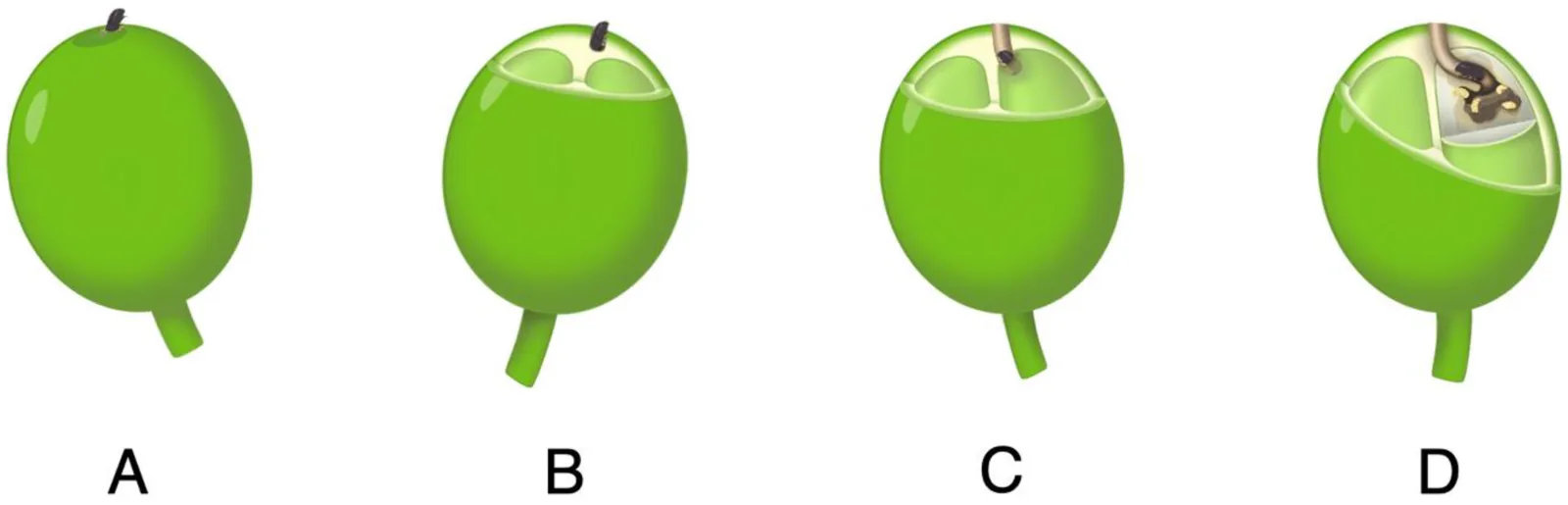
Hypothenemus hampei (Stephanoderes coffeae in Vayssière, who defends that name in a footnote and lost) is an African beetle. The female measures 1.5 to 1.6 mm, or 1.4 to 1.8 according to current sources.
Her route through the fruit explains why she is so hard to reach. She flies, attacks the cherry at the top, the navel zone, pierces the mesocarp and then the parchment. She then sets up her egg chamber in the seed itself. As long as she is in the pulp, a treatment can still reach her; once inside the bean, it cannot.
Egg laying is abundant: 30 to 50 eggs in clutches of 4 to 8. The full cycle lasts 20 to 35 days, or 24 to 45 depending on temperature. The female lives about three and a half months.
The male, for his part, never leaves. Smaller, with atrophied wings, he does not leave the berry where he was born: he fertilizes his sisters in the gallery and dies there. Males make up only 8 to 12% of the population, thirteen females to one male.
This biology has a heavy consequence. Each cherry is a closed world from which females leave already fertilized. A single one is therefore enough to found a lineage on an unaffected plot, without having to meet a male there. And inbreeding quickly fixes whatever works.
The densities reached are in proportion to this arrangement: a single cherry can shelter up to a hundred individuals, a tree three to five generations.
Coste 1955, p. 285-288 (P. Vayssière); UCDA 2019, p. 76-77; Wikipedia, “Coffee borer beetle”, accessed 09/07/2026; LC ch. 15The female looks for a precise hardness of albumen, that of fruits three to four months old, beyond 5 mm in diameter. Albumen is the developing seed, and its firmness changes with the age of the fruit. The UCDA has the insect enter about eight weeks after flowering, then wait for the bean to harden before laying.
It has a predilection for dried black berries left on the tree or on the ground. They serve it as shelter and nursery during the off-season, which makes every forgotten fruit a focus for the next harvest.
Losses are quantified differently depending on the source and the period. Vayssière gives up to 25% of the crop and a commercial downgrade of up to 50%. The UCDA speaks of 50 to 100% yield loss in the case of heavy infestation, with young cherries dropping and lots being downgraded. In Hawaii, poorly kept farms reached 95% infested cherries before 2011.
The insect's trip around the world is dated, and it begins with seeds. Vayssière places the contamination of Java by African seeds in 1909, and that of São Paulo from Java in 1913; current sources give 1926 for Brazil. Then come Guatemala and Mexico in the 1970s, Colombia in the late 1980s, Puerto Rico in August 2007, Kona (Hawaii) in August 2010.
Coffee berry borer
| Agent | Hypothenemus hampei, beetle of 1.4-1.8 mm, monophagous |
| Cycle | 30-50 eggs, 20-45 d, 13 females to 1 wingless male; 3-5 generations per tree |
| Conditions | fruits of 3-4 months, over 5 mm; dried berries on the ground or on the tree; afternoon flight |
| Dispersal | short flight; seeds and cherries (Java 1909, Brazil 1913/1926, Colombia 1980s, Hawaii 2010) |
| Losses | up to 25% (Vayssière), 50-100% in heavy infestation (UCDA); 20 M families affected |
| Control | picking up, fortnightly picking, wet processing, Brocap 15/ha, Beauveria (30-40%), parasitoids, birds; endosulfan banned 2011 |
In all, the insect weighs on the economy of more than twenty million families.
Coste 1955, p. 285-288; UCDA 2019, p. 76-77; Lee et al. 2023; Wikipedia, “Coffee borer beetle”; LC ch. 15The control of 1955: systematic collection of all berries during the three months following the harvest, three-minute scalding, operations stopped at four in the afternoon, the hour the females take flight. A processing fact: the wet process (pulping, fermentation, washing) drowns galleries and larvae; the dry process spreads thousands of berries for days in the exact state the insect prefers, within flight range of the plots (see processing).
The figure of a fermentation “at 60 °C” supposed to kill it, in the same chapter, is manifestly wrong. Biological control was already described: the African hymenopteran Prorops nasuta, one individual of which destroys a hundred eggs or fifty larvae, Heterospilus coffeicola, and the fungus Beauveria bassiana, which colonizes the adult from the inside.
Coste 1955, p. 285-288 (Vayssière); LC ch. 15Against the berry borer, there is no single weapon. What is called integrated pest management is a stack of small measures, none of which suffices alone. Here is the one the UCDA describes for Uganda, item by item.
Hygiene. Pick at least every two weeks, collect and then bury or burn fallen berries, strip old berries left on the tree. Each of these forgotten berries is a hotel for the insect during the off-season.
Shade pruning. It exposes the insect to its predators. And shade trees also attract more birds: in Costa Rica, warblers have been measured cutting berry borer populations by half.
Traps. Brocap or homemade, the latter being nothing more than a clear bottle with a vial of 75% ethanol attractant. The protocol matters: 15 traps per hectare, placed at two thirds of the height of the trees, cleaned every two weeks.
Parasitoids, that is, insects that lay their eggs in the berry borer and kill it as they develop: Cephalonomia stephanoderis, Prorops nasuta, Phymastichus coffea.
The fungus Beauveria bassiana, which infects the insect. It needs precise conditions to act: above 80% relative humidity, between 25 and 30 °C. Fresh deposits then infect 30 to 40% of the females searching for a host. The Brazilian review judges it costly and of variable efficacy, which is the honest summary.
Chemistry remained, and it is closing. Endosulfan, long the reference weapon in Latin America, was listed under the Stockholm Convention on April 29, 2011, and so is destined for elimination. The UCDA still cites fenitrothion, pyrethroids and chlorpyrifos, for which the European Union lowered the residue limit to 0.01 mg/kg as of November 13, 2020, which in practice amounts to banning its use on coffee destined for Europe.
Does this whole stack of measures work? Hawaii supplies the best-quantified answer. Adoption of the measures there rose from 8% of producers in 2011 to 59% in 2021. Average yield gained 32%, the price per pound 41%, and revenue per acre 60%. Cumulative benefits are estimated at 251 million dollars, of which 52 million from Beauveria alone, 69 from the first integrated pest management and 130 from research-based integrated pest management.
UCDA 2019, p. 77-78; Wikipedia, “Coffee borer beetle”; Lee et al. 2023; Frontiers in Sustainable Food Systems 5 (2021), agroecological management of coffee pests in Brazil; ICO, “Growing coffee without endosulfan”; Regulation (EU) 2020/1085In this plateThe 19 sections
- 01The disease triangle
- 02Fungi, spores, obligate parasites
- 03Orange rust: biology and cycle
- 04Ceylon, 1869-1890: the birth of plant pathology
- 05A fungus's world tour, 1872-2020
- 06Races, SH genes and the Oeiras catalog
- 07Resistance: Kent, S.795, the Timor Hybrid and its descendants
- 08The great coffee leaf rust of 2008-2013, country by country
- 09Milder nights
- 10The erosion of resistance, 2017-2024
- 11Diagnosis, surveillance and warning
- 12The coffee berry borer, the chief enemy
- 13Coffee wilt disease: from the Ubangi to Uganda
- 14Coffee berry disease, Kenya 1922 and 1971
- 15Nematodes, bugs, leaf miners, scale insects, borers
- 16Diseases of soil, of fruit, and what is not alive
- 17The pharmacopoeia of yesterday and today
- 18Control methods compared
- 19Today: 2023-2026
The table of contents, with the first sentence of each section