Orange rust: biology and cycle
How does orange rust drain a coffee plant?
Start the scene or choose a stage. The animation simplifies the mechanism; what follows gives the details and the available references.
The wind lands a urediniospore, the orange spore of rust, on the underside of a leaf. It will do nothing without liquid water: rain, dew, mist or sprinkling. Humid air is not enough. The BSPP retains 6 to 24 hours of leaf wetness: risk is counted in hours of wet leaf, not in millimeters of rain.
Read the stages without animation
- A spore, a drop of waterThe wind lands a urediniospore, the orange spore of rust, on the underside of a leaf. It will do nothing without liquid water: rain, dew, mist or sprinkling. Humid air is not enough. The BSPP retains 6 to 24 hours of leaf wetness: risk is counted in hours of wet leaf, not in millimeters of rain.
- Germinating in two to four hoursIn a drop of water at 24 °C, the spore germinates in two to four hours and sends out a tube toward a stoma. The useful window runs from 15 to 28 °C according to McCook; the Bebber model puts germination between 12.9 and 30.9 °C, with an optimum at 21.4 °C.
- Entering through a stoma, hidingAn hour later, the tube enters through a stoma, one of the tiny openings through which the leaf breathes. The fungus then spreads in the leaf without anything showing: the infection becomes visible only twelve to eighteen days later.
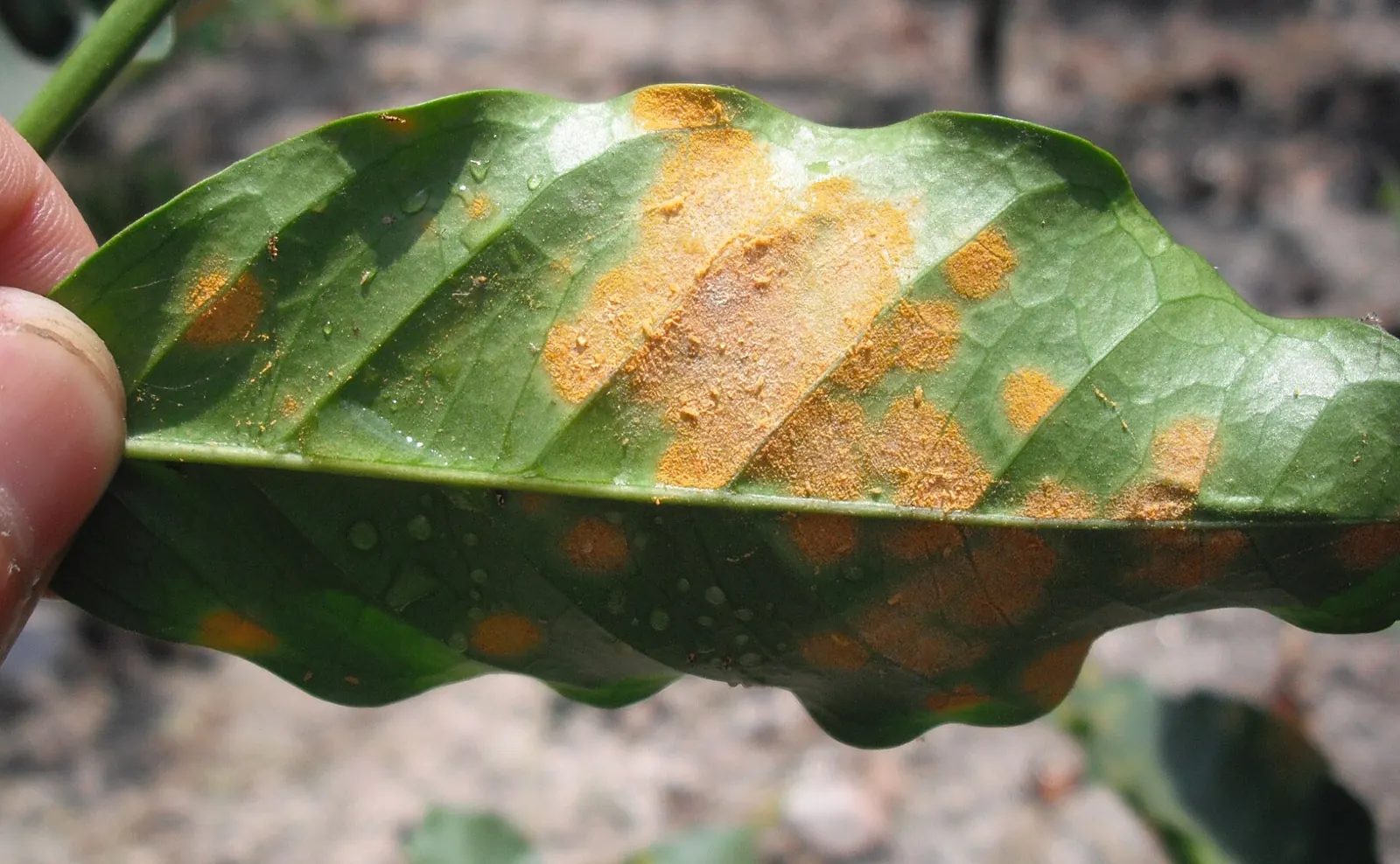
- An orange pustule, thousands of sporesAt three weeks, the yellowish spot of one to two millimeters is covered with an orange powder: the pustule emerges through the stoma and releases its urediniospores. One lesion yields 300,000 to 400,000 of them, in four to six waves over three to five months, and a range of 22 to 27 °C multiplies sporulation by 2,000. Current sources count 25 to 35 days between two cycles.
- The tree loses its leaves and wears outThe tree does not die: it loses its leaves, stops making sugars, draws on its root reserves and fills its cherries poorly. Because the buds that bear the fruiting branches never renew themselves, each defoliation takes away productive framework, and a plantation is lost in three or four seasons.
To remember: The water drop decides: without liquid water on the leaf, the spore does not germinate, whatever the region's rainfall.
In history: Barat timed the infection as early as 1955; his durations have not changed, and detection remains structurally three weeks behind contamination.
Read the full article and its sources ↓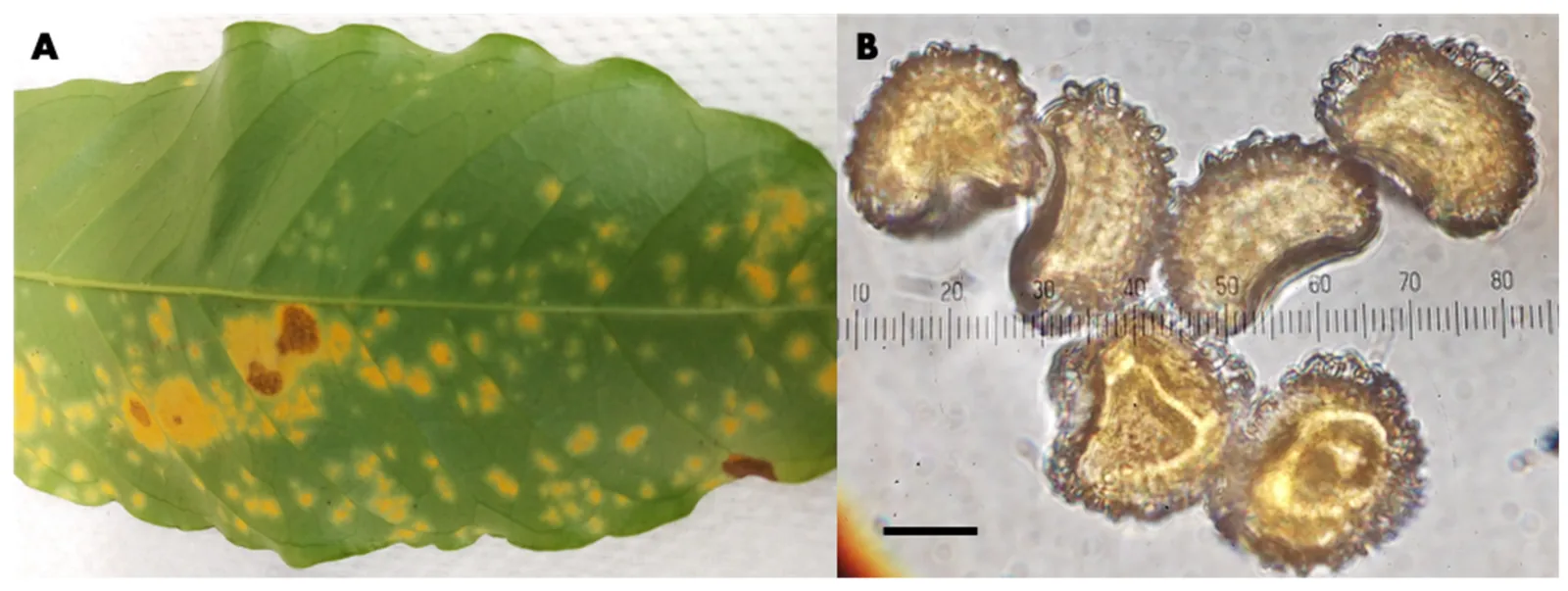
The symptoms described by Barat in 1955 have not changed: on the underside of the leaf, yellowish spots of 1 to 2 mm, scattered and then coalescing, translucent against the light like oil stains on paper, covered with a bright orange powder of urediniospores that stays on the fingers. Old lesions turn brown. The tree does not die: it loses its leaves, stops making sugars, draws on its root reserves, fills its cherries poorly and does not prepare the next harvest.
A plantation is lost in three or four seasons, through exhaustion, without a single tree falling. Since the primary buds that bear the fruiting branches never renew themselves (Meier, cited by Coste), each defoliation takes away some of the productive framework.
Coste 1955, p. 35 and 224-226; UCDA, Robusta Coffee Handbook (2019), p. 85; LC ch. 12-13Barat timed the infection, and each duration explains a constraint in the field. In a drop of water at 24 °C, the spore germinates in two to four hours. An hour later, it sends out a tube that enters through a stoma, that is, through one of the tiny openings the leaf uses to breathe. The infection becomes visible only twelve to eighteen days later, and sporulation comes at three weeks. Current sources count 25 to 35 days between two cycles.
Temperature sets the useful window. McCook places it between 15 and 28 °C. The Bebber et al. (2016) model puts a finer figure on germination: minimum 12.9 °C, optimum 21.4 °C, maximum 30.9 °C. The BSPP retains 6 to 24 hours of leaf wetness, with an optimum of 21-25 °C.
Orange rust
| Agent | Hemileia vastatrix, basidiomycete, obligate parasite; lineages C1-C3, more than 50 races |
| Cycle | germination 2-4 h in water at 24 °C, stoma at +1 h, latent period 12-18 d, sporulation at 3 weeks; 300-400,000 spores per lesion |
| Conditions | leaf wet 6-24 h, 15-28 °C (optimum 21-25); mild nights shorten the cycle |
| Dispersal | wind (short), rain, people and plants (long); focal epidemic |
| Losses | 15% worldwide, 15-80% by country; $1-2bn/yr; Ceylon 68,787 → 14,170 ha |
| Control | copper, triazoles, strobilurins; SH varieties; pruning, managed shade, fertilization; 5% thresholds |
The decisive point lies in the word wet. Germination requires liquid water on the leaf: rain, dew, condensed mist, sprinkling. Humid air is not enough. What matters, then, is not a region's rainfall but the number of hours per year that a leaf stays wet within the right range. Two regions that receive the same amount of water do not carry the same risk.
The fungus's output also depends on heat. A lesion produces four to six waves of spores over three to five months, or 300,000 to 400,000 spores. Under controlled conditions, a range of 22-27 °C multiplies sporulation by 2,000 compared with 18-23 °C. Strong light with little nitrogen increases it further (Toniutti et al., 2017).
A practical consequence follows from these durations. What a producer notices one morning in the rows is the state of things three weeks earlier, since that is the time it takes for the spot to become visible. Detection is structurally behind contamination.
Coste 1955, p. 224-226 (Barat); McCook 2019, p. 39-41; Bebber, Delgado Castillo and Gurr, Philosophical Transactions B (2016); BSPP 2022, p. 10-11; Wikipedia, “Hemileia vastatrix”, accessed 09/07/2026; LC ch. 13Dispersal is by wind over short distances and by people over long ones: clothing, tools, and live plants exchanged between colonial administrations, aboard steamships that had just cut crossing times by half or two thirds. On site, the epidemic is focal: one focus, then spread step by step; Avelino showed that plots exposed to prevailing winds, at the edge of pastures, receive more spores, that rain washes spores off the leaves, and that shade trees reduce this washing.
McCook describes three altitude belts: at the bottom, arabica is impossible anyway and rust is at home; at the middle level (about 800 to 1,400 m depending on latitude), coexistence is possible but costly; at the top (above 1,500-1,600 m), rust exists without serious harm, because the cycle is slowed by cold. These belts are drawn in temperatures; meters are only a local translation of them.
McCook 2019, p. 5-6 and 39-41; BSPP 2022, p. 11-12 (Avelino et al. 2012, 2020); LC ch. 13Barat acknowledges in 1955 that the conditions for the shift to epidemic remain poorly understood: depending on the region, either the dry season or the rainy season is blamed; shade sometimes favors the disease (leaves wet longer, reduced temperature range), sometimes resistance (less stress, no exhausting overproduction). He recommends Bordeaux mixture at 1-1.5%, three to four applications a year, 6 to 10 hl/ha, the first one preventive.
A second rust, Hemileia coffeicola, identified in Cameroon in 1933, sporulates abruptly without prior necrosis; it never had the economic weight of the first. Three genetic lineages of H. vastatrix are now distinguished: C1 and C2, ancestral, infect diploid species (canephora, liberica, excelsa, racemosa); C3, called domesticated, infects only tetraploid arabica and its hybrids; they can hybridize.
The fungus reproduces clonally over almost its entire range, produces basidiospores with no known alternate host, and the appearance of new races is explained by a “cryptosexuality” during the formation of asexual spores.
Coste 1955, p. 224-226 (Barat); BSPP 2022, p. 9 and 20 (Silva et al. 2018; Carvalho et al. 2011); LC ch. 13In this plateThe 19 sections
- 01The disease triangle
- 02Fungi, spores, obligate parasites
- 03Orange rust: biology and cycle
- 04Ceylon, 1869-1890: the birth of plant pathology
- 05A fungus's world tour, 1872-2020
- 06Races, SH genes and the Oeiras catalog
- 07Resistance: Kent, S.795, the Timor Hybrid and its descendants
- 08The great coffee leaf rust of 2008-2013, country by country
- 09Milder nights
- 10The erosion of resistance, 2017-2024
- 11Diagnosis, surveillance and warning
- 12The coffee berry borer, the chief enemy
- 13Coffee wilt disease: from the Ubangi to Uganda
- 14Coffee berry disease, Kenya 1922 and 1971
- 15Nematodes, bugs, leaf miners, scale insects, borers
- 16Diseases of soil, of fruit, and what is not alive
- 17The pharmacopoeia of yesterday and today
- 18Control methods compared
- 19Today: 2023-2026
The table of contents, with the first sentence of each section