Coffee berry disease, Kenya 1922 and 1971
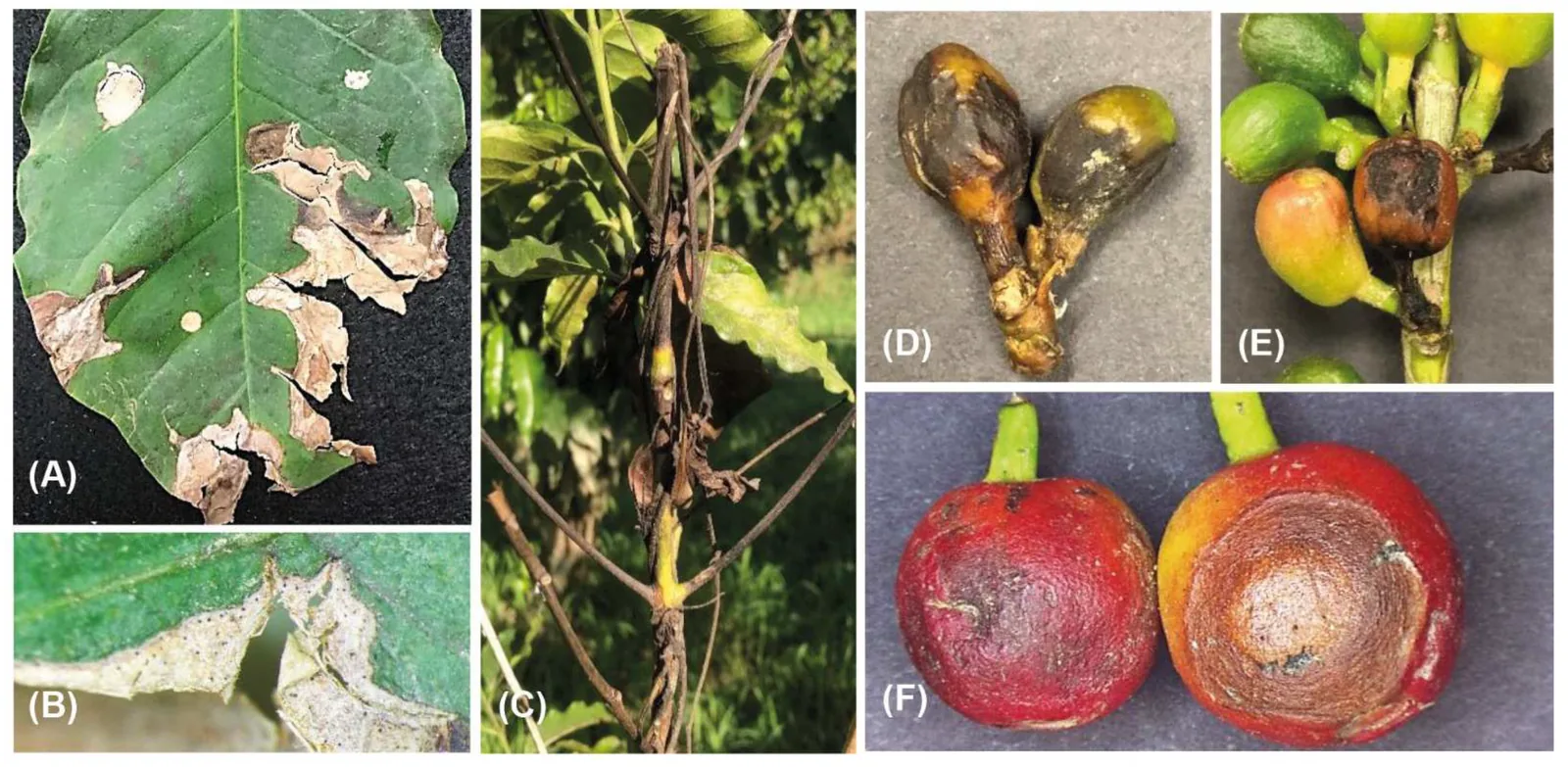
Barat describes anthracnose under the name Glomerella cingulata, whose asexual form is called Colletotrichum coffeanum. The fungus spares no organ: leaves, twigs, flowers, fruits. It ends in die-back, that is, the descending death of twigs, which starts at the tip and moves toward the trunk. One form attacks mainly the berries, and it is this one that bears a proper name, coffee berry disease (CBD).
Rayner's discovery in Kenya changes how the disease is read. The fungus is already settled in a latent state in the bark of trees that look healthy. It only waits for the plant to weaken before declaring itself.
The list of triggering factors then becomes legible, because none of them is the fungus itself: lack of shade and exhausting overproduction, erosion, weeds, wind, and, in arabica, defoliation by rust. Caring for the tree is here a sanitary measure, on a par with a treatment.
In 1955, then, the mechanism was held correctly with a wrong identification. The agent of CBD is not Colletotrichum coffeanum but a distinct species, Colletotrichum kahawae, described only in 1993.
Coste 1955, p. 220-222 (Barat); Waller et al., Mycological Research 97 (1993); LC ch. 15CBD is reported in 1922 on young plantations on the slopes of Mount Elgon, at Sotik, in western Kenya. It crosses the Rift Valley, from the east, only in 1939. In 1951, it covers all the Kenyan coffee zones.
From Kenya, it then spreads to the rest of the continent.
- 1930Angola
- 1937Congo
- 1955-57Cameroon
- 1959Uganda
- 1964Tanzania
- 1971Ethiopia
- 1985Malawi
CBD has remained confined to Africa. That is the reason for the strict quarantine imposed on African plant material headed for the Americas. American coffee plants have never met this fungus. Nobody wants to be the one who brought it there.
The Kenyan epidemic of 1967-68 triggers the genetic response. The Coffee Research Foundation launches a breeding program in 1971. The resistance then available came down to three genes of distinct origins. The T gene comes from the Timor Hybrid. The R gene comes from Rume Sudan, a wild accession from the Boma Plateau collected in 1941. The k gene comes from K7.
| Gene | Origin | Example |
|---|---|---|
| SH1, SH2, SH4, SH5 | Ethiopian arabica | landraces, Geisha (partial) |
| SH3 | C. liberica | S.26, S.288, S.795 (India) |
| SH6 to SH9 | C. canephora | Timor Hybrid, Catimor, Sarchimor, Castillo |
| T, R, k genes (CBD) | HdT, Rume Sudan, K7 | Ruiru 11, Batian |
Berry anthracnose (CBD)
| Agent | Colletotrichum kahawae (described 1993), latent in the bark |
| Cycle | attacks green berries; breaks out when the tree weakens |
| Conditions | cool, rainy highlands in East Africa; overproduction, erosion, rust |
| Dispersal | rain; Kenya 1922 → Angola 1930, Congo 1937, Cameroon 1955-57, Uganda 1959, Tanzania 1964, Ethiopia 1971, Malawi 1985 |
| Losses | Kenyan epidemic 1967-68; absent from the Americas (quarantine) |
| Control | genes T (HdT), R (Rume Sudan), k (K7): Ruiru 11 (1985), Batian (2010); copper and systemics on green berries |
The three are assembled in Ruiru 11 (1985). It is a composite F1 hybrid: the mother is a Catimor, the father a multicross of SL28, SL34, Rume Sudan, N39 and K7. The price to pay is manual pollination, on which the variety depends, because the seeds of an F1 do not give the same tree again.
Batian (2010) lifts this constraint: a tall variety, propagated by seed, it also aims at the SL cup. The WCR catalog rates Ruiru 11 highly resistant to rust and resistant to CBD, Batian resistant to CBD.
Elsewhere, tolerance was sought in the Ethiopian stock rather than in crossing. Java and Geisha were retained in Cameroon and Tanzania for their tolerance to CBD. Chemical control has not changed: copper and systemic fungicides in the rainy season, on the green berries, that is, at the moment and on the organ where the fungus strikes.
Journal of Plant Diseases and Protection (2023), “Coffee berry disease: a century-old anthracnose”; Current Agriculture Research Journal 9 (2021); WCR 2025, Ruiru 11 and Batian sheets; site/data.jsIn this plateThe 19 sections
- 01The disease triangle
- 02Fungi, spores, obligate parasites
- 03Orange rust: biology and cycle
- 04Ceylon, 1869-1890: the birth of plant pathology
- 05A fungus's world tour, 1872-2020
- 06Races, SH genes and the Oeiras catalog
- 07Resistance: Kent, S.795, the Timor Hybrid and its descendants
- 08The great coffee leaf rust of 2008-2013, country by country
- 09Milder nights
- 10The erosion of resistance, 2017-2024
- 11Diagnosis, surveillance and warning
- 12The coffee berry borer, the chief enemy
- 13Coffee wilt disease: from the Ubangi to Uganda
- 14Coffee berry disease, Kenya 1922 and 1971
- 15Nematodes, bugs, leaf miners, scale insects, borers
- 16Diseases of soil, of fruit, and what is not alive
- 17The pharmacopoeia of yesterday and today
- 18Control methods compared
- 19Today: 2023-2026
The table of contents, with the first sentence of each section