Resistance: Kent, S.795, the Timor Hybrid and its descendants
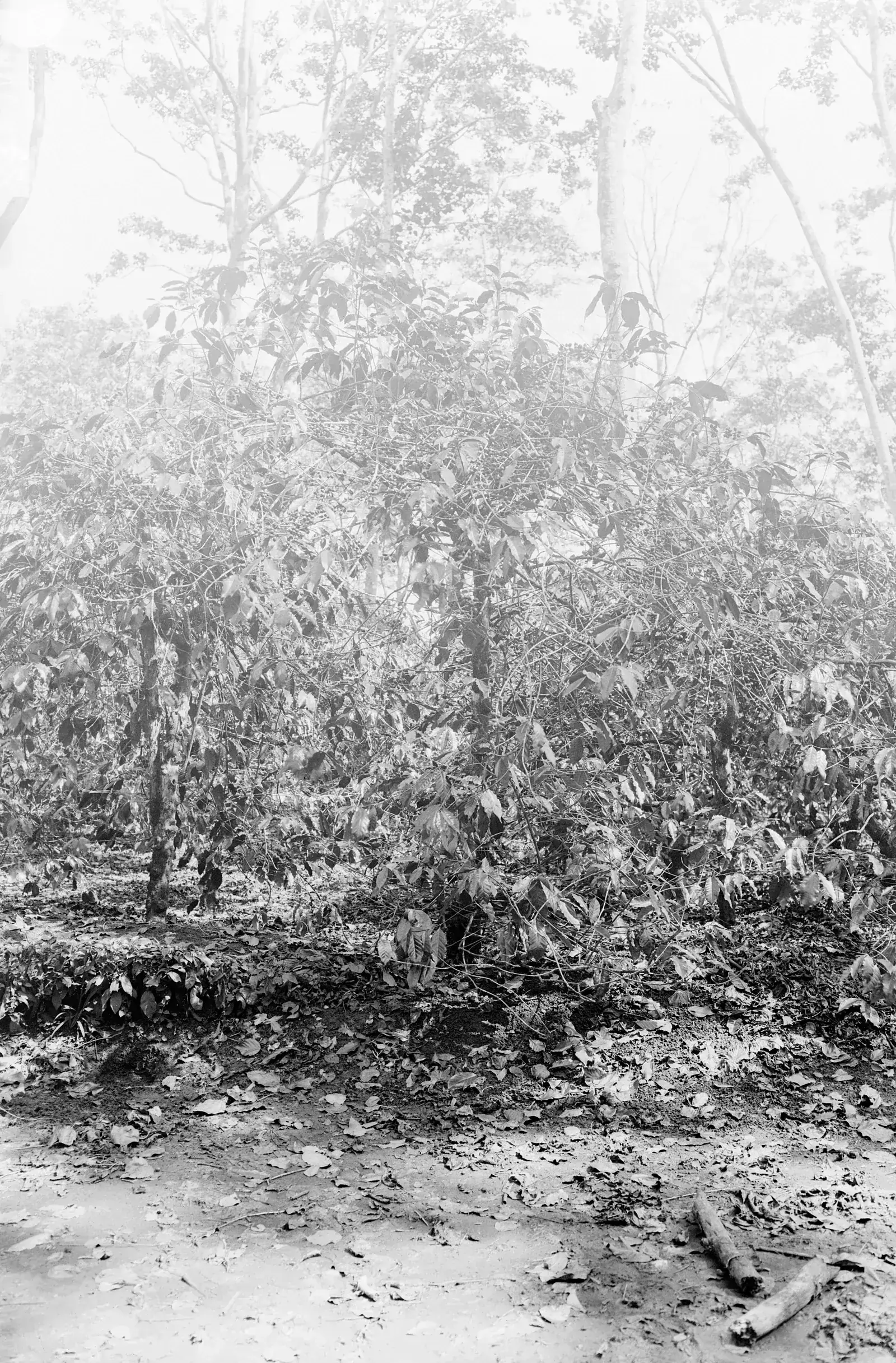
The first so-called resistant variety is Kent, a tree selected around 1911 by L. P. Kent on the Doddengudda estate (Mysore) because it held up when everything fell around it; its resistance has since been overcome, but it remains a parent of S.795. Still in India, around 1910 in Coorg, a spontaneous arabica × liberica hybrid, S.26, transmits the SH3 gene: the Central Coffee Research Institute at Balehonnur (1925) derives from it S.288 (1936), then S.795 (S.288 × Kent, released in 1945-46), the first widely grown resistant variety, still 25 to 30% of Indian arabica, whose resistance the 2025 WCR catalog now rates as low. Coste cites in 1955 the lineages S.288, 526 and 544, and the arabica × canephora crosses carried out at Balehonnur since 1927.
WCR, Arabica Coffee Varieties (2025), Kent and S795 sheets; Coste 1955, p. 349; site/data.jsRust had reached Timor around 1886. In the 1920s, on a Portuguese plantation on the island, some trees were noticed that did not fall sick. Examination in 1927 identified a spontaneous arabica × canephora cross.
This stroke of luck was worth any laboratory, and it is worth seeing why. The tree is tetraploid (2n = 44) and self-fertile like arabica, so it can be used as is in breeding. Yet all the hybrids made by hand between the two species until then were diploid and sterile, for lack of a compatible chromosome count: 22 on one side, 11 on the other.
The Timor Hybrid carries SH6 to SH9, that is, four of the nine known resistance genes. Its cup, on the other hand, is judged low to medium. All the work that follows consists of keeping the genes while losing this fault.
From it the CIFC derived, as early as 1959, the Catimor (accession 832/1 × Caturra, dwarf habit), then the Sarchimor (832/2 × Villa Sarchí). These are two families and not two varieties, and the nuance matters: each country has drawn its own lineages from them, which can differ greatly from one another.
On the Catimor side: T5175, T8667, Costa Rica 95, IHCAFE 90, Lempira, Oro Azteca, Catisic, Cauvery, Ateng. On the Sarchimor side: T5296, Parainema, Cuscatleco, IAPAR 59, Obatã, Marsellesa. Crosses with Catuaí or Mundo Novo added the dwarf habit and bean quality on top.
Colombia, for its part, played ahead of the game. In 1982 Cenicafé released the Variedad Colombia (Caturra × HdT 1343, a multiline composite) to prepare for the arrival of rust, before it had even reached the country. Castillo followed in 2005, after twenty-three years of work, with regional versions.
In Brazil, the IAC took a different route as early as 1950: Icatu. The principle is to redo by hand what Timor had given by accident. A canephora is made tetraploid with colchicine, crossed with a Bourbon, then backcrossed onto Mundo Novo.
McCook 2019, p. 134-135; Coste 1955, p. 331 (Piza, 1929); BSPP 2022, p. 17-18 (Zambolim 2016); WCR 2025, Timor Hybrid, Catimor, Sarchimor sheets; site/data.js; LC ch. 14What this hybrid brings can now be read in genomes. Salojärvi and his coauthors (Nature Genetics, 2024) sequenced the Timor Hybrid itself and five of its backcrosses: the introgression covers 7 to 11% of the genome of the varieties descended from it, and the region associated with resistance lies on chromosome 4 of the canephora subgenome, where three families of defense genes are tandem-duplicated (five copies of RPP8, ten of CPR1, three of LRK10L), eight copies being retained as candidates.
Almost all resistance to rust descends from the Timor Hybrid, which can be followed in the variety map. The origins and the genetic bottlenecks that made arabica so uniform are on the origins plate; canephora, born of rust, has its own plate.
Candidate does not mean validated. The review by Yang et al. (2026) points out that this introgression comes with a measurable quality penalty; the WCR catalog classes Catimor and Sarchimor at intermediate resistance and “good” quality, below Bourbon and SL28 but well above the source hybrid. Genetic fingerprinting now makes it possible to verify that a material sold as resistant truly descends from the source, and conversely to find canephora segments in trees sold under a prestigious name.
Salojärvi et al., Nature Genetics 56 (2024); Yang et al., journal 2026, p. 3 and 6; WCR 2025; LC ch. 14In this plateThe 19 sections
- 01The disease triangle
- 02Fungi, spores, obligate parasites
- 03Orange rust: biology and cycle
- 04Ceylon, 1869-1890: the birth of plant pathology
- 05A fungus's world tour, 1872-2020
- 06Races, SH genes and the Oeiras catalog
- 07Resistance: Kent, S.795, the Timor Hybrid and its descendants
- 08The great coffee leaf rust of 2008-2013, country by country
- 09Milder nights
- 10The erosion of resistance, 2017-2024
- 11Diagnosis, surveillance and warning
- 12The coffee berry borer, the chief enemy
- 13Coffee wilt disease: from the Ubangi to Uganda
- 14Coffee berry disease, Kenya 1922 and 1971
- 15Nematodes, bugs, leaf miners, scale insects, borers
- 16Diseases of soil, of fruit, and what is not alive
- 17The pharmacopoeia of yesterday and today
- 18Control methods compared
- 19Today: 2023-2026
The table of contents, with the first sentence of each section