The great coffee leaf rust of 2008-2013, country by country
What the Big Rust cost
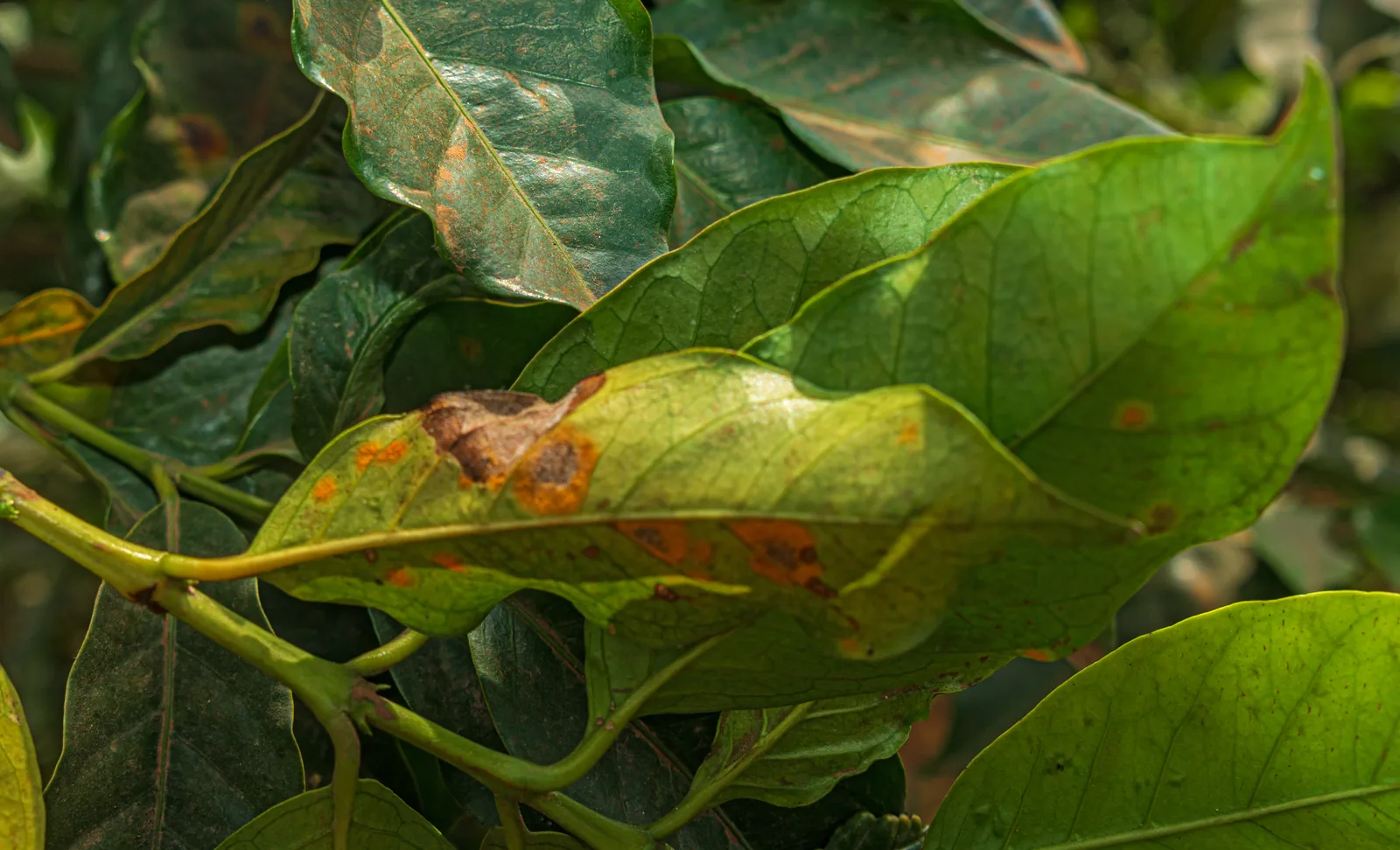
Drop in production attributed to the rust epidemic, by country, between 2008 and 2013. Some farms lost 70 to 80% of their crop.
The trigger is not the heat of the day but the mildness of the nights: higher nighttime minimums shorten the fungus's latent period and extend it to higher altitudes.
The figures
| Production loss | |
|---|---|
| El Salvador | −57 % |
| Mexico | −46 % |
| Peru | −39 % |
| Colombia, 2008-2011 | −33 % |
| Central America, 2012-13 | −16 % |
Between 2007 and 2011, Colombia lost about a third of its production, a drop of 33%, including 31% in 2008 alone. At the end of 2011, the epidemic spread to the arc running from Peru to Mexico.
In 2012-2013, Central America lost 16% overall. This average hides the extremes, and quoting it alone would be misleading: El Salvador down 57%, Mexico down 46%, Peru down 39%, some farms up to 70 or 80%.
Costa Rica, Honduras and Guatemala declared a national emergency in 2012-13. Eleven countries did so between 2010 and 2013 according to Peter Baker (CABI), who christened the episode “Big Rust” in 2014. Losses continued afterward: 2013-2014 in Central America and Mexico, 2014-2015 in Peru and Ecuador.
The cost has been estimated in several ways, and the orders of magnitude agree. USAID puts it at one billion dollars between 2012 and 2014, affecting more than two million people. Other estimates give one billion dollars and 250,000 jobs lost, mostly on farms. PROMECAFÉ, the regional research organization, counts 373,585 displaced workers for its part.
| Big Rust | Production loss |
|---|---|
| Colombia 2007-2011 | down 33% |
| Central America 2012-13 | down 16% |
| El Salvador | down 57% |
| Mexico | down 46% |
| Peru | down 39% |
| NY price | $3/lb (early 2011) to under $1.50 (June 2013) |
| Displaced workers | 373,585 (PROMECAFÉ) |
| Damage 2012-14 | $1 billion (USAID); 250,000 jobs (Mallén 2014) |
| National emergencies | 11 countries, 2010-2013 |
Why does employment take the hit so fast? Because hand picking is the moment when a region employs the most people. Yet a tree defoliated in mid-cycle does not fill its cherries. There is nothing to pick, and no season. Emigration from Guatemalan households nearly doubled between 2007 and 2016, with a marked link to coffee households.
McCook 2019, p. 171-178; Koutouleas et al., Plant Pathology 73 (2024); BSPP 2022, p. 7-9 (Baker 2014; Mallén 2014; Dupre et al. 2022); USAID, cited by Wikipedia, “Hemileia vastatrix”; LC ch. 16The world price made the opposite journey from the harvest: the New York benchmark contract was trading at three dollars a pound in early 2011 and below 1.50 dollars in June 2013. In Central America, the crop and the price were lost at the same time. Avelino and his coauthors show that every high-intensity epidemic recorded in Colombia and Central America since 1987 coincided with, or followed, periods of low international prices or expensive inputs that reduced profitability, and with it the fungicides bought in time, fertilization, stumping and shade maintenance.
In Nicaragua, low-income producers, with little training and no access to technical services, suffered the heaviest losses (Villarreyna et al., 2020). In Colombia, a wave of Ponzi schemes had swallowed a little over 1% of annual GDP just before the 2008 epidemic, in coffee households already caught between low prices and expensive fertilizer.
Avelino et al., “The coffee rust crises in Colombia and Central America (2008-2013)”, Food Security 7 (2015); BSPP 2022, p. 10 and 15; McCook 2019, p. 171-172; LC ch. 16Four hypotheses have been put forward to explain the unprecedented severity of the episode, and the BSPP reviews them.Virulencenew races were indeed found in Honduras, Guatemala and Costa Rica after the epidemics began, but comparisons of spores from before and after 2008 in Colombia (Rozo et al., 2012) did not confirm a more virulent strain; the new races would be a consequence rather than a cause. Producers' means, set out above.Climateexcessive rain in Colombia in 2008, unusually low rainfall in the wet season and heavy rainfall in the dry season in Central America, and a reduced temperature range in the hardest-hit countries (Avelino et al., 2015); but the mechanistic model of Bebber et al. (2016), based on climate reanalyses from 1990 to 2015, finds no long-term trend in risk in Colombia, only a small but significant rise in daily infection risk between 2008 and 2011 (p = 0.027), and explicitly rejects the hypothesis of climate change as the cause of the epidemic.Degradation of landscapesthe shift from shade-grown coffee to full sun is said to have reduced natural enemies; but other studies find more rust under humid canopy. The BSPP concludes that there is no single explanation.
BSPP 2022, p. 9-12; Bebber, Delgado Castillo and Gurr, Phil. Trans. R. Soc. B 371 (2016); Avelino et al. 2015The most disturbing point is that rust came back, in part, on varieties selected to resist it, those that carried the Timor genes and on which whole national programs had been built. All three sides of the triangle had moved within the same decade. McCook adds an institutional factor: the collapse of the quotas of the International Coffee Agreement in 1989, the lasting fall in prices, the shrinking of national institutes and extension services.
The varieties had been inherited and the machinery meant to renew them had been dismantled. At Sasaima, in Colombia, he photographs two plantations a few meters apart, same altitude, same nights, same spores: one abandoned and defoliated, the other dense and green. What separates them is credit, cash on hand at the moment of treating, the age of the trees, a technician within reach. Organic farms were the most vulnerable, for lack of an effective alternative to copper: in 2016, PROMECAFÉ advised them to turn temporarily to conventional methods.
McCook 2019, p. 173 and 197-199; BSPP 2022, p. 16; LC ch. 16In this plateThe 19 sections
- 01The disease triangle
- 02Fungi, spores, obligate parasites
- 03Orange rust: biology and cycle
- 04Ceylon, 1869-1890: the birth of plant pathology
- 05A fungus's world tour, 1872-2020
- 06Races, SH genes and the Oeiras catalog
- 07Resistance: Kent, S.795, the Timor Hybrid and its descendants
- 08The great coffee leaf rust of 2008-2013, country by country
- 09Milder nights
- 10The erosion of resistance, 2017-2024
- 11Diagnosis, surveillance and warning
- 12The coffee berry borer, the chief enemy
- 13Coffee wilt disease: from the Ubangi to Uganda
- 14Coffee berry disease, Kenya 1922 and 1971
- 15Nematodes, bugs, leaf miners, scale insects, borers
- 16Diseases of soil, of fruit, and what is not alive
- 17The pharmacopoeia of yesterday and today
- 18Control methods compared
- 19Today: 2023-2026
The table of contents, with the first sentence of each section