Fungi, spores, obligate parasites
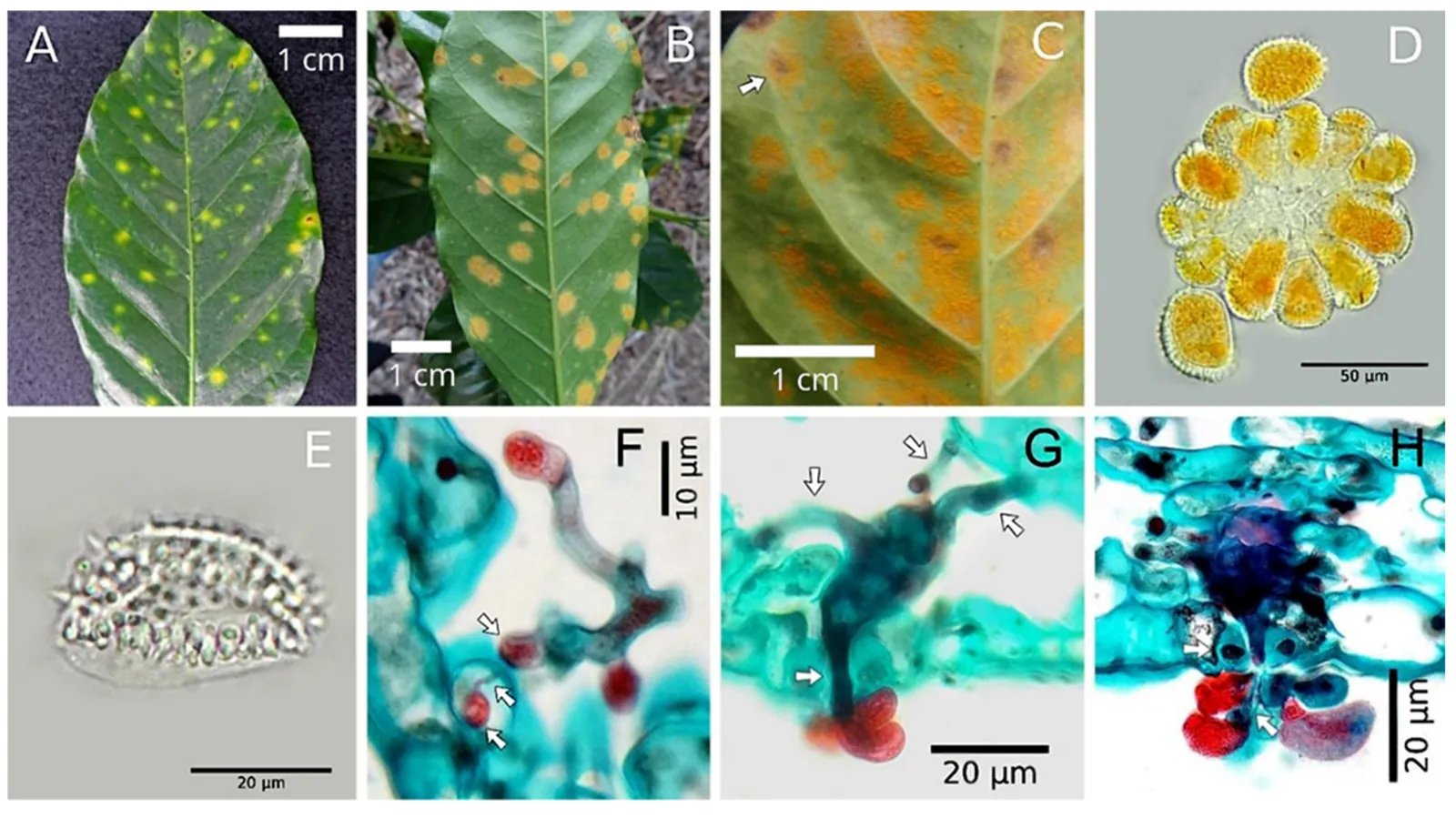
A fungus has no chlorophyll: it makes nothing and takes material that has already been made, from dead wood, debris or a living plant. What we see (cap, down, powder) is the reproductive organ; the organism itself is an invisible network of filaments. It spreads by spores, a powder in which every grain is a possible start, carried by the wind, by bouncing raindrops, by tools, clothing, and above all by the live plants that get shipped. Coffee has traveled, and what eats it has traveled in the same crates.
LC ch. 11b, after Coste 1955, ch. XITwo strategies stand opposed. Dead-matter fungi wait: Barat describes a root rot that survives more than seven years in a large Kouillou stump as long as it still holds carbohydrate reserves, which is why stumps must be removed completely and two to three years allowed to pass before replanting. Obligate parasites, on the other hand, live only on a living host and die outside it: they have no refuge in the soil or in dead wood.
That is a weakness (removing every host from a territory starves them out) and a strength (they travel with living things, and the millions of hectares of coffee planted continuously offer them an endless food supply). Hemileia vastatrix falls in this second case; it cannot even be grown on a nutrient medium in the laboratory, and no alternate host has ever been found for it.
Coste 1955, p. 210-217 (Barat); McCook 2019, p. 39-41; Koutouleas and Collinge, BSPP Plant Pandemic Study 5 (September 2022), p. 20; LC ch. 11b and 13For a plant, resisting does not mean being invulnerable: it means detecting the intrusion, blocking its progress, and sacrificing a few cells to wall off the parasite. It is a matter of degree. And the parasite is alive: among billions of spores, it takes only one carrying what is needed to get around the defense of a variety planted across a continent. As early as 1932, Wilson Mayne established in Nature that the coffee plant's resistance to rust follows Mendelian inheritance and that the fungus exists as distinct races, defined solely by the list of coffee plants they are able to attack. A variety is therefore never resistant in the absolute, but to certain races, at a given date, in the regions where it has been tested.
Mayne, Nature (1932); McCook 2019, p. 94; LC ch. 11bIn this plateThe 19 sections
- 01The disease triangle
- 02Fungi, spores, obligate parasites
- 03Orange rust: biology and cycle
- 04Ceylon, 1869-1890: the birth of plant pathology
- 05A fungus's world tour, 1872-2020
- 06Races, SH genes and the Oeiras catalog
- 07Resistance: Kent, S.795, the Timor Hybrid and its descendants
- 08The great coffee leaf rust of 2008-2013, country by country
- 09Milder nights
- 10The erosion of resistance, 2017-2024
- 11Diagnosis, surveillance and warning
- 12The coffee berry borer, the chief enemy
- 13Coffee wilt disease: from the Ubangi to Uganda
- 14Coffee berry disease, Kenya 1922 and 1971
- 15Nematodes, bugs, leaf miners, scale insects, borers
- 16Diseases of soil, of fruit, and what is not alive
- 17The pharmacopoeia of yesterday and today
- 18Control methods compared
- 19Today: 2023-2026
The table of contents, with the first sentence of each section