Milder nights
Why do milder nights make rust explode?
Start the scene or choose a stage. The animation simplifies the mechanism; what follows gives the details and the available references.
What rose first in the coffee zones of Latin America was the minimum nighttime temperatures. A cold night takes the leaf out of the fungus's useful window for several hours and interrupts germination before the dew dries in the morning.
Read the stages without animation
- A cold night cuts germinationWhat rose first in the coffee zones of Latin America was the minimum nighttime temperatures. A cold night takes the leaf out of the fungus's useful window for several hours and interrupts germination before the dew dries in the morning.
- A mild night lets it finishA night that stays within the window gives the fungus hours it did not have: the spore germinates as long as the leaf stays wet. The range between day and night has narrowed, and it is the range that counts, not the average.
- Ten rounds instead of eightThe latent period, the time between infection and new spores, shortens. Over a favorable season of six months, a three-week cycle gives about eight rounds; a cycle of two and a half weeks gives ten.
- Two rounds, an order of magnitudeIn a multiplicative process, two more rounds change the order of magnitude: 256 versus 1,024 if each round merely doubled the population, and the real factor is far higher. An epidemic does not start because conditions have become good, but because they stayed good a little longer.
- The belts climbThe zone where coexisting with rust is costly is eating into the one where it was free. Yet the highest plots carry the most susceptible material, Bourbon, Typica, Caturra, Catuaí, Pacamara, classed “susceptible” to “very susceptible” by World Coffee Research: nobody had a reason to sacrifice cup quality there for resistance.
To remember: It is not the hotter days that matter, it is the nights that no longer cool enough to stop the fungus.
In history: McCook locates the climatic trigger in nighttime minimums; Avelino predicts that “rust will be the main problem of our future”.
Read the full article and its sources ↓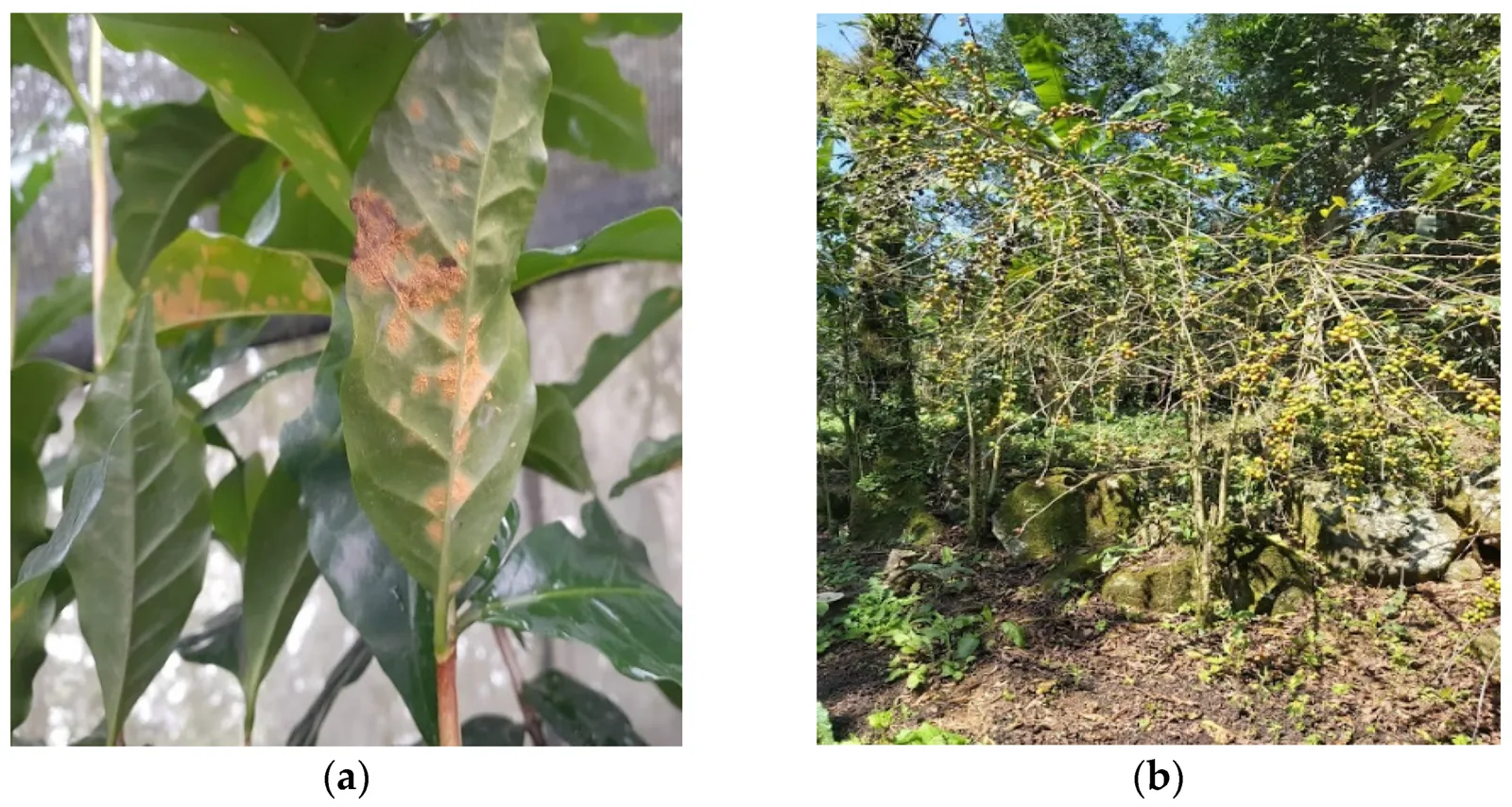
The climatic trigger described by McCook is not “it is hotter” but “the nights are less cold”. What rose first in the coffee zones of Latin America was minimum nighttime temperatures, so the daily temperature range narrowed. A cold night takes the leaf out of the useful window for several hours and interrupts germination before the dew dries in the morning; a night that stays within the window gives the fungus hours it did not have.
The latent period shortens. Over a favorable season of six months, a three-week cycle gives about eight rounds, a cycle of two and a half weeks gives ten; in a multiplicative process, two more rounds change the order of magnitude (256 versus 1,024 if each round merely doubled the population, and the real factor is far higher). An epidemic is not triggered because conditions have become good, but because they stayed good a little longer.
McCook 2019, p. 177; Coste 1955, p. 224-226; LC ch. 16 (illustrative arithmetic)The second effect is geographic: the belts climb. The zone where coexistence is costly eats into the zone where it used to be free, toward an area that shrinks with every meter gained. And the highest plots are precisely those planted with the most susceptible material, because there was no reason to sacrifice cup quality there for a resistance that was not needed: Bourbon, Typica, Caturra, Catuaí, Pacamara, all classed by the 2025 WCR catalog between “susceptible” and “very susceptible”, and all rated good to exceptional in the cup.
The altitude printed on a bag is a thermometer disguised as a tape measure. Avelino observes that in Central America the other major leaf disease, ojo de gallo (Mycena citricolor), linked to long, cool, rainy seasons, has almost disappeared since 2012, while rainy seasons interspersed with dry days and higher temperatures favor rust; with fewer rainy days forecast, “rust will be the main problem of our future”. Yang et al. (2026) list among the unknowns the real thermal thresholds per cultivar in the field (most of the knowledge comes from brief heat shocks in the laboratory; arabica proved resilient up to 37 °C under controlled conditions with elevated CO2) and the quantitative relationships between rain, humidity, rust and quality.
McCook 2019, p. 5-6 and 177; BSPP 2022, p. 21 (interview with J. Avelino); WCR 2025; Yang et al. 2026, p. 8; LC ch. 16In this plateThe 19 sections
- 01The disease triangle
- 02Fungi, spores, obligate parasites
- 03Orange rust: biology and cycle
- 04Ceylon, 1869-1890: the birth of plant pathology
- 05A fungus's world tour, 1872-2020
- 06Races, SH genes and the Oeiras catalog
- 07Resistance: Kent, S.795, the Timor Hybrid and its descendants
- 08The great coffee leaf rust of 2008-2013, country by country
- 09Milder nights
- 10The erosion of resistance, 2017-2024
- 11Diagnosis, surveillance and warning
- 12The coffee berry borer, the chief enemy
- 13Coffee wilt disease: from the Ubangi to Uganda
- 14Coffee berry disease, Kenya 1922 and 1971
- 15Nematodes, bugs, leaf miners, scale insects, borers
- 16Diseases of soil, of fruit, and what is not alive
- 17The pharmacopoeia of yesterday and today
- 18Control methods compared
- 19Today: 2023-2026
The table of contents, with the first sentence of each section