Nematodes, bugs, leaf miners, scale insects, borers
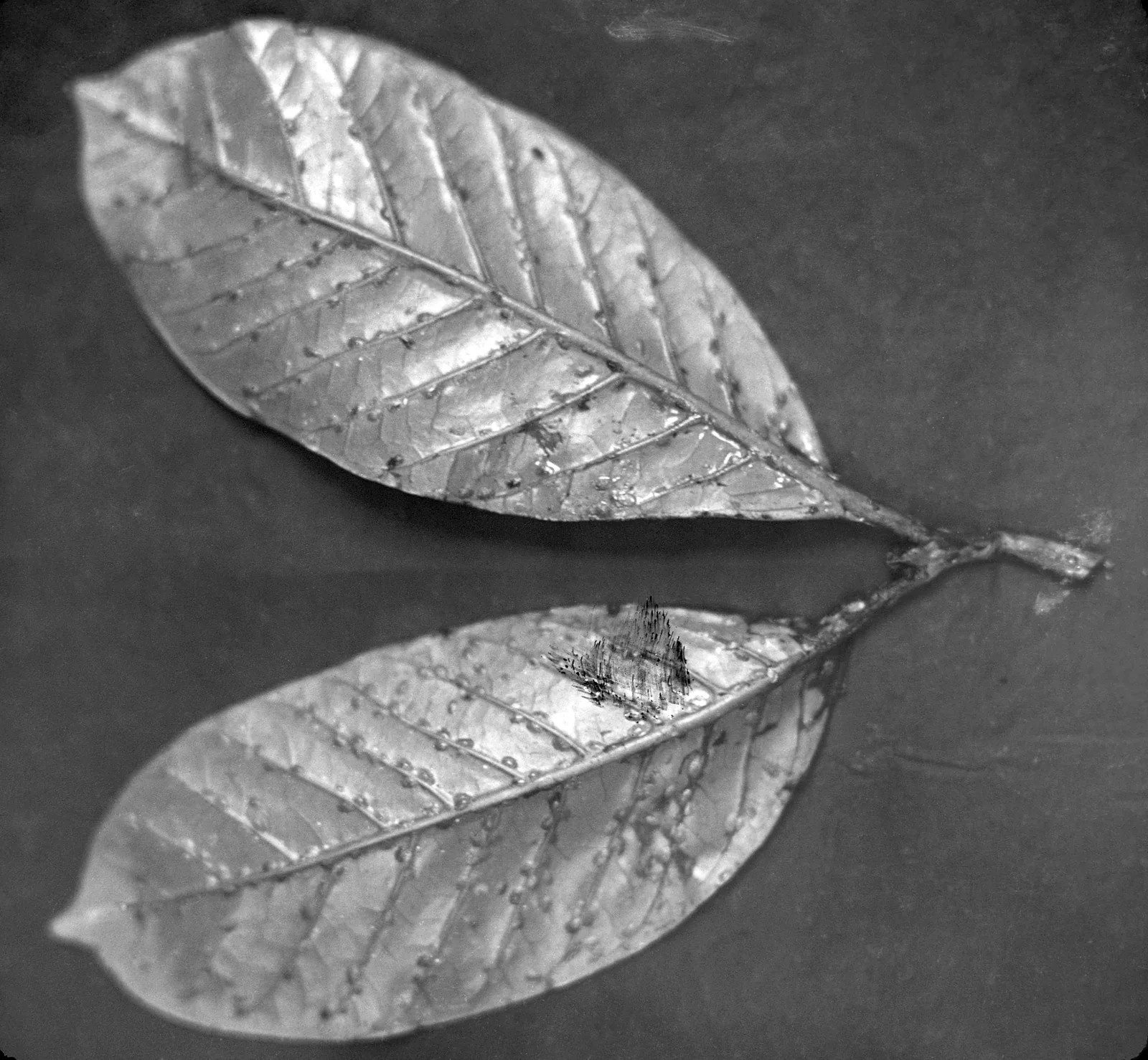
Nematodes are worms a few tenths of a millimeter long that penetrate roots without any specific symptom: the tree yellows, stagnates, and the observer concludes a fertilization fault. In Java, Pratylenchus coffeae destroyed more than 95% of the arabicas of a plantation in under six months; since liberica planted under the same conditions was affected only to 59%, arabica was grafted onto it, like the grapevine onto American roots after phylloxera.
Vayssière also cites Heterodera marioni (more than fifty hosts, today a Meloidogyne) and Tylenchus similis, and concludes that no species or variety of coffee plant is recognized as resistant. In Central America, Meloidogyne incognita in Guatemala and Meloidogyne sp. in El Salvador led to hypocotyl grafting on canephora at very large scale: unselected rootstocks give 30 to 40% resistant plants, the parents T3561 and T3751 transmit 56 and 54%, their cross 78%, which gave the Nemaya rootstock; Brazil uses Apoatã.
Nematodes
| Agent | Pratylenchus coffeae, Meloidogyne spp. (incognita, exigua), Radopholus |
| Cycle | in the roots, no specific symptom; yellowing, decline |
| Conditions | replanted soils, contaminated nurseries |
| Dispersal | soil, plants, water |
| Losses | Java: 95% of arabicas in 6 months; up to 60% with excelsa rootstocks |
| Control | grafting onto canephora (Nemaya: 78% resistant plants; Apoatã), mycorrhizae, partially resistant Sarchimor varieties; fumigants banned |
Excelsa seedlings used as rootstocks still left 60% losses, so much did they segregate. Parainema, Cuscatleco and IAPAR 59 are rated resistant to certain Meloidogyne, not to Pratylenchus.
Coste 1955, p. 235-239 (Vayssière); Bertrand et al., Euphytica (2000); WCR 2025; site/data.js; LC ch. 15The Antestiopsis bugs pierce green berries and inject a saliva that dissolves the endosperm, that is, the nutrient reserve of the bean. The damage shows in three places. On the tree, shrunken beans. In washing, cherries that float, because an emptied bean no longer weighs enough, and that are discarded for that reason. In the bean, finally, a yeast of the genus Nematospora that the bite inoculates along the way: this is stigmatomycosis.
The insect's biology explains why it settles in without ever carrying everything off. The cycle lasts about two months and the adult lives eight months, so generations overlap. But the clutches are small, 9 to 12 eggs, and 70 to 90% of these eggs are parasitized by micro-hymenopterans. Natural regulation therefore already does most of the work.
In the absence of berries, the bug falls back on the buds. It then causes “witches' brooms”, those tufts of short twigs that tie up wood for years.
Vayssière's protocol is an action threshold before the term existed. Dust five trees with ash and pyrethrum. Count the bugs that fall onto a cloth. Treat only beyond five bugs per tree.
In the Great Lakes region, in Rwanda and Burundi, the bite of Antestiopsis thunbergii does more than empty the bean: it opens the way for a bacterium, Pantoea coffeiphila. Described in 2015, this is the cause of the potato taste (potato taste defect) that downgrades the region's arabica. The insect does not destroy the crop, it downgrades it.
Coste 1955, p. 245-251 (Vayssière); Gueule et al., International Journal of Systematic and Evolutionary Microbiology 65 (2015); LC ch. 15Antestiopsis bugs
| Agent | A. orbitalis, A. thunbergii (East Africa) |
| Cycle | 2 months; adult 8 months; 9-12 eggs, 70-90% parasitized |
| Conditions | dense shade, green berries available |
| Dispersal | flight |
| Losses | shrunken beans, floaters, stigmatomycosis, witches' brooms; potato taste (Pantoea coffeiphila, 2015) |
| Control | threshold 5 bugs/tree (1955), pyrethrum, aeration pruning, beneficial insects |
The Leucoptera leaf miners, L. caffeina in Africa and L. coffeella in America, dig galleries between the two epidermises of the leaf. The larva consumes the green tissue without piercing the surface: the leaf stays in place but stops feeding the tree, and the fall comes afterward.
The cycle depends on temperature. Vayssière counted 25 to 60 days; today it is counted at about 22 days at 25 °C, that is, 5 days as egg, 12 as larva and 5 as pupa. Each female lays more than 50 eggs. Vayssière recorded up to seven generations a year, and eight to twelve are counted in Brazil. So many overlapping generations leave few windows without the insect.
The preference for arabica is clear, and it is in the nursery that damage is most serious. Natural regulation can nonetheless be strong: in Guadeloupe, a small parasitic wasp, the braconid Mirax insularis, parasitized 65 to 80% of the caterpillars.
In Brazil, the world's top producer with more than 59 million bags on 1.9 million hectares in 2023, L. coffeella remains a key pest. Losses range from 30 to 70% depending on the season: above 50% in Brazil and Colombia, 20 to 40% in Puerto Rico, about 12% in Mexico. Defoliation reaches 75%, and up to twenty sprays a year are counted under heavy infestation.
Leaf miner
| Agent | Leucoptera coffeella (Americas), L. caffeina (Africa) |
| Cycle | ~22 d at 25 °C; 8-12 generations/yr; more than 50 eggs |
| Conditions | dry season, full sun, arabica |
| Dispersal | flight; 1 pheromone trap per 4 ha |
| Losses | 30-70%, up to 87%; defoliation 75% |
| Control | up to 20 sprays/yr in Brazil, resistance; parasitism 8-89%; neem; Siriema VC4 and AS1 resistant |
The basic insecticides are thiamethoxam, which protects for more than 180 days, chlorantraniliprole and cartap. The same scenario replays with each molecule: resistance to organophosphates has been documented for decades, and it has recently appeared to the first two on this list. The new molecule isocycloseram is being monitored (2025), for this precise reason.
Natural parasitism varies greatly from one country to another: 8 to 44% in Brazil, 17 to 32% in Kenya, 58 to 89% in Colombia. Buckwheat intercrops increase it. On the genetic side, the response is thin: only two resistant cultivars are registered in Brazil, Siriema VC4 and Siriema AS1.
About fifty species of mealybugs suck the sap. Coccus viridis adds poisoning of its host by its saliva. The Planococcus, a problem mainly in the dry season, are spread by ants, which makes any isolation ditch useless: a trench does not stop an ant. Phthiriosis follows the same pattern, a fungus associated with a Pseudococcus, which encloses the taproot, that is, the main root, in a black sheath.
The longhorn beetle Bixadus sierricola, in West Africa, proceeds differently. Its larva digs under the bark a ring-shaped gallery that girdles the trunk, then descends more than 40 cm into the taproot. Girdling a trunk amounts to cutting off the circulation of the sap. As many as 24 exit holes have been counted on a single canephora, for a larval development of five months to three years.
Control is then done tree by tree: injection of gasoline or carbon disulfide into the gallery, opening plugged with putty, a hundred trees per man per day. Anthores leuconotus plays the same role in East Africa.
Coste 1955, p. 215, 257, 272-279 and 303-305 (Barat, Vayssière); Insects 12 (2021), review of Leucoptera coffeella; Frontiers in Sustainable Food Systems 5 (2021); Journal of Economic Entomology (2025), isocycloseram; UCDA 2019, p. 78; LC ch. 15In this plateThe 19 sections
- 01The disease triangle
- 02Fungi, spores, obligate parasites
- 03Orange rust: biology and cycle
- 04Ceylon, 1869-1890: the birth of plant pathology
- 05A fungus's world tour, 1872-2020
- 06Races, SH genes and the Oeiras catalog
- 07Resistance: Kent, S.795, the Timor Hybrid and its descendants
- 08The great coffee leaf rust of 2008-2013, country by country
- 09Milder nights
- 10The erosion of resistance, 2017-2024
- 11Diagnosis, surveillance and warning
- 12The coffee berry borer, the chief enemy
- 13Coffee wilt disease: from the Ubangi to Uganda
- 14Coffee berry disease, Kenya 1922 and 1971
- 15Nematodes, bugs, leaf miners, scale insects, borers
- 16Diseases of soil, of fruit, and what is not alive
- 17The pharmacopoeia of yesterday and today
- 18Control methods compared
- 19Today: 2023-2026
The table of contents, with the first sentence of each section