Coffee wilt disease: from the Ubangi to Uganda
How was coffee wilt disease understood, and where do its weapons come from?
Start the scene or choose a stage. The animation simplifies the mechanism; what follows gives the details and the available references.
In 1927, in Ubangi-Shari, present-day Central African Republic, excelsoid coffee plants stop growing; the foliage blackens and curls without falling. In cross section, the central cylinder bears brown-violet streaks: the fungus does not destroy the tissues, it clogs the vessels, and the tree dies of thirst in moist soil. In 1942, 15,000 hectares are destroyed.
Read the stages without animation
- 1927: the tree looks burnedIn 1927, in Ubangi-Shari, present-day Central African Republic, excelsoid coffee plants stop growing; the foliage blackens and curls without falling. In cross section, the central cylinder bears brown-violet streaks: the fungus does not destroy the tissues, it clogs the vessels, and the tree dies of thirst in moist soil. In 1942, 15,000 hectares are destroyed.
- Barat: through woundsFor Barat, in Coste's 1955 treatise, the fungus enters exclusively through wounds and is not transmitted by the soil. Hence a treatment centered on disinfecting pruning wounds every three months; the Boukoko station looks for resistant ones.
- 1993: the soil, and move nothingThe disease resurfaces in 1993 in the Bundibugyo district, in Uganda, on canephora; by 1997, ten districts are affected. The Ugandan manual holds it to be transmitted by the soil, with no chemical remedy: healthy plants, tree uprooted on the spot without dragging it, neither firewood nor husks as mulch, tools disinfected, a year and a half to two years without replanting.
- Four lineagesIn 2024, Peck and his coauthors compare thirteen strains spanning six decades: the fungus comprises at least four lineages, one of arabica in Ethiopia, one of canephora in Uganda, the DRC and Tanzania, and two historical ones. In Ethiopia, the national loss is 1.6% of yield, but the affected farms lose 37% of their production.
- Weapons received from anotherThe fungus received from another fungus of the same genus genes that help it degrade the walls of coffee plant cells. The transfer is horizontal, from one organism to another and not from parent to offspring, and passes through large mobile elements of about 110 kilobases.
To remember: The diagnosis of transmission has changed, and with it the instructions: it is no longer only the wound that is disinfected, one avoids moving anything at all.
In history: Considered a closed case after the 1950s, the disease came back in 1993, on another species.
Read the full article and its sources ↓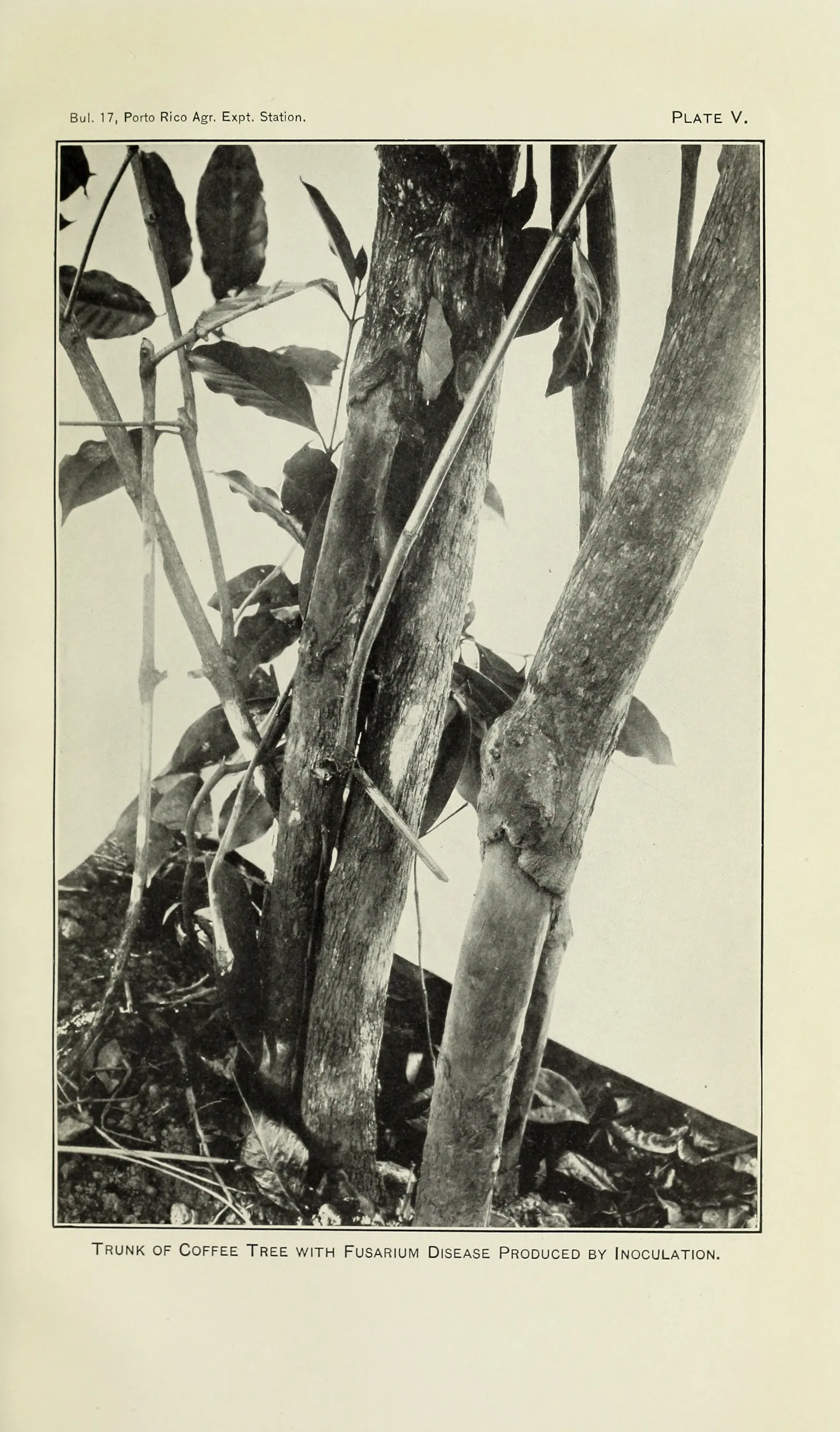
In 1927, in Ubangi-Shari (present-day Central African Republic), excelsoid coffee plants abruptly stop growing; the foliage blackens and curls without falling, the tree “looks burned”. In cross section, the central cylinder carries brown-violet streaks: the fungus Gibberella xylarioides (asexual form Fusarium xylarioides) does not destroy the tissues, it clogs the vessels, and the tree dies of thirst in moist soil. Judged alarming in 1938, the disease had almost completely destroyed 15,000 hectares of excelsoids by 1942.
Coffee wilt disease
| Agent | Fusarium (Gibberella) xylarioides, 4 lineages, genes acquired from F. oxysporum (Starships) |
| Cycle | entry through wounds, collar, roots; vessels clogged; tree “burned” within months |
| Conditions | pruning wounds, tools, infected soil and debris |
| Dispersal | wind, runoff water, tools, plants, husks, firewood |
| Losses | 15,000 ha of excelsa in CAR (1942); 56% of Ugandan canephora since 1993, ~$100M; Ethiopia 20-70% incidence |
| Control | no product; uprooting and burning, wound disinfection, fallow 1.5-2 years, KR 1-10 clones (2009), Trichoderma on trial |
For Barat, it enters exclusively through wounds and is not transmitted by the soil, hence a treatment centered on disinfecting pruning wounds every three months; the Boukoko station was looking for resistant subjects (B10, A445).
Coste 1955, p. 217-220 (Barat); LC ch. 15Considered a closed case, it resurfaces in 1993 in the Bundibugyo district, in western Uganda, this time on canephora. By 1997, the ten main producing districts are affected, 450 km from the nearest Congolese border.
The scale is hard to quantify, but all the orders of magnitude are heavy. The UCDA estimates that the disease has destroyed about 56% of Ugandan canephora since its detection. Other sources speak of nearly half the trees and about 100 million dollars in losses, with foci in the Democratic Republic of the Congo and in Tanzania. A regional program funded by the Common Fund for Commodities, the European Union and the British DFID starts in 2000.
The diagnosis of transmission has changed since Barat, and that changes the instructions. The current Ugandan manual holds the disease to be transmitted by the soil, and there is no chemical remedy. All that remains is hygiene measures, all meant to avoid moving the fungus.
- The plantHealthy plants, taken from an approved nursery.
- The affected treeUprooting and destruction on the spot, without dragging it through the rows: a tree that is carried sows along the way.
- MulchNeither firewood nor coffee husks, which can carry the fungus to the foot of healthy trees.
- ToolsDisinfected with bleach or fire, and wounds treated at once.
- ReplantingNothing for a year and a half to two years, the time for the soil to empty.
Genetics remains. Ten resistant clones derived from the Ugandan populations themselves, the NARO-Kituza Robusta 1 to 10, have been distributed since 2009 (see canephora).
UCDA 2019, p. 4-5 and 83-84; Peck, “Coffee wilt disease: the forgotten threat to coffee”, Plant Pathology (2024); Rutherford, Phytopathology 96 (2006); site/data.jsIn Ethiopia, a distinct lineage has specialized on arabica. Surveys give average incidences of 20 to 70% depending on the zone, with 45% at Gera and 69% at Bebeka.
Two ways of counting the loss give two opposite pictures, and both must be held. At the national scale, the annual loss is estimated at 1.6% of yield, or 3,360 t and about 3.75 million dollars: that is little. On the affected farms, production falls by 37% and income by 67%: that is ruin. A national average dilutes damage that is, itself, concentrated.
On the control side, opponents of the fungus are being sought. Isolates of Trichoderma and actinomycetes taken from the rhizosphere of wild coffee plants, that is, from the soil around their roots, are being tested as antagonists (2023-2024).
On December 6, 2024, Peck and his coauthors publish in PLOS Biology the comparison of thirteen historical strains spanning six decades. Fusarium xylarioides comprises at least four lineages: one specific to arabica in Ethiopia, one of canephora in Uganda, the DRC and Tanzania, and two historical ones.
The most striking result concerns the origin of its weapons. The fungus acquired from Fusarium oxysporum genes that help it degrade the coffee plant's cell walls. The transfer is horizontal, that is, from one organism to another and not from parent to offspring, and it passes through large mobile elements of about 110 kilobases called Starships.
In other words, a fungus did not merely mutate: it received from another a set of tools developed on other crops. No quantification of recent losses accompanies this result.
Peck et al., PLOS Biology 22 (2024), e3002480; Frontiers in Plant Science 14 (2023), Trichoderma against F. xylarioides; Ethiopian Journal of Biological Sciences, review of coffee wilt disease in Ethiopia; LC ch. 15In this plateThe 19 sections
- 01The disease triangle
- 02Fungi, spores, obligate parasites
- 03Orange rust: biology and cycle
- 04Ceylon, 1869-1890: the birth of plant pathology
- 05A fungus's world tour, 1872-2020
- 06Races, SH genes and the Oeiras catalog
- 07Resistance: Kent, S.795, the Timor Hybrid and its descendants
- 08The great coffee leaf rust of 2008-2013, country by country
- 09Milder nights
- 10The erosion of resistance, 2017-2024
- 11Diagnosis, surveillance and warning
- 12The coffee berry borer, the chief enemy
- 13Coffee wilt disease: from the Ubangi to Uganda
- 14Coffee berry disease, Kenya 1922 and 1971
- 15Nematodes, bugs, leaf miners, scale insects, borers
- 16Diseases of soil, of fruit, and what is not alive
- 17The pharmacopoeia of yesterday and today
- 18Control methods compared
- 19Today: 2023-2026
The table of contents, with the first sentence of each section