Diseases of soil, of fruit, and what is not alive
Root rots bear the color names that planters gave to what they saw on dug-up roots: white fungus (Leptoporus lignosus), brown rot (Phellinus lamaensis), black fungus (Rosellinia bunodes, apoplectic death). The agaric root rots (Armillariella mellea, Clitocybe tabescens) kill in patches starting from the shade trees; Barat saw some of more than a hectare. For Armillaria (root rot, collar crack), the UCDA describes wood decomposed into a moist white mass crossed by black lines, vertical cracks at the collar, and control by ringbarking trees before felling to empty the roots of their carbohydrate reserves, on which the fungus depends.
A root disease does not cost a harvest: two to three years of waiting plus four years before the first harvest, it costs a decade.
Coste 1955, p. 210-217 (Barat); UCDA 2019, p. 86-87; LC ch. 15On the fruits, three diseases, two of which are dated from their first report.
- Powdery diseaseTrachysphaera fructigena, reported in the Gold Coast in 1919.
- Warty diseaseBotrytis cinerea, Kenya around 1929.
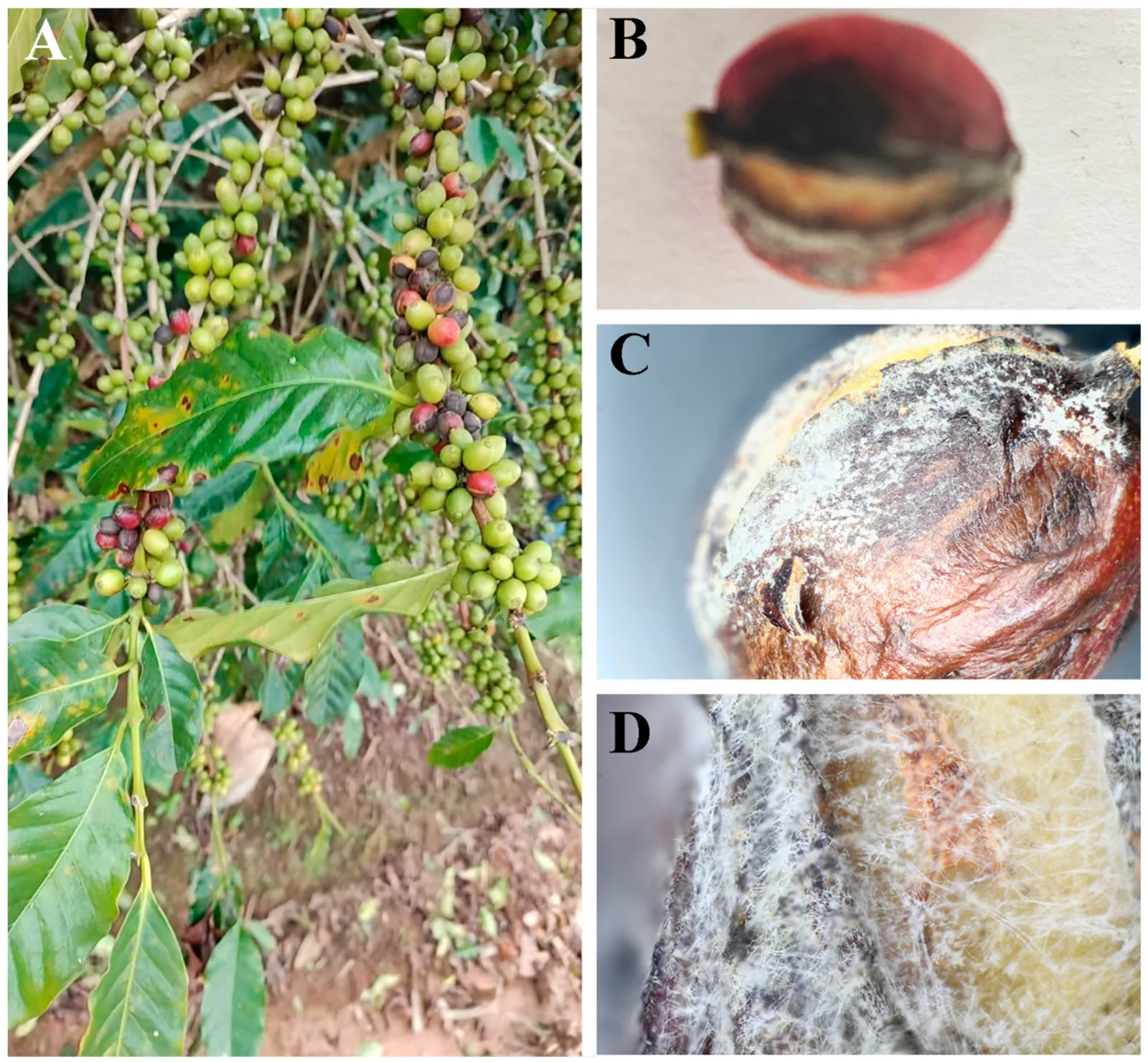
- Red blisterCercospora coffeicola, in Uganda and at Bukoba (Tanzania), on old seed-grown canephora. Raised red spots merge into blisters with a black center; the cherries dry out and pulp poorly, so the defect is still paid for at processing.
Against red blister, no chemical is proposed. Everything rests on how the plot is managed: tolerant varieties, NPK fertilization, pruning, spacing, at least 50% shade and drainage. In other words, the “environment” side of the triangle is taken away from the fungus instead of aiming at the fungus itself.
On the leaves, the catalog is longer.
- Brown eye spotCercospora, mainly in nurseries.
- Pink diseaseCorticium salmonicolor.
- KolerogaPellicularia koleroga, one of the most serious in India.
- Viruela mancha, or ojo de galloOmphalia flavida, now Mycena citricolor. Exclusively of the Americas, 30 to 40 spots per leaf. In retreat since 2012 in Central America, but more frequent on rust-resistant varieties.
- Sooty molds and “leprosy”Sooty mold is named for the soot it mimics on the leaf. “Leprosy”, for its part, is not due to a fungus but to an alga, Cephaleuros virescens.
One line of this catalog deserves a pause. Ojo de gallo becomes more frequent on rust-resistant varieties. Resisting one fungus protects against no other, and replanting a whole orchard with anti-rust varieties may shift the problem rather than remove it.
Finally, black tip, which blackens the end of young shoots, does not belong on this list: it is not infectious. Jurion linked it to a jump of 26 °C in two hours at sunrise, which young tissue cannot withstand. No product can do anything about it, since there is nothing to kill; only shade cushions the swing.
Coste 1955, p. 224 and 228-229 (Barat); UCDA 2019, p. 86; BSPP 2022, p. 21; LC ch. 11b and 15In this plateThe 19 sections
- 01The disease triangle
- 02Fungi, spores, obligate parasites
- 03Orange rust: biology and cycle
- 04Ceylon, 1869-1890: the birth of plant pathology
- 05A fungus's world tour, 1872-2020
- 06Races, SH genes and the Oeiras catalog
- 07Resistance: Kent, S.795, the Timor Hybrid and its descendants
- 08The great coffee leaf rust of 2008-2013, country by country
- 09Milder nights
- 10The erosion of resistance, 2017-2024
- 11Diagnosis, surveillance and warning
- 12The coffee berry borer, the chief enemy
- 13Coffee wilt disease: from the Ubangi to Uganda
- 14Coffee berry disease, Kenya 1922 and 1971
- 15Nematodes, bugs, leaf miners, scale insects, borers
- 16Diseases of soil, of fruit, and what is not alive
- 17The pharmacopoeia of yesterday and today
- 18Control methods compared
- 19Today: 2023-2026
The table of contents, with the first sentence of each section