The disease triangle
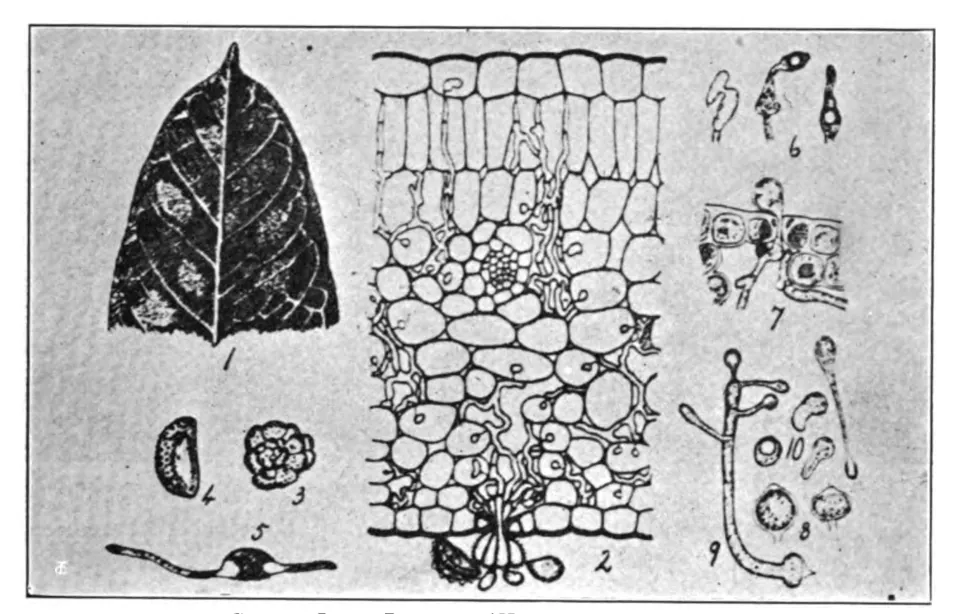
A plant epidemic requires three things brought together in the same place at the same time: a pathogen able to attack (present and virulent), a host able to be attacked (a plant susceptible to that precise agent), and an environment that allows the meeting (temperature, free water on the organs, light, cultural practices). Plant pathologists call this conjunction the disease triangle. Removing one side is enough to prevent the epidemic; the presence of the pathogen alone does not trigger it. Hemileia vastatrix has been established for decades in regions where it does no notable damage, and it has wiped out entire industries elsewhere, sometimes with the same race.
McCook, Coffee Is Not Forever (Ohio University Press, 2019), p. 3; LC ch. 13What gives the concept its reach is that none of the three sides is fixed. The fungus exists as races and keeps producing new ones. The host changes because it is planters who decide on the variety, the density and the shade, and who have narrowed the genetic diversity of cultivated arabica to a handful of lineages. Conditions change with the climate and with practices (removal of shade, sprinkler irrigation, pruning).
A region that has coexisted peacefully with leaf rust for forty years is not protected: for the moment, it is simply missing one side of the triangle. Coexistence between coffee and its diseases is always provisional.
McCook 2019, p. 3-6; LC ch. 13The “host” side cannot be reduced to the variety. Barat, who wrote the chapter on fungal diseases in Coste's treatise, opens with a strong thesis: the Ceylon catastrophe owed as much to the planters' agronomic ignorance (plantations on fully bare soil, clean weeding, no anti-erosion measures, squandered humus, shade removed) as to the fungus. He notes elsewhere that the agent of anthracnose lives in a latent state in the bark of healthy-looking trees and only breaks out when the plant weakens.
McCook, sixty-four years later and without citing Barat, concludes that leaf rust is never only biological: each historical phase (colonial, Cold War, neoliberal) manufactured its own vulnerability.
Coste, Les caféiers, vol. I (1955), p. 207 and 220-222 (H. Barat); McCook 2019, p. 12-16; LC ch. 12In this plateThe 19 sections
- 01The disease triangle
- 02Fungi, spores, obligate parasites
- 03Orange rust: biology and cycle
- 04Ceylon, 1869-1890: the birth of plant pathology
- 05A fungus's world tour, 1872-2020
- 06Races, SH genes and the Oeiras catalog
- 07Resistance: Kent, S.795, the Timor Hybrid and its descendants
- 08The great coffee leaf rust of 2008-2013, country by country
- 09Milder nights
- 10The erosion of resistance, 2017-2024
- 11Diagnosis, surveillance and warning
- 12The coffee berry borer, the chief enemy
- 13Coffee wilt disease: from the Ubangi to Uganda
- 14Coffee berry disease, Kenya 1922 and 1971
- 15Nematodes, bugs, leaf miners, scale insects, borers
- 16Diseases of soil, of fruit, and what is not alive
- 17The pharmacopoeia of yesterday and today
- 18Control methods compared
- 19Today: 2023-2026
The table of contents, with the first sentence of each section