The carbon footprint of a cup
The pile behind the mill
Start the scene or choose a stage. The animation simplifies the mechanism; what follows gives the details and the available references.
At pulping, the cherry is pinched: the bean goes on its way, the pulp falls behind the mill. The same pulp gives three opposite results there, depending on what is done with it.
Read the stages without animation
- The mill gives up the pulpAt pulping, the cherry is pinched: the bean goes on its way, the pulp falls behind the mill. The same pulp gives three opposite results there, depending on what is done with it.
- In the open air, the pile emits methaneLeft to ferment in the open air, the pulp emits methane, a greenhouse gas far more powerful than CO₂ over twenty years. The pile is not neutral: it heats up.
- In the digester, it dries the coffeeDigested anaerobically in a closed tank, the digester, the same pulp provides a fuel that replaces the wood or gas used for drying. The methane goes into the burner instead of going into the air.
- In compost, the nitrogen comes backComposted, it gives back to the plot a nitrogen that will not have to be bought as synthetic fertilizer. Now these fertilizers are the main source of emissions at the farm.
- What the cup weighsA conventional arabica consumed in the United Kingdom weighs 15.33 kilos of CO₂ equivalent per kilo of green coffee; under sustainable conditions, 3.51 kilos, 77% less. Brought down to an 18-gram espresso: 0.28 kilo against 0.06. What is at stake in the field weighs more than what is at stake at the counter.
To remember: putting the pulp to use is one of the main levers of coffee's footprint, and one of the few that bring something in to the producer.
Read the full article and its sources ↓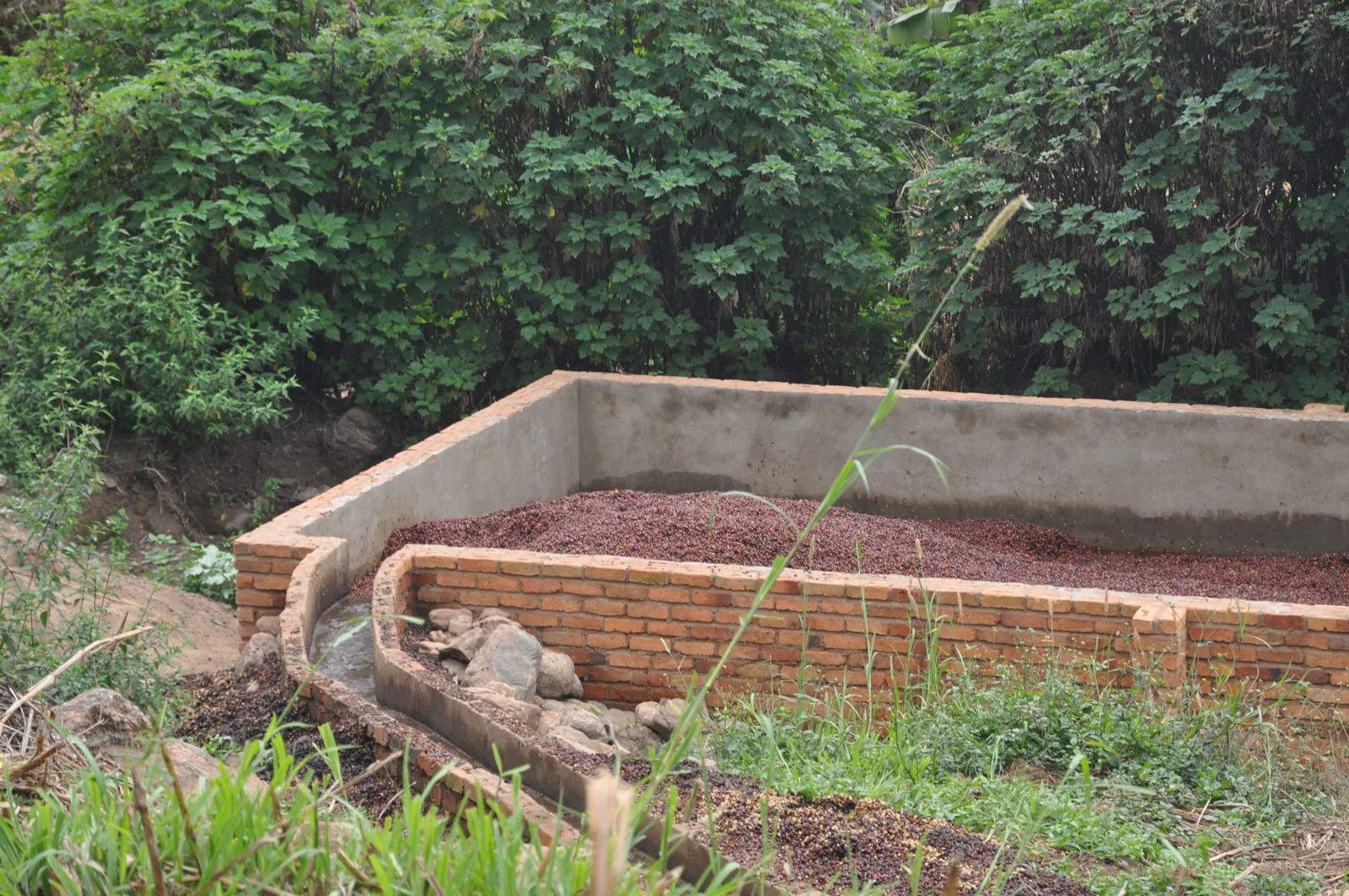
Mark Maslin and Carmen Nab (University College London) quantify the footprint of coffee per kilo of green coffee. A conventional arabica from Brazil or Vietnam, consumed in the United Kingdom, weighs 15.33 kg of CO2 equivalent per kilo of green coffee.
The same kilo produced under so-called sustainable conditions falls to 3.51 kg, a possible reduction of 77%. These conditions have a precise content: agroforestry, reduced fertilizers, sea freight, solar drying. It is therefore not a label, it is a list of practices.
Brought down to the cup, on the basis of 18 g of green coffee, the gap is easier to read. A conventional espresso weighs about 0.28 kg of CO2e, a sustainable espresso 0.06 kg.
Milk changes the order of magnitude. The latte goes to 0.55 kg (0.33 when sustainable), the cappuccino to 0.41 (0.20), the flat white to 0.34 (0.13). When there is any, the milk weighs more than the coffee itself.
In coffee alone, cultivation dominates, and first of all nitrogen fertilizers, ahead of transport and roasting. Relative to 9.5 billion kilos produced a year, and to a production that these authors see tripling by 2050, the stake is agricultural before it is domestic: what is at stake at the counter weighs less than what is at stake in the field.
Maslin & Nab (UCL), The Conversation, 01/04/2021What links the carbon footprint to the rest of this plate is the pile behind the mill. The same pulp gives three opposite results there, depending on what is done with it.
Left to ferment in the open air, it emits methane, a greenhouse gas far more powerful than CO2 over twenty years. The pile is not neutral: it heats up.
Digested anaerobically in a digester, the same pulp provides a fuel that replaces the wood or gas used for drying. The methane then goes into the burner instead of going into the air.
Composted, it gives back to the plot a nitrogen that will not have to be bought as synthetic fertilizer. Now these fertilizers are the main source of emissions at the farm.
Putting the by-products to use is therefore not a separate chapter of the coffee footprint. It is one of its main levers, and one of the few that bring something in to the producer.
ICO 2024, p. 15-16, 57-59; Maslin & Nab 2021; LC ch. 20 reasoningIn this plateThe 15 sections
- 01The mass balance, from cherry to drunk bean
- 02Three centuries of drinking the husk: qishr, kisher and Sultana's coffee
- 031922: pulp as fertilizer, alcohol and fuel
- 04Pulp: composition, toxicity and what can be done with it
- 05Cascara, from waste to “novel food”
- 06Mucilage and washing water
- 07Treating the water: lagooning, wetlands, biodigesters, BECOLSUB
- 08Parchment and husks: fuel, biochar, paper, cup
- 09Silverskin: the smallest item, the most industrialized
- 10Spent coffee grounds: composition, phytotoxicity, household uses
- 11Spent coffee grounds in cities: biofuel, logs, cosmetics, activated carbon
- 12Capsules
- 13The carbon footprint of a cup
- 14From line to circle: what blocks and what works
- 15Today (2023-2026)
The table of contents, with the first sentence of each section