Capsules
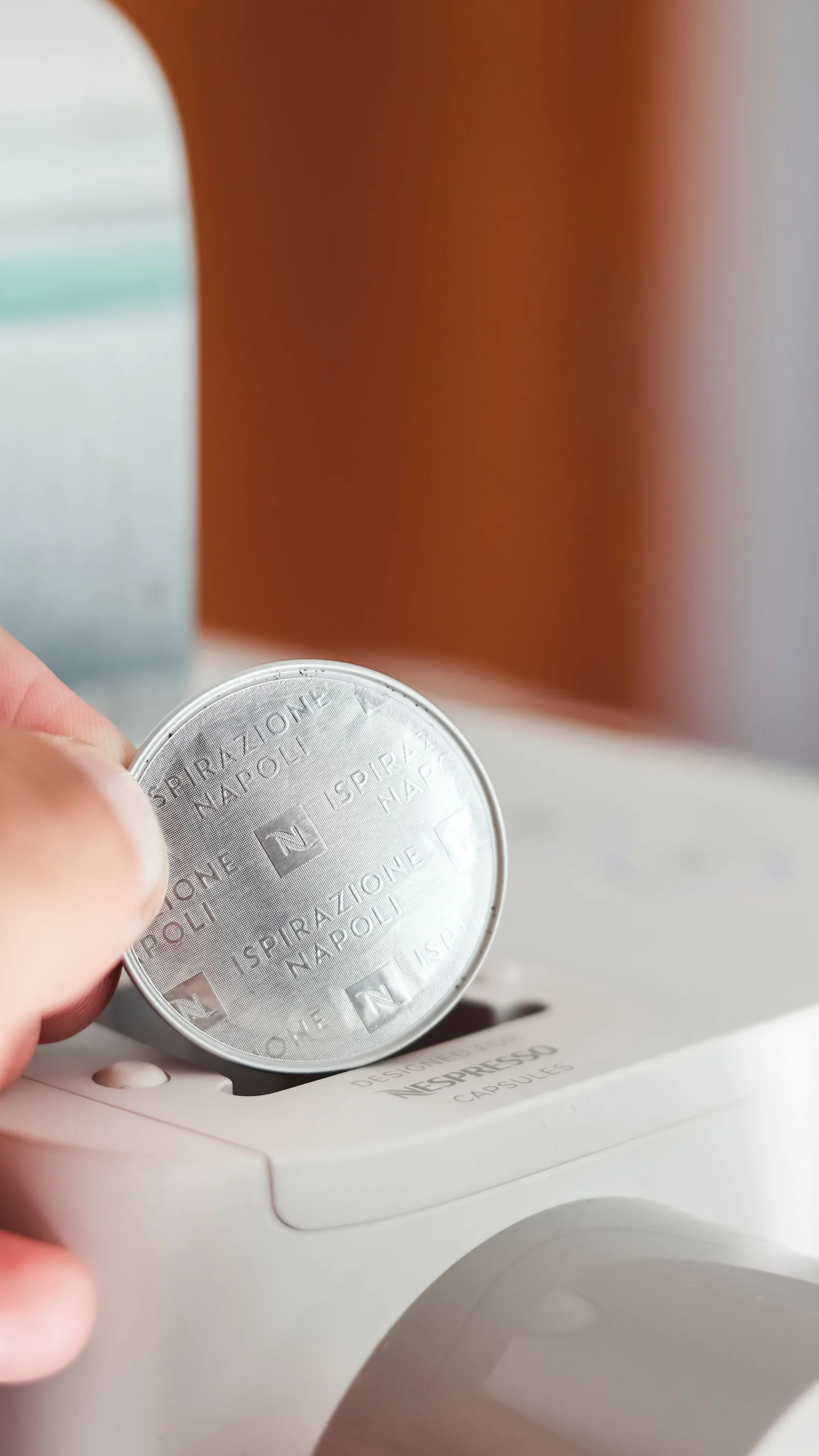
The capsule adds a waste the cherry had not foreseen: an aluminum or plastic container weighing a few grams around 5 to 14 g of grind. Nespresso had sold more than 20 billion capsules between 2000 and August 2010, with growth of about 30% a year; each capsule not recycled leaves about 1 g of aluminum, whose recycling requires only 5% of the energy of primary production. In 2017, 24.6% of Nespresso capsules were actually recycled worldwide, whereas the company said it had the capacity to recycle 100% and had collection systems in 36 countries; more than 80% of the capsules produced in 2015 contained recycled aluminum. The stated goal today is a worldwide recycling rate of 60% in 2030. In early 2016, Hamburg banned capsules in city buildings on environmental grounds. Keurig switched its K-Cups to recyclable polypropylene at the end of 2020; Nespresso launched in 2023 in France and Switzerland paper-based pods intended for biowaste collection. Capsules that are compostable “under industrial conditions” pose their own problem: they degrade only in industrial composting and contaminate plastics collection if thrown in there.
Wikipedia, “Nespresso” and “Single-serve coffee container,” accessed on 09/07/2026; nestle-nespresso.com/sustainability, accessed on 09/07/2026- The European framework has changed. Regulation (EU) 2025/40 of December 19, 2024 on packaging and packaging waste (PPWR), in force since February 2025, replaces directive 94/62/EC: from 2030, all packaging will have to reach a recyclability grade (A, B or C) based on design criteria, and at least grade B in 2038
- minimum recycled-content rates apply to plastics from 2030, raised in 2040
- single-use formats are banned from January 1, 2030 (annex V)
- article 9 requires permeable tea and coffee bags and flexible pods to be compostable under industrial conditions by February 12, 2028 at the latest, throughout the Union and without any collection condition; the condition of biowaste collection applies only to the national option that targets rigid non-metallic pods for machines. The mixture of plastic, aluminum and wet grounds that makes up the capsule is exactly what this regulation targets.
Life cycle analysis nevertheless tempers the case against the capsule. The team from the Université du Québec à Chicoutimi (Viana et al., 2023) compares four preparations of a 280 ml cup: traditional filter uses 25 g of grind, French press 17 g, capsule 14 g, instant 12 g. Coffee production accounts for 40 to 80% of total emissions: producing 11 g of arabica emits about 59 g of CO2 equivalent, whereas making a capsule and landfilling it emit 27 g. The traditional filter, which overdoses and heats more water, has the highest footprint; instant the lowest, at recommended doses. The visible waste is not the main item.
Viana, Marty, Boucher & Dessureault (UQAC), The Conversation, 01/05/2023Capsules and carbon
| Fact | Value | Source |
|---|---|---|
| Nespresso capsules sold 2000-2010 | > 20 billion | Wikipedia |
| Aluminum per non-recycled capsule | ~1 g | Wikipedia |
| Nespresso recycling rate 2017 | 24,6 % | Wikipedia |
| Nespresso goal 2030 | 60 % | nestle-nespresso.com |
| Grind per 280 ml cup | filter 25 g, French press 17 g, capsule 14 g, instant 12 g | Viana et al. 2023 |
| 11 g of arabica produced | ~59 g CO2e | Viana et al. 2023 |
| Capsule made and landfilled | ~27 g CO2e | Viana et al. 2023 |
| Conventional green coffee | 15.33 kg CO2e / kg | Maslin & Nab 2021 |
| “Sustainable” green coffee | 3.51 kg CO2e / kg | Maslin & Nab 2021 |
| Conventional espresso | ~0.28 kg CO2e | Maslin & Nab 2021 |
| Conventional latte | ~0.55 kg CO2e | Maslin & Nab 2021 |
In this plateThe 15 sections
- 01The mass balance, from cherry to drunk bean
- 02Three centuries of drinking the husk: qishr, kisher and Sultana's coffee
- 031922: pulp as fertilizer, alcohol and fuel
- 04Pulp: composition, toxicity and what can be done with it
- 05Cascara, from waste to “novel food”
- 06Mucilage and washing water
- 07Treating the water: lagooning, wetlands, biodigesters, BECOLSUB
- 08Parchment and husks: fuel, biochar, paper, cup
- 09Silverskin: the smallest item, the most industrialized
- 10Spent coffee grounds: composition, phytotoxicity, household uses
- 11Spent coffee grounds in cities: biofuel, logs, cosmetics, activated carbon
- 12Capsules
- 13The carbon footprint of a cup
- 14From line to circle: what blocks and what works
- 15Today (2023-2026)
The table of contents, with the first sentence of each section