Silverskin: the smallest item, the most industrialized
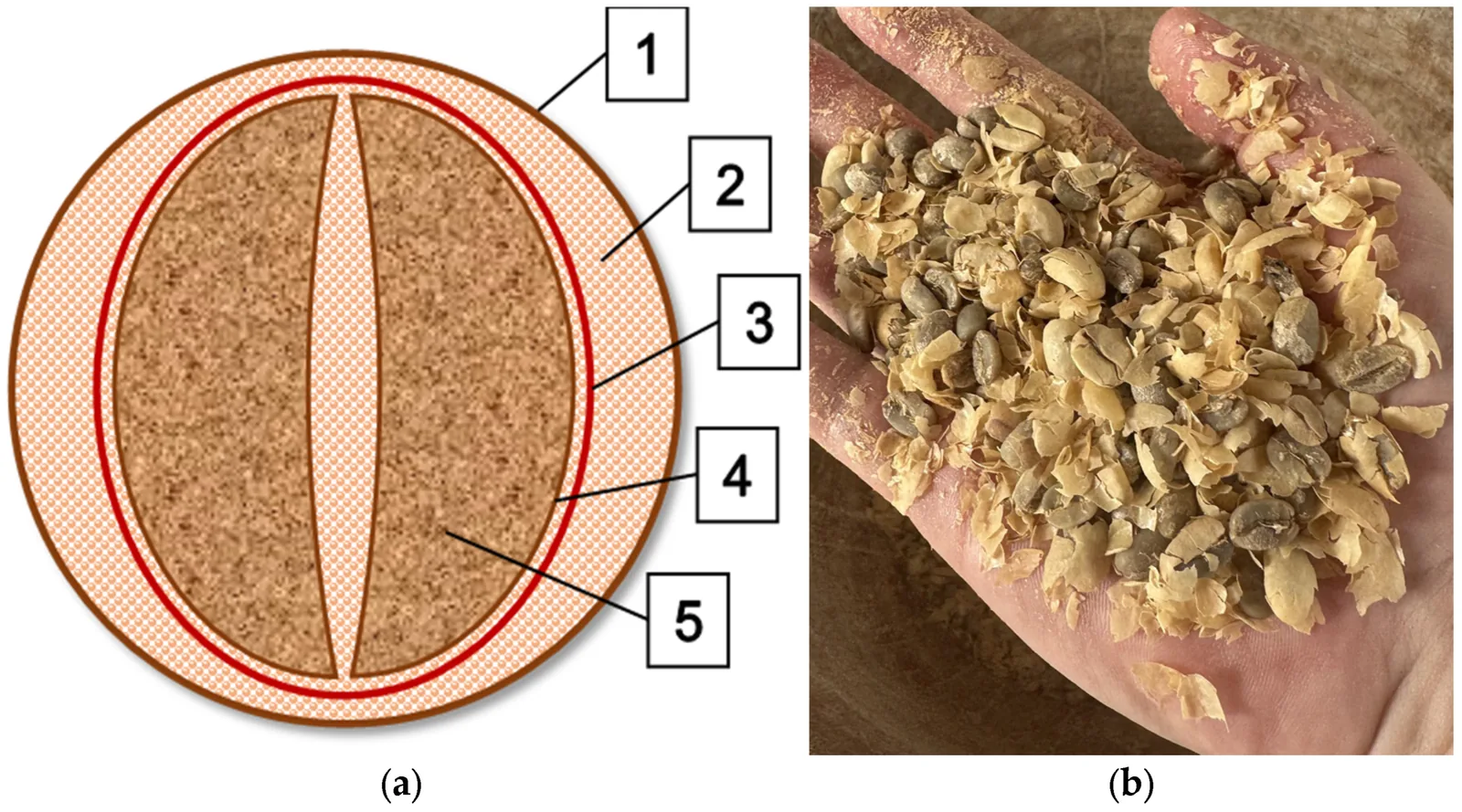
Under the parchment, stuck to the seed, is the seed coat, thinner than an onion skin. The heat of roasting lifts it from the bean and it flies off into the cyclone (see roasting). This is the silverskin.
Its weight is debated. The ICO puts it at 0.4% of the weight of the cherry. Chemistry reviews speak rather of 1 to 2% of the cherry, or of a few percent of the green bean. The gap is not a contradiction: it comes from the basis of calculation and the species.
Its composition makes it first of all a fiber. Arya et al. find 54 to 62% total dietary fiber in it, Angeloni et al. up to 68 to 80%, of which 46 to 54% insoluble. Then come 16 to 19% protein, 2 to 4% lipids and 5 to 7% ash.
In detail, what one reads is a plant wall: 23.8% cellulose, 16.7% hemicellulose and 28.6% lignin, the three polymers that hold the tissues of a plant upright.
The silverskin is not, however, dead matter. It still contains 730 to 845 mg/kg of caffeine and 975 to 1,156 mg/kg of chlorogenic acids. Its antioxidant capacity, 139 mmol Fe²⁺/kg, is comparable to that of dark chocolate, which explains the interest of manufacturers in what comes out of the cyclone.
Arya et al. 2021 (Ballesteros et al. 2014; Narita & Inouye 2014; Bresciani et al. 2014); Angeloni et al., Molecules 2020 (PMC7411821); ICO 2024, p. 65It is the by-product with the longest list of industrial outlets, and the ICO gives names: cosmetics with Intercos, faux leather of which Volkswagen is among the users, paper at Favini with 15% substitution of the material, furniture at Mater, pellets for anaerobic digestion. Research continues to extend the list: bio-polyethylene composite reinforcement (2019), chocolate cake ingredient as a fiber source (2024), plywood filler (2025), biocomposite films based on polylactide and silverskin extracts (2025).
The reason for this lead has nothing to do with the material: the silverskin is the only coffee by-product that forms in a plant, in Europe or North America, as a steady, clean and dry stream, next to the industries and design offices able to use it. For a craft workshop, what comes out of the cyclone fits in a bag and goes to the compost or the mulch.
ICO 2024, p. 65-67; Dominici et al. 2019 (PMC6749558); Franca et al. 2024 (PMC11641578); Wronka et al. 2025 (PMC11989794); Petaloti et al. 2025 (PMC11944891); LC ch. 20In this plateThe 15 sections
- 01The mass balance, from cherry to drunk bean
- 02Three centuries of drinking the husk: qishr, kisher and Sultana's coffee
- 031922: pulp as fertilizer, alcohol and fuel
- 04Pulp: composition, toxicity and what can be done with it
- 05Cascara, from waste to “novel food”
- 06Mucilage and washing water
- 07Treating the water: lagooning, wetlands, biodigesters, BECOLSUB
- 08Parchment and husks: fuel, biochar, paper, cup
- 09Silverskin: the smallest item, the most industrialized
- 10Spent coffee grounds: composition, phytotoxicity, household uses
- 11Spent coffee grounds in cities: biofuel, logs, cosmetics, activated carbon
- 12Capsules
- 13The carbon footprint of a cup
- 14From line to circle: what blocks and what works
- 15Today (2023-2026)
The table of contents, with the first sentence of each section