The mass balance, from cherry to drunk bean
From cherry to cup, what is left?
Start the scene or choose a stage. The animation simplifies the mechanism; what follows gives the details and the available references.
A ripe cherry weighs 1.5 to 2 grams. According to René Coste's ratio, still in use, it takes 5 to 7 kilos of arabica cherries for one kilo of marketable coffee. We start here from one kilo of cherries, placed on the scale.
Read the stages without animation
- 1,000 g of cherriesA ripe cherry weighs 1.5 to 2 grams. According to René Coste's ratio, still in use, it takes 5 to 7 kilos of arabica cherries for one kilo of marketable coffee. We start here from one kilo of cherries, placed on the scale.
- At the farm: skin, pulp, mucilageSkin and pulp weigh 39 to 43% of the weight of the fresh cherry; mucilage, the sticky layer that coats the parchment, about 22 kilos per 100 kilos of cherries. This first loss happens at the farm, in a producing country, wet, over a few weeks of harvest.
- At hulling: 150 to 200 g of greenThe parchment, the envelope that surrounds the bean, accounts for 35 to 39% of the dried cherry. 150 to 200 grams of green coffee remain: 80% of the mass is discarded before shipping. These percentages do not add up, because they do not start from the same base.
- At roasting: the silverskinRoasting removes 15 to 20% of the weight of the green coffee, mostly water and volatile compounds. The silverskin, only 0.4%, comes off in the workshop or plant, most often in a consuming country, as a steady, dry stream.
- In the cup: 22 to 37 gWater dissolves only 18 to 22% of the grind; the rest, the spent coffee grounds, is thrown out at the drinker's. For 1,000 grams of cherries, 22 to 37 grams pass into the cup, 2 to 4% of the starting weight.
To remember: almost the whole cherry becomes by-product, and each layer falls in a different place: the farm, the roasting plant, the kitchen.
In history: in 1922, Ukers counted about 68% pulp, 6% parchment and 26% marketable coffee: three items for the whole cherry.
Read the full article and its sources ↓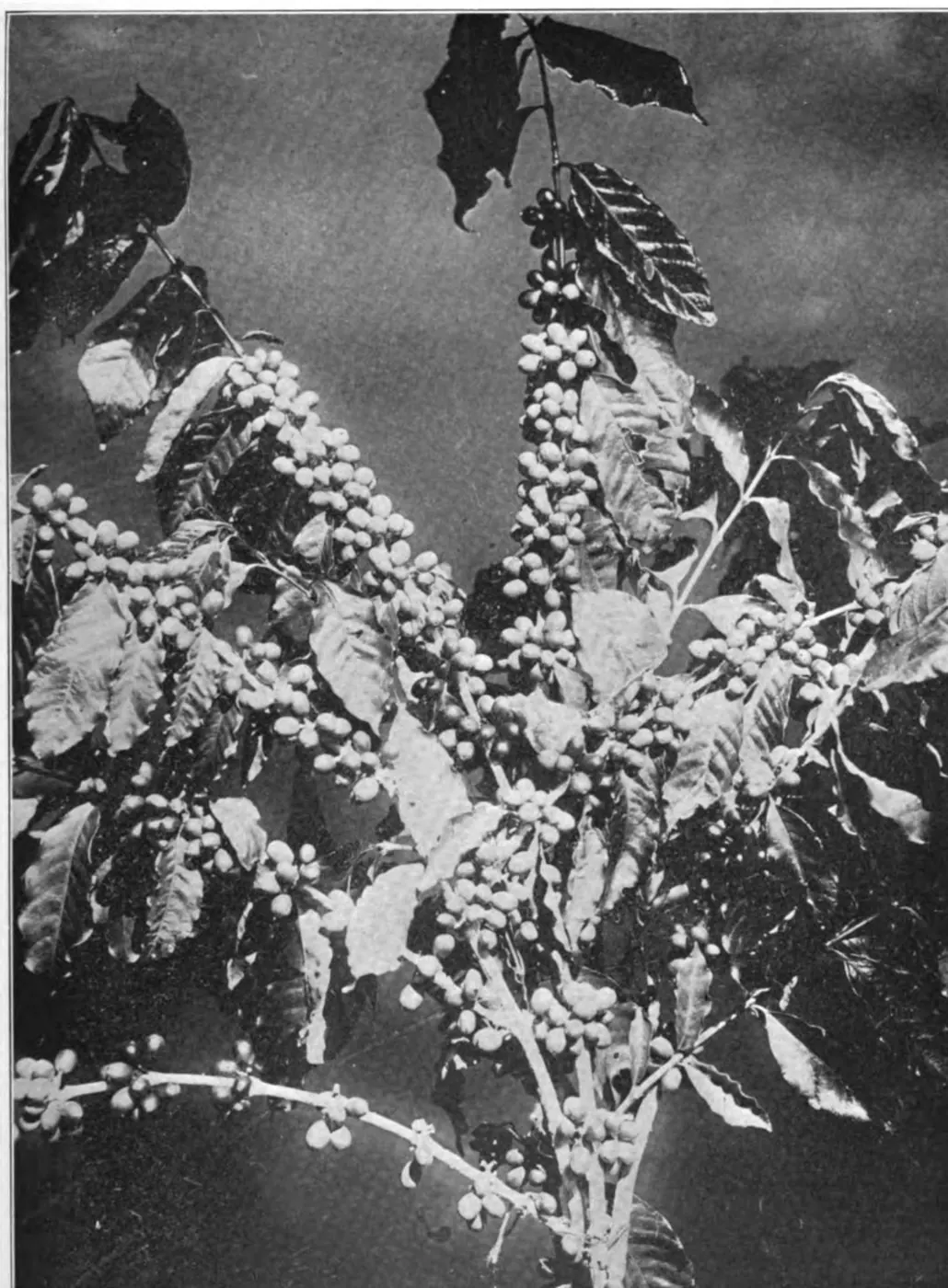
A ripe cherry weighs 1.5 to 2 g. According to the ratio given by René Coste and still in use, it takes 5 to 7 kg of arabica cherries for one kilo of marketable coffee, 5 kg for canephora and 12 kg for liberica; one kilo of cherries therefore gives 150 to 200 g of green coffee, and 80% of the mass is already discarded before shipping.
Roasting then removes 15 to 20% of the weight of the green coffee, mostly water and volatile compounds. Extraction, finally, dissolves only 18 to 22% of the grind; the rest is the puck that gets thrown away. The complete calculation gives 22 to 37 g of dissolved matter per 1,000 g of cherries, that is 2 to 4% of the starting weight, within the range of 1 to 5% set by the ICO. For an espresso of 7 g of grind, about fifty grams of cherries were needed and the water draws out about 1.5 g.
Coste 1955, p. 48; ICO, Coffee Development Report 2022-23: Beyond Coffee (2024), p. 28-29; calculation LC ch. 20From cherry to cup
What remains, in grams, of a thousand grams of picked cherries, at each stage of the chain. The last bar is the matter actually dissolved in the drink.
Three percent of the cherry reaches the cup. All the rest, ninety-seven percent, leaves the chain in another form.
The figures
| Remaining mass | |
|---|---|
| Picked cherries | 1,000 g |
| Green coffee | 150-200 g |
| Roasted coffee | 120-170 g |
| Dissolved matter | 22-37 g |
Mass balance
| Step | What remains (per 1,000 g of cherries) |
|---|---|
| Picked cherries | 1,000 g |
| Green coffee (5 to 7:1) | 150-200 g |
| Roasted coffee (-15 to -20%) | 120-170 g |
| Dissolved matter (18-22%) | 22-37 g |
| Share drunk | 2-4% (ICO: 1-5%) |
Charles W. Trigg, who wrote the chemistry chapter of Ukers, gives the breakdown as it was counted in 1922: about 68% pulp, 6% parchment and 26% marketable coffee. Three items for the whole cherry, and nothing more.
The ICO, a century later, refines it layer by layer. Skin and pulp weigh 39 to 43% of the weight of the fresh cherry. Mucilage represents about 22 kg per 100 kg of cherries. Parchment accounts for 35 to 39% of the dried cherry. The dry process husk is worth about 45% of the starting weight, and the silverskin only 0.4%.
By-products
| Co-product | Share | Where it forms |
|---|---|---|
| Skin and pulp | 39-43% of the cherry | Farm, wet, seasonal |
| Mucilage | ~22 kg / 100 kg | Farm, dissolved in water |
| Parchment | 35-39% of the dried cherry | Station, dry, storable |
| Husk (dry process) | ~45 % | Station, dry |
| Silverskin | 0,4 % | Roasting plant |
| Spent coffee grounds | ~11.4 Mt / year | At the drinker's |
| Total biomass | 40.68 Mt / year, 86% of the harvest |
These percentages do not add up, and that is normal: they are not relative to the same base. Some start from the fresh cherry, others from the dried cherry or from the starting weight. Comparing two by-product figures without checking the base is comparing two different things.
Over a crop year, this accounting becomes a tonnage. The 2022-2023 crop year produced 165.5 million 60-kg bags, or 47.29 million tonnes of cherries. Worldwide processing draws 40.68 million tonnes of biomass a year from them, that is, 86% of the weight of the cherries harvested. The ICO compares this tonnage to the weight of 365,000 blue whales.
Almost everything is decided in the days following picking: 95 to 99% of the weight of the cherry becomes by-product right in post-harvest. The washed process alone removes about 80% of it, because it separates the skin, pulp and mucilage right at the station.
The count does not stop at the farm. Consumption adds about 11.4 million tonnes of spent coffee grounds a year. These do not form in the producing countries, but in the kitchens, offices and bars of the consuming countries.
Ukers 1922, ch. XVII (Trigg), p. 155 sq.; ICO 2024, p. 21-22, 24, 28, 55-67, 78, 82; LC ch. 20The losses do not happen in the same place. The first takes place at the farm, in a producing country, over a few weeks of harvest, in wet form. The second, the silverskin, forms in a workshop or roasting plant, most often in a consuming country, as a steady, dry stream. The third, the spent coffee grounds, forms at the drinker's. This geography explains, better than chemistry, why the smallest by-product has found the most industrial outlets and why the biggest remains in heaps behind the mills: the value of the waste follows the same path as the value of the coffee, toward the places where the means, the logistics and the industries already are.
ICO 2024, p. 65-73; LC ch. 20 analysisIn this plateThe 15 sections
- 01The mass balance, from cherry to drunk bean
- 02Three centuries of drinking the husk: qishr, kisher and Sultana's coffee
- 031922: pulp as fertilizer, alcohol and fuel
- 04Pulp: composition, toxicity and what can be done with it
- 05Cascara, from waste to “novel food”
- 06Mucilage and washing water
- 07Treating the water: lagooning, wetlands, biodigesters, BECOLSUB
- 08Parchment and husks: fuel, biochar, paper, cup
- 09Silverskin: the smallest item, the most industrialized
- 10Spent coffee grounds: composition, phytotoxicity, household uses
- 11Spent coffee grounds in cities: biofuel, logs, cosmetics, activated carbon
- 12Capsules
- 13The carbon footprint of a cup
- 14From line to circle: what blocks and what works
- 15Today (2023-2026)
The table of contents, with the first sentence of each section