Spent coffee grounds in cities: biofuel, logs, cosmetics, activated carbon
At industrial scale, the yields are known. Transesterification of the lipids in the spent grounds gives biodiesel with a yield of 73 to 96% of the extracted oil; hydrolysis and fermentation give bioethanol (15.3 g/l, 87.2% yield after pretreatment); pyrolysis gives biochar; heat treatment above 170 °C opens the porosity and produces an activated carbon, a filtering material that the water and air industry consumes in considerable quantities; an integrated process extracts 25.6 g of D-mannose per 100 g of dry grounds. The obstacle is not chemistry but collection: spent grounds are produced in small quantities, wet, at thousands of points, and go moldy within a few days.
Lee et al. 2023 (PMC10146170); Arya et al. 2021The story of Bio-bean sums up the difficulty. The company was founded in London in 2013 by Arthur Kay, then an architecture student.
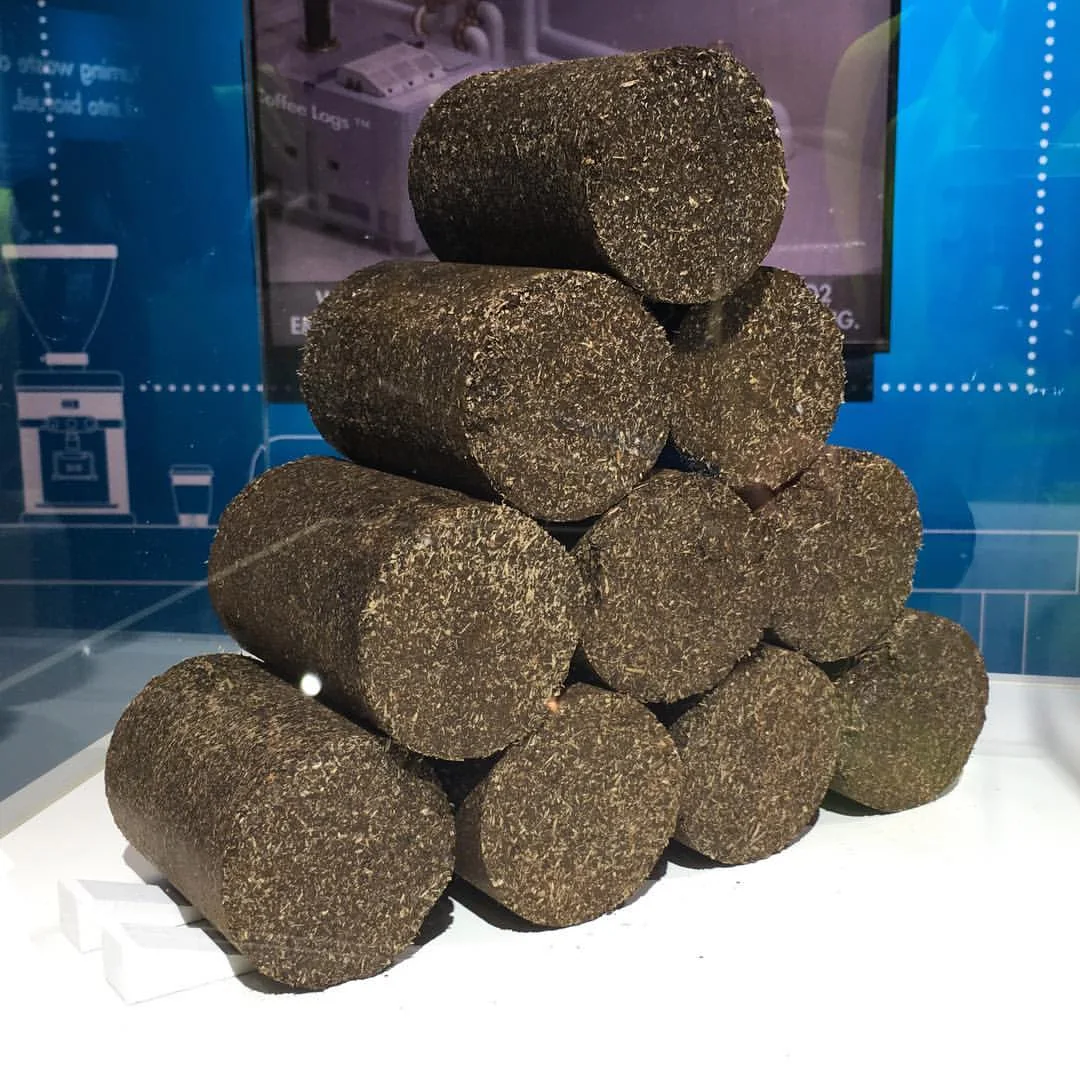
In 2015, it opened in Cambridgeshire a plant able to process 50,000 t of grounds a year. The material came from cafés, offices, stations and airports, Caffè Nero and London Stansted among them. The plant dried it, then pressed it into pellets and logs for stoves, the “Coffee Logs,” each made from the grounds of about 25 cups.
The chain went up a notch in 2017. With Shell, Argent Energy and Transport for London, Bio-bean produced a biodiesel from spent grounds that fueled London buses.
The fall was brutal. In March-April 2023, after a fire at the plant and without ever having been profitable, the company was placed in administration. Envar Composting bought the assets in July 2023, and the logs stopped being made.
In Copenhagen, Kaffe Bueno follows the other route. This B Corp-certified bioscience company does not burn the grounds, it extracts rare molecules from them. There is coffee oil for cosmetics, Kaffoil. There is a functional ingredient, Kaffage, with clinical results announced in October 2025. And there is a surfactant, that is, a molecule that detaches fatty substances, Kleanstant, awarded in 2024 and 2025. The ICO cites it as a reference for spent grounds cosmetics.
Recovery routes
| Route | Material | Principle | Real scale | Obstacles |
|---|---|---|---|---|
| Compost, vermicompost | Pulp, husk, spent grounds, silverskin | Aerobic degradation or by worms, return to the soil | Common on the farm and in households | Leachates, high C/N, phytotoxicity of the fresh material |
| Animal feed | Pulp, husk | Ensiling or drying, 2.5 to 42% of the ration depending on the species | Local, Central America since the 1970s | Caffeine and tannins, detoxification needed |
| Cascara | Dried pulp, husk | Infusion 3 g / 100 ml / 90 °C / 5 min | Niche, coffee shops since 2017 | Novel food (EU authorized 2022), no customs code, sanitary drying |
| Biogas | Pulp, mucilage, husk, water | Anaerobic fermentation, methane for drying | Pilots and equipped stations | Investment, digester stability, seasonality |
| Combustion, briquettes | Parchment, husk | Drying heat, pressed briquettes (Dilla) | Common for parchment | Open-air burning discouraged by the ICO |
| Biochar | Parchment, husk, spent grounds | Pyrolysis without oxygen, amendment | Pilots | Equipment, uncertain carbon market |
| Mushrooms | Spent grounds, pulp | Pasteurized substrate for oyster mushrooms, 73% of the substrate consumed | Small scale (GroCycle since 2011) | Labor, local outlet |
| Biofuel | Spent coffee grounds | Biodiesel (73-96% of the oil), bioethanol, logs | Bio-bean 2013-2023, 50,000 t/year plant, bankruptcy | Scattered collection, wet material, profitability |
| Cosmetics, extraction | Spent grounds, silverskin, pulp | Oil, antioxidants, caffeine, surfactants | Kaffe Bueno, Intercos | Industrial extraction, cosmetics regulation |
| Materials | Parchment, husk, silverskin | Composites, paper (Favini 15%), faux leather, plywood, cups (Huskee) | Industrial for silverskin, niche for husk | Steady stream required, logistics |
| Pectin, concentrate | Mucilage | Pectin extraction, beverage concentrate (NAOX) | A case cited by the ICO | Mucilage diluted in washing water |
| Activated carbon, biosorbent | Spent grounds, husk | Thermal activation > 170 °C, adsorption of pollutants | Laboratory and pilots | Competition from coconut-shell activated carbon |
Comparing the two trajectories gives the rule. The model that survives is the one that sells the gram dear, not the one that burns the tonne: collecting and drying a wet and scattered material costs too much for what a fuel is worth.
Wikipedia, “Bio-bean,” accessed on 09/07/2026; Lekto Woodfuels, “What happened to Coffee Logs?,” updated January 2025; Biofuels International, “Caffè Nero teams up with Bio-bean”; kaffebueno.com, accessed on 09/07/2026; ICO 2024, p. 72In this plateThe 15 sections
- 01The mass balance, from cherry to drunk bean
- 02Three centuries of drinking the husk: qishr, kisher and Sultana's coffee
- 031922: pulp as fertilizer, alcohol and fuel
- 04Pulp: composition, toxicity and what can be done with it
- 05Cascara, from waste to “novel food”
- 06Mucilage and washing water
- 07Treating the water: lagooning, wetlands, biodigesters, BECOLSUB
- 08Parchment and husks: fuel, biochar, paper, cup
- 09Silverskin: the smallest item, the most industrialized
- 10Spent coffee grounds: composition, phytotoxicity, household uses
- 11Spent coffee grounds in cities: biofuel, logs, cosmetics, activated carbon
- 12Capsules
- 13The carbon footprint of a cup
- 14From line to circle: what blocks and what works
- 15Today (2023-2026)
The table of contents, with the first sentence of each section