Three centuries of drinking the husk: qishr, kisher and Sultana's coffee
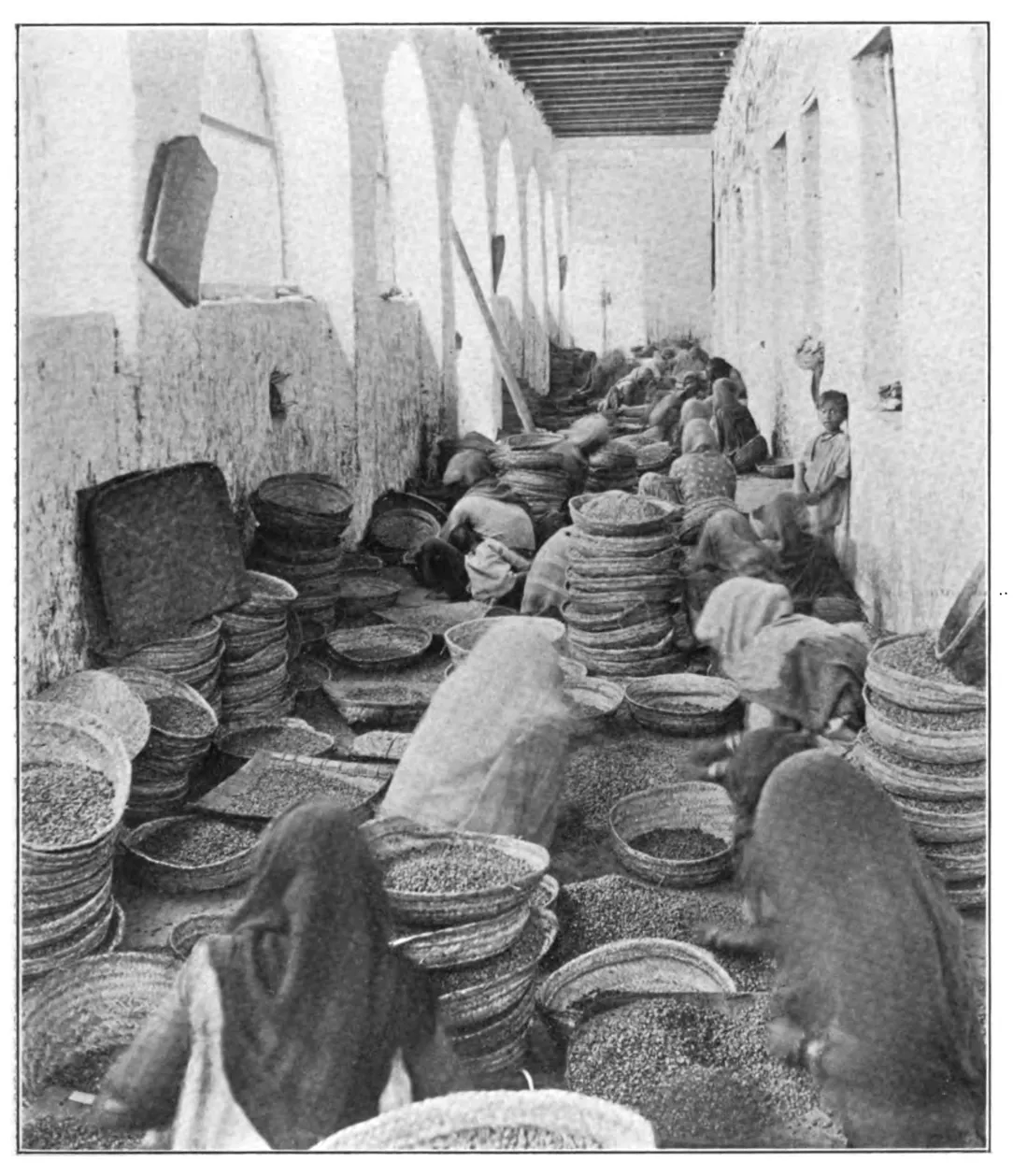
The part of the cherry that the West threw away for a century and a half, the region that made coffee a drink never stopped drinking. In Yemen, the growers do not consume the bean: it all goes to export. What is left for them to drink is the husk of the fruit.
This drink has a name, kisher (qishr). It is a decoction of the husks of the fruit, often boiled with ginger and sometimes cinnamon.
The sorting is done by hand. In the cleaning houses of Aden and Hodeida, Indian women winnow the coffee on bamboo trays. The clean beans become bun safi, the husks become kisher: one and the same sorting gesture separates the export product from the local drink.
Further south, the recipe changes form. In Abyssinia and Somalia, an hour of boiling roasted husks gives a straw-colored, lightly sweet decoction.
Two stories circulate about the origin of this custom, and neither rests on a solid source. Ukers first reports a legend that dates the decoction of the husks alone to around 1200, before the discovery of roasting. He gives no source for it, and the date should be treated as such.
The second story is a misattribution. The invention of this drink, called Sultan, Sultana or Sultana's coffee, was credited to Dr. Andry by French authors, wrongly; Andry was dean of the Paris faculty of medicine. He merely had his own recipe: boil the husks for half an hour, for a lemon-colored liquid drunk with a little sugar.
Ukers 1922, ch. XX (Cultivation), p. 197 sq.; ch. XXI (Preparing green coffee), p. 245 sq.; ch. XXXV (Manners and customs), p. 655 sq.; ch. XXXVI, p. 693 sq.; Wikipedia, “Qishr,” accessed on 09/07/2026The European testimonies are old. Johann Vesling, a German botanist settled in Venice, already distinguished in 1638, commenting on Alpini, the qualities of a drink made from the husks (the “skins”) of the berries from those of the liquor drawn from the “stones” themselves. Jean de La Roque, in 1732, describes the Arabian “Sultana's coffee,” made from the skins and parchments, without bitterness and therefore drunk without sugar, and declares it impossible to reproduce outside the country, the husks being too dry to yield anything after the journey.
In 1886, the Pharmaceutical Journal still notes that the Arabs around Jeddah throw away the stone and infuse the husk; dried and roasted pulp was even imported into England to take the place of coffee. In 1902 and 1903, The Lancet and the Scientific American Supplement discuss the “alleged medicinal properties” of the husk of the bean.
Ukers 1922, ch. IV (Vesling 1638); ch. XVII, p. 155 sq., n. 108 (Pharm. Jour. 1886, xvii, p. 656); Ukers bibliography: The Lancet 1902, II, p. 944; Sci. Am. Suppl., March 7, 1903, LV; La Roque 1732, p. 263 and 270 (digest); LC ch. 6 and 20In this plateThe 15 sections
- 01The mass balance, from cherry to drunk bean
- 02Three centuries of drinking the husk: qishr, kisher and Sultana's coffee
- 031922: pulp as fertilizer, alcohol and fuel
- 04Pulp: composition, toxicity and what can be done with it
- 05Cascara, from waste to “novel food”
- 06Mucilage and washing water
- 07Treating the water: lagooning, wetlands, biodigesters, BECOLSUB
- 08Parchment and husks: fuel, biochar, paper, cup
- 09Silverskin: the smallest item, the most industrialized
- 10Spent coffee grounds: composition, phytotoxicity, household uses
- 11Spent coffee grounds in cities: biofuel, logs, cosmetics, activated carbon
- 12Capsules
- 13The carbon footprint of a cup
- 14From line to circle: what blocks and what works
- 15Today (2023-2026)
The table of contents, with the first sentence of each section