Harvest and processing: Kiboko and washed
How is canephora cherry processed in Uganda?
Start the scene or choose a stage. The animation simplifies the mechanism; what follows gives the details and the available references.
Cherries ripen over several passes ten to fifteen days apart, spread over several months. The best quality comes from selective picking of bright red cherries; green ones are left six to eight days longer. The Ugandan manual forbids stripping, which mixes green, pest-damaged and overripe cherries, and cherries fallen on the ground, often contaminated with ochratoxin A, are not collected.
Read the stages without animation
- Pick bright redCherries ripen over several passes ten to fifteen days apart, spread over several months. The best quality comes from selective picking of bright red cherries; green ones are left six to eight days longer. The Ugandan manual forbids stripping, which mixes green, pest-damaged and overripe cherries, and cherries fallen on the ground, often contaminated with ochratoxin A, are not collected.
- Kiboko, the whole cherryIn the natural process, the whole cherry is dried in the sun: this is Kiboko. On a slab, a tarp, a table or raised mesh, never on bare ground; a layer of 4 cm at most for the first two or three days, turned with a rake, covered at night so that dew does not rewet what the day has dried.
- Washed: pulping with clean waterThe washed process is better paid and more demanding: it takes 2 to 10 liters of clean water per kilo of cherry. The pulper separates the skin and pulp from the bean, which comes out coated in mucilage, the sticky layer glued to the parchment.
- Ferment, then washThe mucilage ferments for one to two days, then a careful washing carries it away. Semi-washed replaces this fermentation with a mechanical demucilager: about 0.5 liter of water per kilo instead of 2 to 10, and no more tanks or washing to manage.
- Dry down to 12 or 14%Parchment dries in ten to fifteen days, down to 12-13% moisture. Kiboko takes fourteen to thirty days to reach 13-14%: a black cherry, odorless, free of stones and dust, which must yield at least 50% at hulling.
To remember: Kiboko saves water and lasts weeks; washed costs water and is better paid.
In history: The first pulper-demucilagers damaged the parchment, which for a long time earned the process a reputation for fermented flavors.
Read the full article and its sources ↓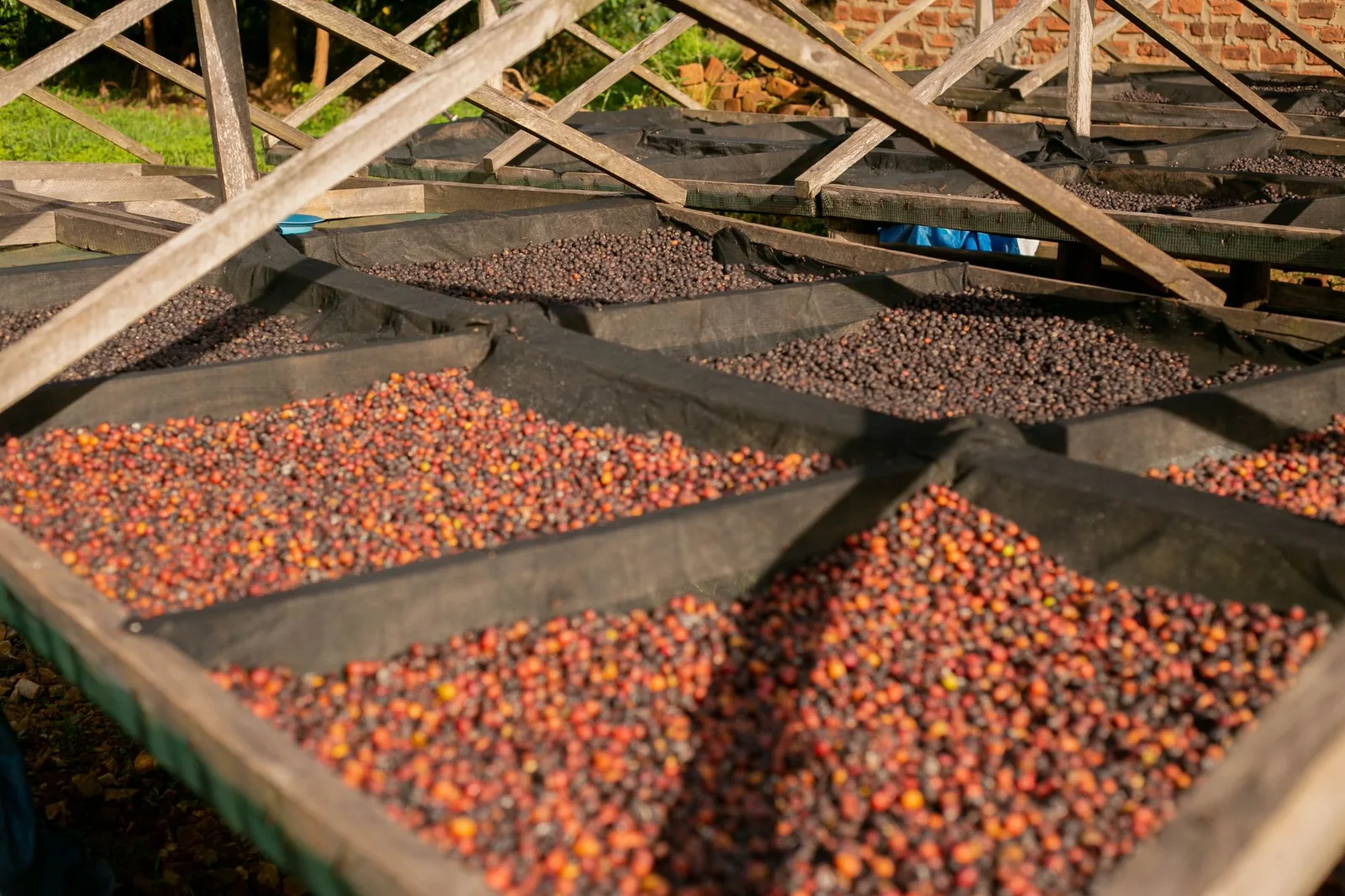
Two harvests a year, the main one and the “fly crop,” staggered from one region to another (see the table in the margin). Cherries ripen over several passes ten to fifteen days apart, spread over several months; the best quality comes from selective picking of bright red cherries, the green ones being left six to eight days longer. The manual forbids stripping “at all costs”: Ugandan varieties do not ripen uniformly, stripping mixes green, pest-damaged and overripe cherries, breaks the leaves and fruiting nodes of the following season, and once dried all cherries turn black, so that nothing distinguishes the unripe from the ripe except the cup. Cherries fallen on the ground, often contaminated with ochratoxin A, are not collected; picking is done onto a clean tarp.
UCDA 2019, § 8.0 to 8.2, p. 89-91, table 21, figures 55-59Picking itself involves two gestures. Selective picking, cherry by cherry, maximizes the ripe, lets the green grow and protects the nodes of the following season; it costs in passes and labor, and presupposes a flowering grouped by regular rains. Stripping, the hand that slides the whole branch into a basket, is fast and cheap; it is the gesture of Vietnam, Côte d'Ivoire and Cameroon, where the country profile notes it as a “non-selective” harvest, and it is justified where flowering is homogeneous or the harvest mechanized, but it produces black beans, overripe fermentations and a loss of yield the following year.
The manual settles the question for Uganda, where ripening is staggered; Brazil solves the problem differently, with its three groups of Emcapa clones with grouped, early, medium or late ripening, which allow a clean harvest by plot.
UCDA 2019, § 8.2, p. 90-91; country profiles Vietnam, Côte d'Ivoire and Cameroon (pays.json); Ferrão et al. 2020 via the Emcapa sheetThe dry process gives Kiboko: the whole cherry dried in the sun, husk included. The surface can be a cemented slab, a tarp, a table or raised mesh. Never bare ground: coffee that touches the earth picks up dust, stones and moisture there.
| Drying surface | UCDA recommendation |
|---|---|
| Bare ground | prohibited: dirt, earthy flavors, mold |
| Tarp or mat | acceptable, layer of 4 cm at most in the first days |
| Cemented slab | acceptable, to be turned with a rake, covered at night |
| Raised table | recommended |
| Raised mesh | recommended, prevents parchment cracking |
| Solar dryer | expanding, shortens the time |
Drying management comes down to a few gestures. A layer of 4 cm at most for the first two or three days. Turning with a rake. Covering at night, which keeps dew from rewetting what the day has dried. Fourteen to thirty days depending on the weather, down to 13-14% moisture.
The expected result is described to the letter: a black cherry, odorless, free of stones and dust, and a hulling yield of at least 50%. This last figure is the one that pays, since it says how much marketable coffee will come out of the dry husk. Solar dryers are spreading to shorten the time.
The wet process is better paid, and more demanding. It takes 2 to 10 liters of clean water per kilo of cherry. Then come pulping, a one- to two-day fermentation of the mucilage and a careful washing. Drying the parchment takes ten to fifteen days, down to 12-13%.
| Process | Water per kg of cherry | Duration | Final moisture | Pros | Cons |
|---|---|---|---|---|---|
| Kiboko (dry) | none | 14-30 days | 13-14 % | simple, no machine, local | indistinguishable black cherries, OTA if poorly dried, hulling yield 50% min. |
| Fully washed | 2-10 L | fermentation 1-2 days + 10-15 days drying | 12-13 % | better quality, better paid | clean water in quantity, tanks, managing the fermentation |
| Semi-washed (demucilager) | about 0.5 L | no fermentation + 10-15 days | 12-13 % | consistency, no tanks or washing | initial capital; the first machines damaged the parchment |
The semi-washed variant replaces the fermentation with a mechanical demucilager. The saving is twofold: about 0.5 liter of water per kilo instead of 2 to 10, and no more tanks or washing to manage.
The manual notes that these pulper-demucilagers, designed first for canephora, have become the most consistent way to obtain good quality. Marco's book recalls why the machine took time to catch on. The first models damaged the parchment, which for a long time earned the process a reputation for fermented flavors.
Storage, finally. Sisal bags, never polypropylene. Pallets, 15 cm off the floor and 30 cm from the walls. Nothing near fuels and fertilizers. And first in, first out, so that no lot ages forgotten at the back of the warehouse.
Other countries have their own customs. Dry process at 90% in Vietnam, exclusive in Côte d'Ivoire. In India, one says “Cherry” for the natural and “Parchment” for the washed. The plate on processing details the processes.
UCDA 2019, § 8.3 and 8.4, p. 91-95, figures 60-69; LC ch. 17b; country profiles Vietnam, Côte d'Ivoire and India (pays.json, ICO 2009); professional training document, Guide des classifications et descriptionsUgandan marketable coffee is called “FAQ,” for fair average quality, the fair average quality of the trade. It is graded by screen, that is, by bean size: sieves with round holes numbered from 10 to 20, that is, 4.00 to 8.00 mm.
The grade says both the sieve and the cleanliness of the lot. Screen 18 retains 92% of the beans on sieve 18 and tolerates 7% defects. Screen 17 retains 90% on 17. Then come Screen 15, 14, 13 and 12. Below them are the BHP, for “below higher parchment,” numbered 1899, 1599, 1299 and 1199, where broken or light lots fall. Black beans, for their part, are removed by hand or by optical sorter.
The moisture of all grades is capped at 13-14%. This is not just one more figure: it is the drying target, carried over as is into the grade.
None of this is universal. A screen measures a size, not a taste, and each origin has its own scale: from one country to another, grades cannot be compared. Vietnam has had five grades since 2001, from Special (16/18, 30 defects) to Grade 4 (250 defects). Côte d'Ivoire has four, from 60 to 120 defects. Cameroon runs from “Large beans 18/20” to “Grade 3.” India classifies its Cherry AA, A, AB and its Parchment.
UCDA 2019, § 9.3, p. 98-101, tables 22-23; country profiles Vietnam, Côte d'Ivoire, Cameroon and India (pays.json)In this plateThe 19 sections
- 01A species, not a variety
- 02Discovery and naming, 1880-1900
- 03Java, 1900-1919: rust paves the way for canephora
- 04The genome: diploid, allogamous, parent of arabica
- 05Two groups, then eight: genetic geography
- 06Selecting an allogamous plant: five strategies in a century
- 07Kouilou, Niaouli, Conilon: the Guinean and Atlantic lineage
- 08Uganda: the species on its native ground
- 09Coffee wilt disease, 1927-1993
- 10Agronomy: what the species requires
- 11Propagating, irrigating, cutting back: the grower's options
- 12Harvest and processing: Kiboko and washed
- 13A century of market share
- 14Vietnam since 1990
- 15Fine robustas and the CQI protocol
- 16Price: the 2024-2025 record
- 17The Timor Hybrid: what canephora gives arabica
- 18What changed, 2023-2026
- 19Archive plates
The table of contents, with the first sentence of each section