Kouilou, Niaouli, Conilon: the Guinean and Atlantic lineage
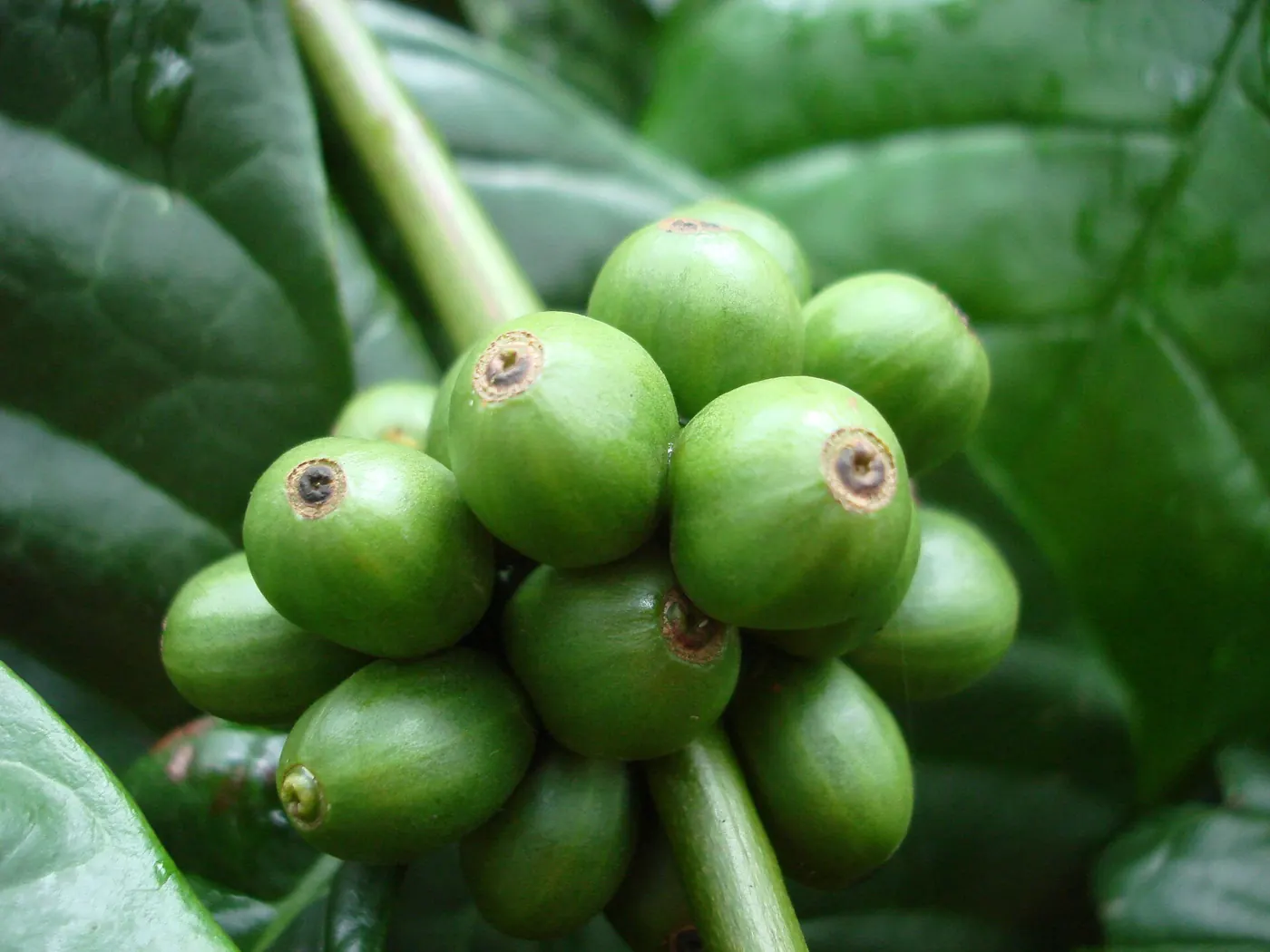
The name Kouilou comes from a coastal river of southern Gabon and Congo, where the species grows spontaneously. The coffee bears the name of the place where it was found.
In Côte d'Ivoire, the “Kouilou” planted since the late nineteenth century come out of no program: they are spontaneous forms taken from the neighboring forests. Two coffee trees discovered in Indénié, in 1905 and 1907, enter the Bingerville station in 1914. One becomes the Petit Indénié, the other the Gros Indénié, with a wider bean.
In Dahomey, the Niaouli trial garden, founded in 1904, fixes in 1923 a botanically very close form, the Niaouli. The division has held: Ivorian genotypes remain of Kouilou type, those of Togo and Benin of Niaouli type.
Kouilou was successfully planted in Madagascar as early as the 1920s, and it left a trace there: a professional training document on acidity still cites “the Kouillou of Madagascar” among the canephoras rich in chlorogenic acid.
Coste gives the mass this lineage then weighed. In 1955, he counts more than 200,000 tonnes of canephora in the world. Of this total, 175,000 tonnes go to Africa and Madagascar, or 95% of everything that was not arabica. At that date, canephora is an African plant.
Gomez et al. 2009 (Ivorian Kouilou as a spontaneous form); Persée 1935 and 1939 via the atlas's Niaouli sheet; professional training document, Tout savoir sur l'acidité; Coste 1955, p. 30The Conilon is the Kouilou that crossed the Atlantic. The name itself is a phonetic deformation of Kouilou, pronounced the Brazilian way.
It is introduced in the state of Espírito Santo in 1912. Kawuki's table indicates a “Congo / Indonesia” origin and specifies what was sought at the time: resistance to rust and tolerance to drought.
Then it remains marginal for sixty years. What brings it out of the shadows is two catastrophes: rust, arrived in Brazil in 1970, and the frost of 1975. Both ruin the low-altitude arabicas, and the state pushes for replanting in canephora. Brazilian canephora was born of an arabica disaster.
Half a century of selection follows, and the rhythm is worth following. Emcapa, now Incaper, releases the first clonal varieties in 1993: Emcapa 8111, 8121 and 8131. These are three groups of mutually compatible clones, with early, intermediate and late maturation, which makes it possible to spread the harvest from April to August instead of picking everything at once.
Then, in 2000, the Robustão Capixaba, drought-tolerant. In 2013, Diamante, Jequitibá and Centenária, which do 42% better than the Emcapa, with 88.75 bags per hectare for Jequitibá and 79.01 points on the CQI protocol. In 2016, Marilândia, which climbs to 135 bags per hectare under irrigation with high technology. And in 2019, Conquista, multiplied by seed, hence accessible to the family farming that has no cuttings workshop.
What these dates hide is time. These varieties come out of twenty years of trials on more than 2,000 clones, and Incaper's full cycle lasts twelve years. Twelve years between the idea and the plant sold to the producer.
Embrapa in Rondônia followed another track: the “Amazonian robustas,” gathered in the BRS series. These are natural crosses between Conilon and Canephora, that is, meetings that nobody directed and that the breeder merely spotted.
BRS 2314 was scored up to 87.2 points and classed Fine Robusta, the mention that the CQI protocol reserves for the best canephoras. Which was not supposed to happen to a canephora: the species had been retained, for a century, for its vigor, its resistance and its yield.
Kawuki et al. 2026, table 1 and § 2.6, citing Ferrão et al. 2019; Ferrão et al. 2020 via the atlas's Emcapa, Jequitibá and Marilândia sheets; WCR 2025, p. 105 (BRS 2314); McCook 2019 (rust in Brazil, 1970); WCR, “History of Robusta,” varieties.worldcoffeeresearch.org, September 7, 2026 (year 1912, origin of the name)The result can be counted. Conab expects for 2025 a harvest of 18.7 million bags of conilon-robusta. It is the highest ever recorded in an off year of the biennial cycle, that is, the lean year of the alternation that makes a coffee tree bear heavily, then lightly the following year. The record therefore falls on the wrong half of the cycle.
The harvest is highly concentrated. Espírito Santo alone supplies 13.1 to 13.8 million bags, or 69 to 70% of the total, ahead of Bahia (2.5 million) and Rondônia (2.28 million).
The USDA places Brazilian canephora production at a record in 2025-26, then at 24.4 million bags in 2026-27, with Espírito Santo still supplying about 70% of the total.
Conab, 2025 estimates, via StoneX (May 2025) and Cultivar (2025); USDA, Coffee: World Markets and Trade, June 2026, via Daily Coffee News, June 24, 2026; level: statistical institute relayed by the specialized pressIn this plateThe 19 sections
- 01A species, not a variety
- 02Discovery and naming, 1880-1900
- 03Java, 1900-1919: rust paves the way for canephora
- 04The genome: diploid, allogamous, parent of arabica
- 05Two groups, then eight: genetic geography
- 06Selecting an allogamous plant: five strategies in a century
- 07Kouilou, Niaouli, Conilon: the Guinean and Atlantic lineage
- 08Uganda: the species on its native ground
- 09Coffee wilt disease, 1927-1993
- 10Agronomy: what the species requires
- 11Propagating, irrigating, cutting back: the grower's options
- 12Harvest and processing: Kiboko and washed
- 13A century of market share
- 14Vietnam since 1990
- 15Fine robustas and the CQI protocol
- 16Price: the 2024-2025 record
- 17The Timor Hybrid: what canephora gives arabica
- 18What changed, 2023-2026
- 19Archive plates
The table of contents, with the first sentence of each section