Discovery and naming, 1880-1900
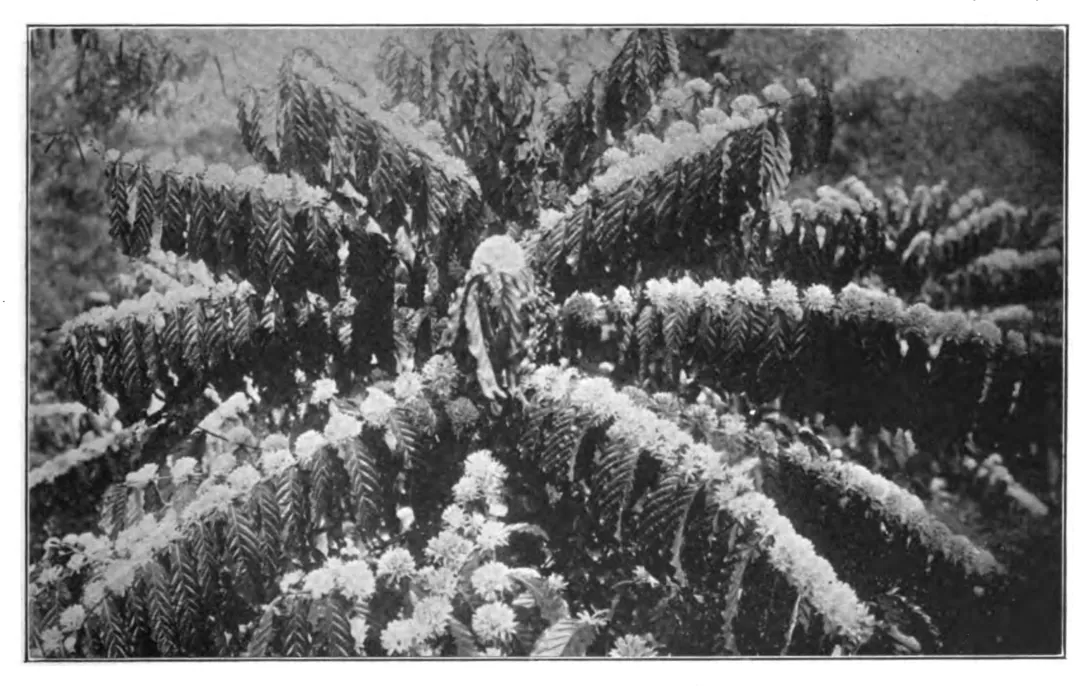
The two great world panoramas of coffee of the late nineteenth century, Thurber in 1881 and Walsh in 1894, ignore the species. Its so-called Kouilou form is observed in the wild by the French around 1880 between Gabon and the mouth of the Congo, along the Kouilou-Niari river that gives it its name. The botanist Louis Pierre, at the Paris Museum, receives a sample collected in Gabon by the missionary Théophile Klaine and proposes the name Coffea canephora in 1895; the validating description is published in Berlin by Albrecht Froehner in 1897, hence the author citation “Pierre ex A. Froehner” that the species carries.
Wikipedia, “Coffea canephora,” and Plants of the World Online (Kew), accessed September 7, 2026; Thurber 1881 / Walsh 1894 digest; level: online encyclopedia cross-checked against Kew's nomenclatural databaseAlmost at the same time, and with no link to Pierre, the Belgian botanist Émile Laurent spots a vigorous wild coffee tree in the Congo. Ukers, writing in 1922 from Javanese sources, dates the discovery to 1898 and reports that a horticultural house in Brussels seizes upon it, multiplies it for the market and christens it Coffea robusta, even though it already bore the name of its discoverer, Coffea Laurentii.
- 1880Kouilou observed in the wild between Gabon and the Congo
- 1897Froehner publishes Coffea canephora (Pierre's name, 1895)
- 1898-1900Laurent in the Congo; Brussels sells “Coffea robusta”
- 1901Congolese material introduced to Java
- 1910-1916Java to Uganda (1910) and India (1916)
- 1912Conilon in Espírito Santo
- 191984% of the area of the Dutch East Indies
- 1927Coffee wilt disease in Ubangi-Shari; Timor Hybrid
- 1955Coste: over 200,000 t; founding of the CIFC
- 1986Đổi Mới in Vietnam
- 1993Coffee wilt disease detected in Uganda; Emcapa 8111-8131
- 2009-2010Symposium and first Q Robusta course (CQI-UCDA); clones KR1-7
- 2014Canephora genome (Denoeud, Science)
- 2024Salojärvi: 7-11% introgression in resistant arabicas
- Feb. 2025$5,849/t, record in London
- 2025-2646.6% of world production (USDA)
The publication of C. robusta by Lucien Linden, in 1900, makes “robusta” a competing species name; it would later be established that the two plants are one and the same, and Froehner's name, being earlier, prevails. This commercial christening is the source of all the later confusion: a firm sold under a brand name what a botanist had already described as a species.
Ukers 1922, ch. XV, p. 252; Wikipedia, “Coffea canephora,” September 7, 2026; Davis-Yang digest (Kawuki 2026 review, table 1); LC ch. 4The collecting of material begins before the names: the review by Kawuki and his coauthors places the first collections for cultivation around 1870 in the region of the Lomami river, in the Congo, and notes that in Uganda local populations were already practicing informal tree selection in the forests before the colonists arrived (Thomas 1935). Canephora was therefore not “invented” in Brussels: it was extracted from forests where it was already known.
Kawuki et al., “Genetic improvement of robusta coffee,” Frontiers in Plant Science, 16, January 15, 2026, introduction and table 1; Wikipedia, “Coffea canephora”In this plateThe 19 sections
- 01A species, not a variety
- 02Discovery and naming, 1880-1900
- 03Java, 1900-1919: rust paves the way for canephora
- 04The genome: diploid, allogamous, parent of arabica
- 05Two groups, then eight: genetic geography
- 06Selecting an allogamous plant: five strategies in a century
- 07Kouilou, Niaouli, Conilon: the Guinean and Atlantic lineage
- 08Uganda: the species on its native ground
- 09Coffee wilt disease, 1927-1993
- 10Agronomy: what the species requires
- 11Propagating, irrigating, cutting back: the grower's options
- 12Harvest and processing: Kiboko and washed
- 13A century of market share
- 14Vietnam since 1990
- 15Fine robustas and the CQI protocol
- 16Price: the 2024-2025 record
- 17The Timor Hybrid: what canephora gives arabica
- 18What changed, 2023-2026
- 19Archive plates
The table of contents, with the first sentence of each section