Vietnam since 1990
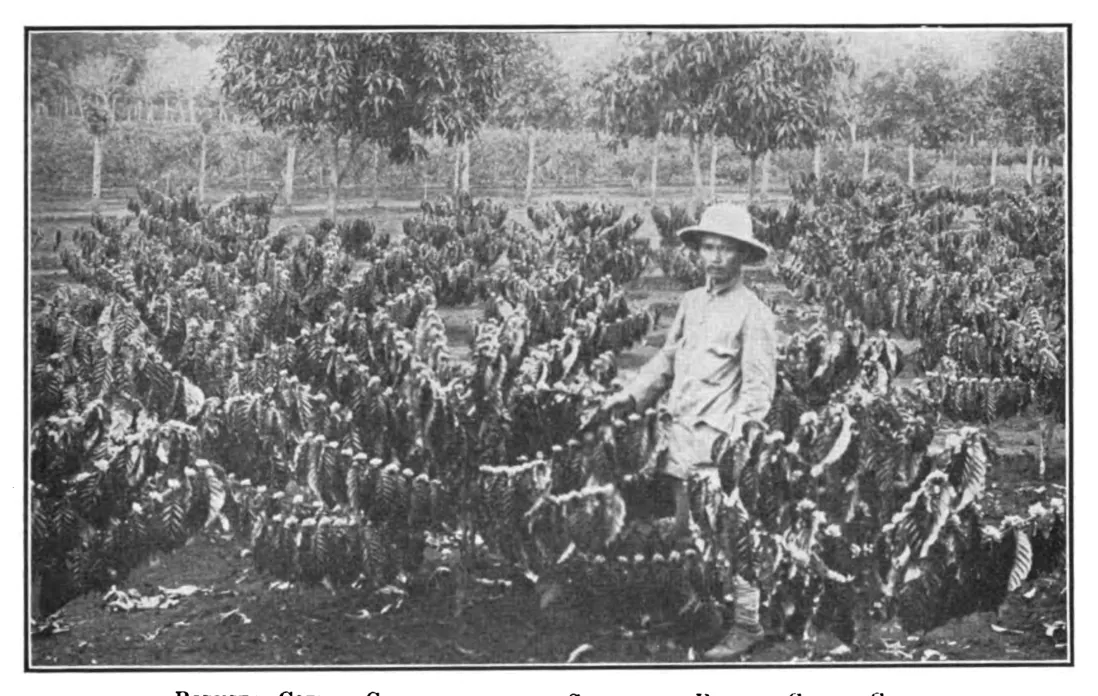
The first plants date from 1857, according to the country profile; the first documented trials begin in 1887 near Hanoi, in Tonkin, with arabica seeds from Réunion, which the soil and climate reject, and canephora takes over with liberica and excelsa. In 1916, a million trees are in production in Tonkin, Annam and Cochinchina, and Ukers reproduces a photograph of canephora on the Suzannah estate, in Cochinchina; exports, 517,000 pounds a year on average until 1918, go almost all to France. The material comes from the Congo and Java in the 1900s. The WASI institute of the Highlands begins formal selection in the late 1970s and releases the clones TR4, TR9, TR11, TR12, the seed variety TRS1 derived from their intercrossing, then TR14 and TR15, selected for climate change.
Ukers 1922, ch. XXII, p. 394; Vietnam country profile (pays.json); Kawuki et al. 2026, § 2.3 and table 1The takeoff comes down to a policy. The Đổi Mới of 1986 opens the market, allows private enterprise and the privatization of land. The state then pushes coffee into the Central Highlands, Đắk Lắk, Lâm Đồng, Gia Lai, on former state farms leased in small plots.
The curve follows the decision. The country goes from about 1 million bags in 1990 to 22 million in 2013 according to the ICO. To this are added more than 25 million around 2010, and 32.5 million expected in 2026-27. It is now the world's second producer behind Brazil.
This coffee is of a single type and managed in a single way: 95% canephora, on about half a million hectares, in intensive irrigated monoculture, stripped and dried. Đắk Lắk alone supplies nearly 30% of the total, and its capital, Buôn Ma Thuột, presents itself as the capital of canephora.
Two consequences go beyond the country's borders. It is this expansion that took the world share of canephora from 27 to more than 40% in thirty years. And it is the stock retention by Vietnamese growers, who were waiting for better prices, that fed the surge of 2024-25.
ICO via Daily Coffee News 2014; Vietnam country profile (pays.json); USDA, June 2026, via Daily Coffee News, June 24, 2026; Sucafina and DRWakefield, Vietnam origin pages (level: commercial pages); Business Recorder, February 17, 2025In this plateThe 19 sections
- 01A species, not a variety
- 02Discovery and naming, 1880-1900
- 03Java, 1900-1919: rust paves the way for canephora
- 04The genome: diploid, allogamous, parent of arabica
- 05Two groups, then eight: genetic geography
- 06Selecting an allogamous plant: five strategies in a century
- 07Kouilou, Niaouli, Conilon: the Guinean and Atlantic lineage
- 08Uganda: the species on its native ground
- 09Coffee wilt disease, 1927-1993
- 10Agronomy: what the species requires
- 11Propagating, irrigating, cutting back: the grower's options
- 12Harvest and processing: Kiboko and washed
- 13A century of market share
- 14Vietnam since 1990
- 15Fine robustas and the CQI protocol
- 16Price: the 2024-2025 record
- 17The Timor Hybrid: what canephora gives arabica
- 18What changed, 2023-2026
- 19Archive plates
The table of contents, with the first sentence of each section