Java, 1900-1919: rust paves the way for canephora
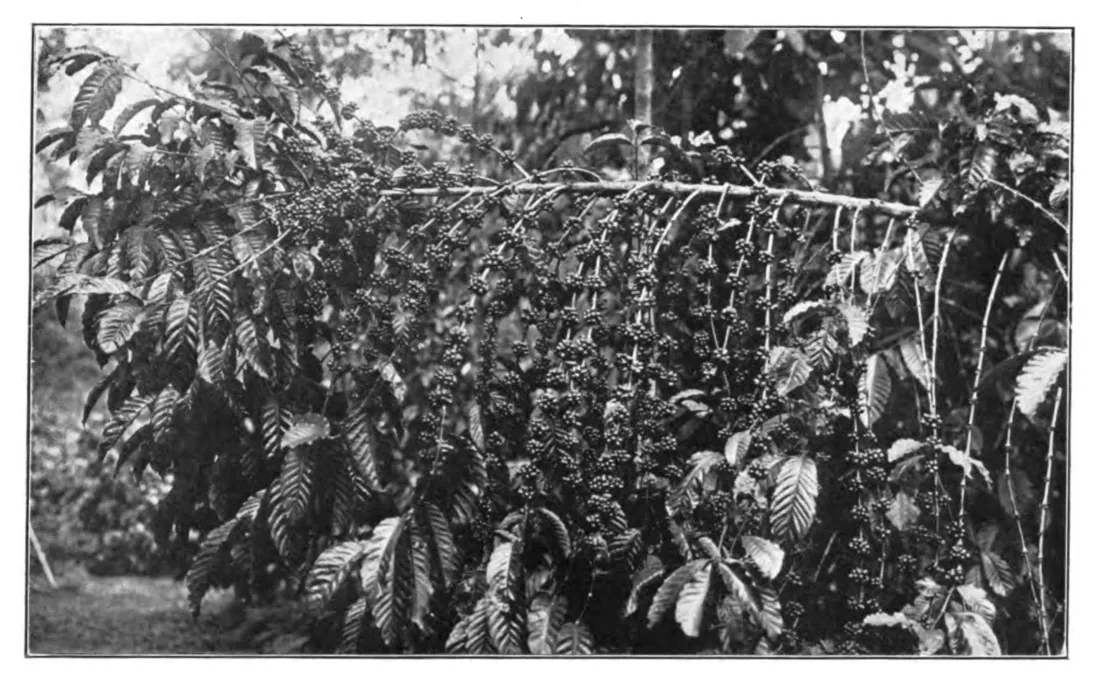
Orange rust destroyed the arabicas of Ceylon from 1869 and reached Sumatra in 1876; in the Dutch East Indies, it drove arabica out of every district below 3,500 feet, a little over 1,000 meters. Liberica, tried first, disappoints. The Congolese material arrives in Java in 1901, via Brussels, with three sought-after traits: resistance to rust, vigor and productivity.
Ukers describes the tree as the Javanese planters saw it: taller than arabica and liberica, parasol-shaped because its long branches droop, flowering all year round and from the first year, ripening its drupes in ten months, with a negligible crop in the first two years and an abundant one from the fourth. At low altitude it produces earlier and more, but its productive life is only ten years against thirty for high-altitude arabica; left unpruned on some mountain estates, it reaches ten to twelve meters and is picked from a ladder, for six to seven pounds of coffee per tree.
Ukers 1922, ch. XV, p. 252 and ch. XXII, p. 370-371; McCook 2019 (digest, chronology); Kawuki et al. 2026, table 1The shift is rapid, and it can be measured. In 1919, the Dutch East Indies count 142,272 acres of coffee. Canephora occupies 110,903, arabica 15,314, liberica 4,940. The species that arrived in 1901 already holds most of the area.
A government declaration of August 1919 says the same thing in percentages: 84% of the area in canephora, 5.5% in arabica, 4.5% in liberica. The rest goes to “dozens of other varieties,” including canephora, Ugandae, Bukobensis, Quillou and stenophylla. All resemble canephora, and that is why they leave with it, without distinction.
These names are nevertheless not duplicates. At the Bangelan trial gardens, Cramer still tests in 1919 the Quillou, that is, the Kouilou. The yield is good: three pounds of fruit give one pound of marketable coffee. Some even prefer it to canephora for the taste of the roasted bean.
Cramer also tests the Ugandae, whose “product has a better flavor than canephora,” it is said at the time.
On the American side, the judgment comes from a public laboratory and not from a seller, which gives it weight. Viehoever and Lepper, at the USDA Bureau of Chemistry, publish a series of tastings that are “clearly favorable.” Their conclusion: canephora “deserves consideration and recognition.”
Ukers 1922, ch. XXII, p. 370-371 and ch. XV, p. 253-254Java does not content itself with growing: it becomes the world's first center of canephora selection.
Three institutions work on it between 1907 and the 1930s: the Besoeki station, ancestor of today's ICCRI, the Malang station and the Bangelan farm. They use all the tools of the breeder of the time. Mass selection, which consists in keeping the best trees of a population and starting again from them. Progeny tests, to know whether a good tree gives good offspring, which is by no means automatic. Self-pollination. And above all cloning by cuttings and grafting.
This last point deserves a word, because it explains all the rest. Canephora is self-incompatible: a tree cannot fertilize itself, so every seed is a new individual, different from its parents. Sowing a good tree does not give a good tree again. Cloning it does. That is why canephora is worked in clones where arabica is worked in varieties.
From this work come, between 1920 and 1940, the BP series for Besoekisch Proefstation, SA for Soember Asin, and Bgn. The abbreviations are place names: a clone bears the address of the station that selected it.
The clone BP 534 is still the most planted in Indonesia today. A clone is not resown, it is recopied, and that is what lets it cross a century without being diluted.
And material circulates in both directions, which explains the present map of canephora. Javanese seeds leave for Uganda in 1910 and for India in 1916. Selections come back to the Congo, to Yangambi. It is through this network that canephora reaches Vietnam, Brazil and Côte d'Ivoire in the first third of the century.
Kawuki et al. 2026, § 2.1 and tables 1-2; WCR, Coffee Varieties Catalog 2025, p. 100 (BP 534)In this plateThe 19 sections
- 01A species, not a variety
- 02Discovery and naming, 1880-1900
- 03Java, 1900-1919: rust paves the way for canephora
- 04The genome: diploid, allogamous, parent of arabica
- 05Two groups, then eight: genetic geography
- 06Selecting an allogamous plant: five strategies in a century
- 07Kouilou, Niaouli, Conilon: the Guinean and Atlantic lineage
- 08Uganda: the species on its native ground
- 09Coffee wilt disease, 1927-1993
- 10Agronomy: what the species requires
- 11Propagating, irrigating, cutting back: the grower's options
- 12Harvest and processing: Kiboko and washed
- 13A century of market share
- 14Vietnam since 1990
- 15Fine robustas and the CQI protocol
- 16Price: the 2024-2025 record
- 17The Timor Hybrid: what canephora gives arabica
- 18What changed, 2023-2026
- 19Archive plates
The table of contents, with the first sentence of each section