Gene banks: a plantation, not a vault
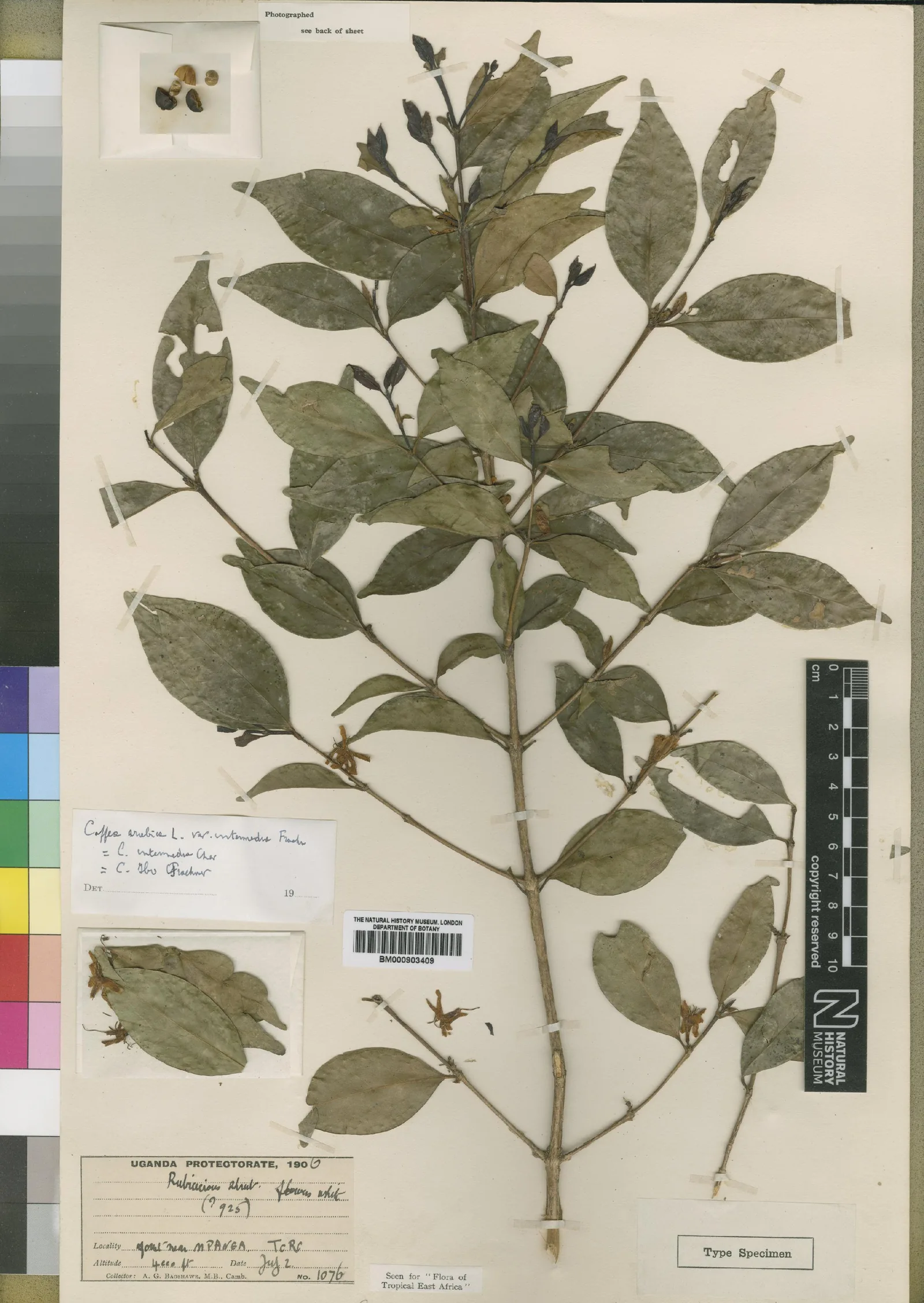
The coffee seed does not accept the treatment that makes large seed reserves possible. This treatment is simple: the seed is dried, put in deep cold, and it waits.
Coffee belongs to the intermediate group. It tolerates partial dehydration and limited cold, and dies beyond that.
Conserving a Coffea species outside its habitat therefore means keeping living trees, in the ground, replanted every generation. A coffee collection is a plantation, and it has all of a plantation's fragilities. Diseases get in. Cross-pollination means that a replanted tree is no longer quite the one that was collected. And everything depends on next year's budget.
Cryopreservation of embryos by vitrification is published and practiced, notably at Kew's Millennium Seed Bank and, as early as 2000, in IRD protocols tested at CATIE. It requires a laboratory and trained hands. At that price, no complete collection has yet been treated in full.
The 2019 assessment measures the consequence. Only 55% of wild species are conserved anywhere.
And the gradient is upside down. Critically endangered species are conserved at only 23%, against 58% of endangered species and 59% of vulnerable ones. In other words, the less chance a species has of holding on in the wild, the less chance it has of being kept in a collection.
The detail completes the picture. 12 species, of which 7 are critically endangered, are neither in a collection nor in a protected area. And there is the group of the 38 species most crossable with cultivars, those that would serve breeding the most. There, 61% are threatened and 58% absent from the banks.
Davis et al. 2019, pp. 3-4 and table 1; Crop Trust, “A closer look at coffee”, Nov. 19, 2019, croptrust.org; LC ch. 21For breeding to have something to work with one day, collections are needed. First a word on what that is. An accession, in a plant collection, is a specific material, gathered at a given place and date, under a reference. It is the basic unit of everything that follows.
The CATIE international collection, at Turrialba in Costa Rica, has kept for more than seventy years the only internationally recognized coffee collection. It holds nearly 2,000 accessions, 12,000 trees and 23 species on 11 hectares.
It is 92% arabica. The other species, all together, therefore occupy less than a tenth of the trees.
And here is the problem, in a single figure. Only about 5% of this material is duplicated elsewhere, in El Salvador, Rwanda and at Starbucks' Hacienda Alsacia in Costa Rica. A field collection is alive, therefore mortal: a hurricane, a disease, a fire, and the material is gone. 63 Ethiopian accessions have been cryopreserved at the USDA bank in Fort Collins, and a 2021 study identifies 403 accessions to duplicate urgently.
Elsewhere, the Jimma research center in Ethiopia holds 4,780 accessions in the field.
How many are there in total in the world? Nobody really knows, and the 2017 Crop Trust report gives the measure of this vagueness: 21,087 accessions declared to FAO in 1998, 41,915 in a later compilation, 21,026 at the 14 banks that answered its own survey, of which 1,314 already lost. The Crop Trust itself warns that the rise in the figures mostly reflects duplicates, not discoveries.
Two reserves remain that nobody manages: the forest and Yemen.
On the forest side, two Ethiopian biosphere reserves, Kafa and Yayu, joined the UNESCO network in 2010. It was late: between 1971 and 1997, 235,400 hectares of forest had been cleared on the southwestern highlands.
On the Yemen side, Montagnon and his coauthors analyzed in 2021, in Genetic Resources and Crop Evolution, 137 samples including 45 Yemeni trees. They identified a genetic group not known anywhere else, baptized Yemenia or New-Yemen, which adds to the mother populations Typica, Bourbon and SL34. An entire diversity was sleeping in a country from which no one went to fetch coffee anymore.
Crop Trust, Nov. 19, 2019; Frontiers in Sustainable Food Systems 2021, 777415 (CATIE, 403 accessions); Genetic Resources and Crop Evolution 2008 (Jimma); Crop Trust 2017, Global Conservation Strategy for Coffee Genetic Resources, pp. 11-22; Montagnon et al. 2021, Genetic Resources and Crop Evolution; genetic digestIn this plateThe 17 sections
- 01The specifications of an understory plant
- 02What the climate is already doing: rust, frost, drought
- 03What the models forecast for 2050
- 04First answer: go up, shade, irrigate
- 05Mechanizing: what the machine compensates for, and where it cannot go
- 06Second answer: F1 hybrids and the industrialization of breeding
- 07Third answer: reading, then editing genomes
- 08What happens under the tree
- 09The reserve of forgotten species
- 10Canephora as the future, and its limits
- 11What remains to be saved: 60% of species threatened
- 12Gene banks: a plantation, not a vault
- 13Economics: record output, tiny farms, underfunded research
- 14Regulation: the European deforestation regulation
- 15Demand: Asia, specialty coffee, coffee without the bean
- 16What we still do not know
- 17Today (September 2026)
The table of contents, with the first sentence of each section