First answer: go up, shade, irrigate
How are producers responding to the heat?
Start the scene or choose a stage. The animation simplifies the mechanism; what follows gives the details and the available references.
Moving up in altitude is the best-documented response. Above 900 m, every hundred meters lengthens ripening by about ten days, and the bean improves, because the fruit has time to make its sugars. But the higher one goes, the less area remains, and the slopes steepen.
Read the stages without animation
- Go upMoving up in altitude is the best-documented response. Above 900 m, every hundred meters lengthens ripening by about ten days, and the bean improves, because the fruit has time to make its sugars. But the higher one goes, the less area remains, and the slopes steepen.
- The forest aboveHigh-altitude forests are often the last intact ones. The Ethiopian models are clear: migration is a gain only if the forest above is conserved or replanted; otherwise, the problem is moved up one level.
- Shade, in moderationUnder cover, the night is 4 to 5 °C warmer. Between 30 and 50% shade, the cup improves in hot, low zones: less heat stress, longer ripening, more sugars.
- Too much shadeBeyond 60%, everything turns around: flowering and yield fall, chlorogenic acids drop, and the humidity that the canopy maintains favors rust. The foliage that lowers the heat of the day is also the foliage that keeps water on the leaf.
- Irrigate, down to the water tableBrazil irrigates about 300,000 hectares of coffee, and irrigation gives 38% more yield there. But an adult unshaded coffee tree transpires about 19 liters a day, more than 7 m³ a year, drawn from the first thirty centimeters of soil where it concentrates 94% of its roots. In Vietnam, the 2024 dry season depleted aquifers that were already overexploited.
To remember: Every response has its limit: the area when going up, rust under too much shade, the water table when irrigating.
In history: As early as 1955, Coste reported Machado's trial in Colombia: too much shade harms more than too much light.
Read the full article and its sources ↓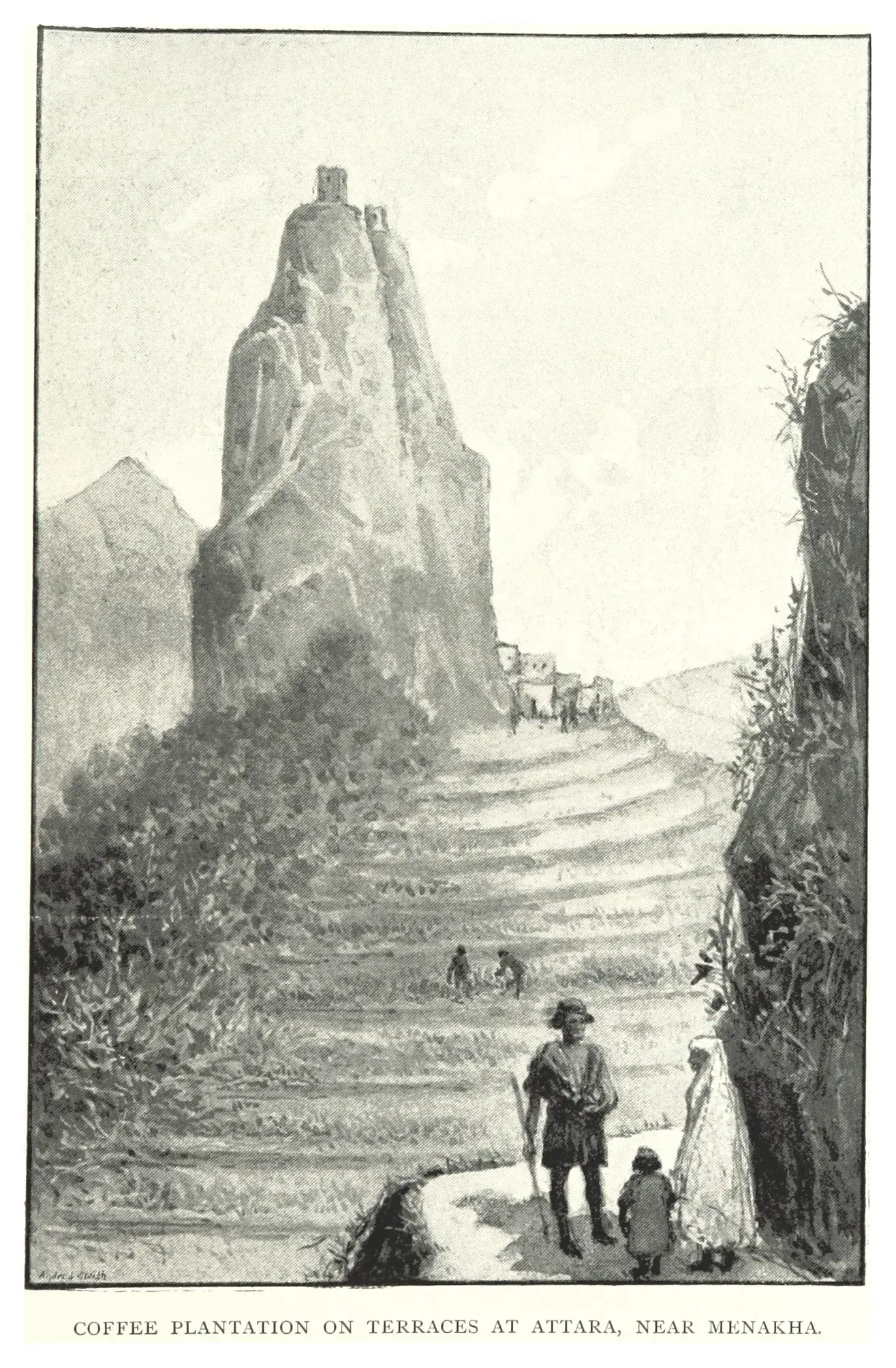
Producers do not read models, they move nurseries. Moving up in altitude is the best-documented response, and it is also the most constrained.
The gain is twofold. Above 900 m, every hundred meters lengthens ripening by about ten days. And the bean improves, because longer ripening gives the fruit time to make its sugars.
The constraint is geometric. The higher one goes, the less available area remains, and the slopes steepen.
A forest problem comes on top of it. High-altitude forests are often the last intact ones, so what is gained in climate risks being taken from the forest cover.
The Ethiopian models are clear on this point: migration is a gain only if the forest above is conserved or replanted. Otherwise, the problem is moved up one level.
Moat and Davis go so far as to name the zones. Resilient: Yayu, Kafa, the high valleys of the southwest. Exposed: Harar, part of Sidamo and Jimma.
Hence their proposal, to plan relocation instead of suffering it. A spontaneous move would repeat the deforestation of the last fifty years, higher up this time.
Moat et al. 2017, Nature Plants 3, 17081; Coste 1955 (ten days per 100 m above 900 m); LC ch. 2Shade is a setting, not a virtue. Coste already reported in 1955 that under cover the night air temperature is 4 to 5 °C higher. Above all he noted that too much shade harms more than too much light, citing Machado's trial in Colombia, at zero, 40 and 75% shade.
The 2026 review quantifies this setting. Between 30 and 50% shade, the cup improves in hot, low zones: less heat stress, longer ripening, more sugars.
| Response | What is established | What is not |
|---|---|---|
| Moving up in altitude | Quality gain and modeled suitability (Moat 2017) | Available area, high-altitude forests, relocation cost |
| Shade 30-50% | Improved cup in hot zones (Yang 2026); carbon x2-4 (Omer 2026) | Molecular mechanisms; net effect on income |
| Irrigation | +38% yield in the Cerrado (Agronomy 2025) | Long-term water availability (Vietnam, Cerrado) |
| Mechanization | Established on the Brazilian plateaus (IFAMR 2018) | Slopes, selectivity, mechanized share not quantified |
| F1 hybrids | +30 to 47% yield, resistance (Georget 2019); $2,500-3,000/ha of plants | Access for small farms; duration of resistance (Peru 2024) |
| Genome editing | CRISPR effective in canephora (2018, 2022) | No edited cultivar in cultivation; tetraploidy; regulation |
| Index insurance | 5,100 producers compensated in Kenya 2025-26 (Blue Marble) | Basis risk; coverage on the order of one thousandth of farms |
| Wild species | Taste of stenophylla measured (2021, 2025); +6 °C of tolerance | Yield, management, outlet; first harvest unpublished |
| Gene banks | Embryo cryopreservation works | Scale-up; 45% of species held nowhere |
| EUDR | Applies Dec. 30, 2026, costs -75% | Geolocation of small plots; effect on deforestation |
| Coffee without the bean | Commercial products (Atomo, Voyage); cells in pilot (VTT) | No authorization for cellular coffee; costs unpublished |
Beyond 60%, everything turns around. Flowering and yield fall, chlorogenic acids drop, and the humidity that the canopy maintains favors rust. The foliage that lowers the heat of the day is also the foliage that keeps water on the leaf.
And shade is not good everywhere. In cool altitude, at Oporapa in Colombia, it degrades fragrance, acidity and body. Where it is not too hot, there is nothing left to protect.
There remains the carbon argument, often put forward. A systematic review of 46 studies (Frontiers in Forests and Global Change, June 2026) finds that shaded systems store two to four times more carbon than monocultures. The soil holds 60 to 90% of it, so most of it is underground.
But carbon revenue represents less than 1% of the income of the farms studied. Shade therefore cannot be financed by carbon. And the synergies are concentrated at moderate shade levels, which brings us back to the same setting.
Coste 1955, vol. I, ch. ecology; Yang et al. 2026, Agriculture, p. 12; Omer et al. 2026, Frontiers in Forests and Global Change, doi 10.3389/ffgc.2026.1865283; LC ch. 2Faced with drought, the Brazilian response comes down to one word: irrigate.
The country has about 300,000 hectares of irrigated coffee, or roughly 15% of its area, concentrated in Minas Gerais, Espírito Santo and Bahia. The figure reads both ways: irrigation is massive, and the largest share of Brazil's coffee area still depends on rain.
The Cerrado Mineiro alone accounts for 234,000 hectares across 55 municipalities, and 6 million bags a year on average. At this scale, irrigation is no longer the equipment of a few farms, it is that of an entire region.
Does it work? Yes, and the figures are clear. A trial comparing irrigated and rainfed cultivars, published in Agronomy in January 2025, measures an average yield gain of 38% under irrigation. StoneX observes for its part that recent irrigated plantations in the Cerrado came through the 2024 drought better.
The catch is that the solution has a limit, and that limit is water itself.
In Vietnam, the 2024 dry season depleted aquifers already overexploited by deep wells. And to grasp the order of magnitude: an adult unshaded coffee tree transpires about 19 liters a day, or more than 7 m³ a year. It goes looking for them in the first thirty centimeters of soil, where it concentrates 94% of its roots. Multiply by the number of trees in a plantation, and you will see why irrigation moves the problem more than it solves it.
Agronomy, Jan. 2025, “Agronomic performance of irrigated and rainfed arabica cultivars in the Cerrado Mineiro”; Coffee Geography Magazine, Apr. 6, 2025 (300,000 ha); StoneX, Nov. 10, 2025; Coste 1955 (transpiration); LC ch. 2In this plateThe 17 sections
- 01The specifications of an understory plant
- 02What the climate is already doing: rust, frost, drought
- 03What the models forecast for 2050
- 04First answer: go up, shade, irrigate
- 05Mechanizing: what the machine compensates for, and where it cannot go
- 06Second answer: F1 hybrids and the industrialization of breeding
- 07Third answer: reading, then editing genomes
- 08What happens under the tree
- 09The reserve of forgotten species
- 10Canephora as the future, and its limits
- 11What remains to be saved: 60% of species threatened
- 12Gene banks: a plantation, not a vault
- 13Economics: record output, tiny farms, underfunded research
- 14Regulation: the European deforestation regulation
- 15Demand: Asia, specialty coffee, coffee without the bean
- 16What we still do not know
- 17Today (September 2026)
The table of contents, with the first sentence of each section